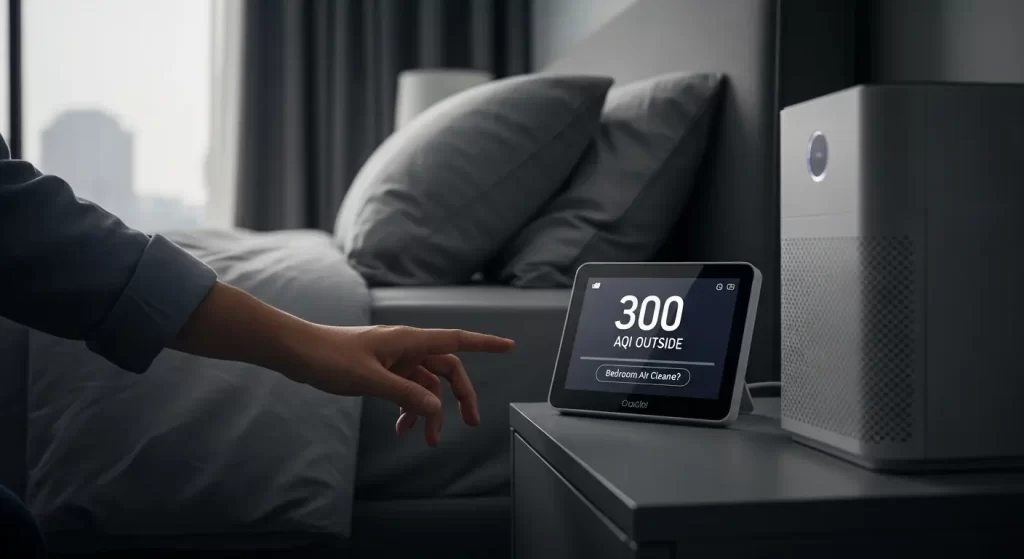
Last month, I opened my phone, checked the weather like I usually do, and froze for a second. The AQI for my city was sitting in the red zone. The kind of number that makes you rethink your morning walk and silently judge the traffic outside your window.
Like most people, I did the obvious thing. I shut my windows, turned on the fan, and told myself, *At least indoors should be fine.*
But then a thought hit me. How do I actually know that? I’ve never measured the air inside my own room. I just assumed it was cleaner because it felt calmer and quieter than the outside world.
So I decided to test it. Nothing fancy. No lab. Just a small air monitor and a bit of curiosity.
We all make the big assumption.
A lot of people think that air quality indoors is always better than air quality outdoors. It feels logical. Our homes have walls, doors, glass, and ceilings. Pollution is outside. We are inside. Problem solved.
Except that’s not how air works.
Air moves. Constantly. It slips in through tiny gaps, open doors, ventilation systems, balconies, and even cracks you never notice. Add cooking fumes, dust, cleaning chemicals, incense, candles, and suddenly your “safe” indoor space becomes a mix of outdoor pollution and indoor mess.
The scary part? Most of us never check. We just trust the feeling.
The Test Setup Process
I got a little indoor air meter that I can take with me. Holding it in one hand, it shows data in real time. Super simple. No complicated setup.
I tested my bedroom in three normal situations that pretty much reflect daily life:
First, with windows open.
Second, with windows closed.
Third, with an air purifier running.
I didn’t rush between them. I waited until the readings settled so the numbers weren’t jumping all over the place.
I wasn’t trying to prove a theory. I just wanted an honest answer.
What I thought would happen vs. what really happened
Surely, shutting the windows would make things better in my mind. That’s what we’ve been taught, right? Pollution outside? Shut it out.
But the results were… underwhelming.
With windows open, indoor AQI was almost the same as outside. No surprise there.
With windows closed, it did drop slightly. But not by much. The air was still far from what anyone would call “clean.”
The real change happened only when I turned on the air purifier. That’s when the numbers finally started to fall properly and stayed low.
That moment was kind of uncomfortable. Because it meant something important:
Closing windows alone doesn’t really protect you. It elicits a sense of security.
Why Windows Aren’t the Magical Shield We Think
We think of our homes as closed boxes. But they’re not.
Air comes in through:
* Spaces between doors and windows* Vents in kitchens and bathrooms* Apartment stairwells and elevators* Walls in older structures
That is why dirty air slowly gets in even if everything seems to be covered.And once it’s inside, it has nowhere to go.
Without something actively filtering it, those particles just float around. You can’t see them. You usually can’t smell them. But you still breathe them.
The Air Purifier Reality Check
I used to think air purifiers were optional gadgets. Something for people with allergies or asthma. Not really necessary for “normal” people.
After this experiment, that mindset changed.
An air purifier isn’t about luxury or comfort. It’s about actively removing bad stuff from the air you’re breathing for hours every day.
It’s like cleaning your room, but instead of dust on the floor, you’re cleaning invisible particles from your lungs.
Once I saw the difference in real time, I started using mine regularly. Especially at night. Because sleep is literally the longest time I spend breathing in one closed space.
The Part Nobody Talks About Enough
We spend most of our lives indoors. Sleeping. Working. Eating. Resting. Scrolling.
If indoor air quality is poor, your body never really gets clean air. Not even when you think you’re “resting.”
Over time, this can show up as:
* Constant fatigue
* Dry or irritated throat
* Headaches that don’t have a clear reason
* Poor sleep
* Worsening allergies
And because these effects are slow, we usually blame stress, screens, diet, or age. Rarely do we blame the air around us.
What This Small Test Changed for Me
The biggest shift wasn’t about technology. It was about awareness.
I realized I had been trusting my home without any evidence. I assumed it was safe because it felt safe.
But comfort doesn’t mean clean.
Now I look at my bedroom differently. It’s not just a place with a bed and a fan. It’s a breathing environment. And like any environment, it needs maintenance.
I don’t obsess over numbers. But I do respect them.
Simple Things That Actually Help
You don’t need to become paranoid about air quality. Just a little conscious.
A few things that genuinely make a difference:
* Use an indoor air monitor once in a while
* Run an air purifier in bedrooms and work areas
* Avoid unnecessary smoke indoors
* Clean your filters regularly
* Ventilate smartly, not during peak pollution hours
Small habits. Big long-term impact.
Stop guessing and start knowing.
Before this test, I would have been sure that the air in my bedroom was clean. I now see it wasn’t as fresh as I imagined.
The air didn’t feel bad. But it wasn’t good either.
And that’s the most dangerous kind of problem. The one you can’t see, smell, or feel immediately.
So if your city’s AQI is high, don’t just close your window and relax. That’s not real protection. That’s hope.
Test your air. Understand it. Improve it.
Because the quality of the air you breathe every day shapes your health more than most things you worry about. And unlike traffic or weather, this is one thing you can actually control.