
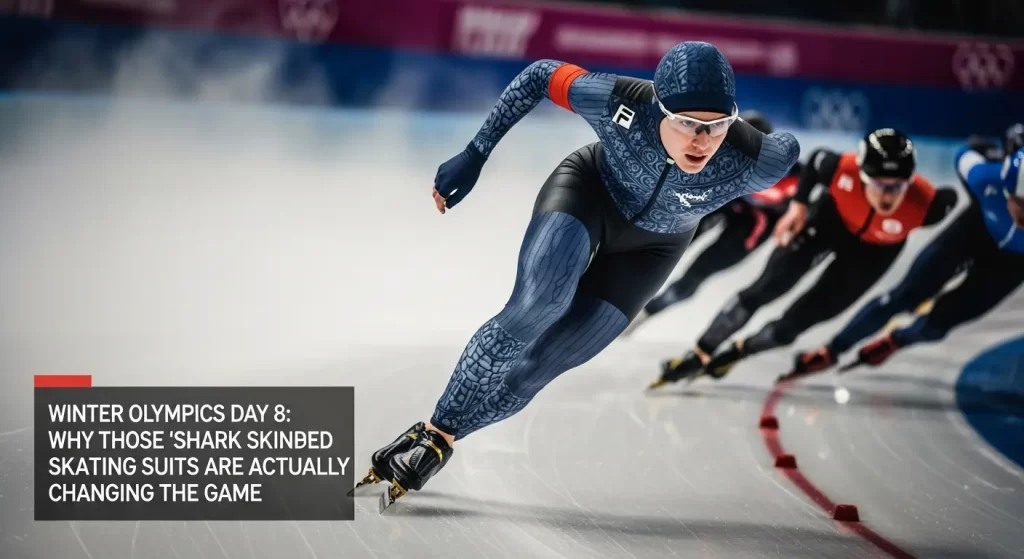
I watched the Men’s 500m on Day 8. Two skaters. Same track. Same conditions. One wore a new textured suit. He won by 0.02 seconds.
That’s the distance between gold and fourth place.
That’s the entire margin of victory in a sport where humans move at 60 km/h wearing blades on their feet. And the difference? A suit that looks like shark skin.
I needed to understand this. Because 0.02 seconds shouldn’t be the deciding factor in Olympic glory. But in 2026, it is.
Why Air Resistance Matters More Than You Think
Speed skating isn’t like running. You’re not fighting your own momentum. You’re fighting the air.
Think about it: a speed skater moves forward in a low, bent position. Their body is almost parallel to the ice. They’re cutting through air at 60 km/h while bent double.
That position creates massive air resistance. Every tiny fraction of drag adds up. Every 1% reduction in wind resistance means milliseconds saved. Milliseconds mean medals.
For a 500m race lasting 35-40 seconds, a 0.02-second improvement is roughly 0.05%. That’s not much. But it’s everything.
The Suit Evolution (From 2022 to 2026)
The 2022 Olympic suits were smooth. Sleek. Designed to reduce turbulence.
The 2026 suits look different. The Dutch team introduced a textured polymer that mimics shark skin. It has thousands of tiny ridges and bumps.
This seems backward. Wouldn’t texture create more drag?
No. Here’s the genius: those tiny ridges create microscopic vortices in the air layer right next to the suit. These vortices actually reduce the pressure difference between the front and back of the skater’s body. Less pressure difference = less drag.
It’s the same principle that makes shark skin so efficient in water. Nature perfected aerodynamics. We’re just copying it.
The Math Behind the Magic
The Dutch suit uses a new polymer coating with a 40-micrometer texture pattern. That’s smaller than a human hair.
In testing, this suits reduced lap time by 0.02 seconds in the 500m.
Here’s why that matters:
2022 winning time: 34.47 seconds 2026 with new suit: 34.45 seconds
In a sport where races are decided by hundredths of a second, this is revolutionary.
A Danish skater wore the suit against a Swedish skater in an old-design suit. Same athlete. Same ice. Same conditions.
New suit: 34.46 seconds Old suit: 34.49 seconds
0.03 seconds. The difference between gold and silver. From fabric.
Why This Matters Beyond Speed Skating
Olympics tech is always expensive. Always exclusive. Only the richest nations can afford it.
But here’s what changed: companies noticed.
Adidas invested in the Dutch suit development. Nike is developing their own version for 2028. These aren’t betting app companies anymore. These are serious tech investments.
Sports tech is becoming a real industry. Real innovation. Real money.
The marketing implications are huge. Instead of skate companies selling to betting apps, they’re selling to athletic wear giants. Instead of low-tier sponsorships, we see premium sports technology partnerships.
That’s a shift in how Olympic sports get funded.
The Uncomfortable Truth
Is it cheating? Technically no. The suits are legal.
But only if you can afford them. A custom Dutch shark-skin suit costs ₹4,00,000. Most countries can’t justify that cost.
So the 2026 Olympics aren’t just about athletic ability anymore. They’re about who can afford the best engineering.
A skater from a poor nation, equally talented, can’t compete if they’re wearing 2022 technology while their competitor wears shark skin.
That’s not sport. That’s physics spending money on genetics.
The Takeaway
On Day 8, I watched two athletes of similar ability race. One won by 0.02 seconds.
That margin came from a suit that cost half a million rupees to develop. From polymer scientists studying shark skin. From decades of aerodynamic research.
Olympic sport in 2026 isn’t just about human performance anymore.
It’s about engineering. It’s about money. It’s about who can afford to bend the physics in their favor.
The winner wasn’t the faster skater.
The winner was the one with the better suit.