
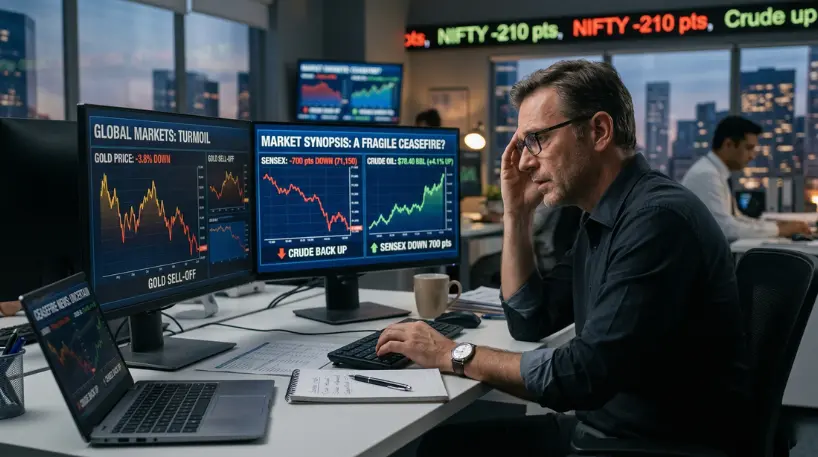
If you’ve been watching markets this morning and feeling like the signals are pointing in four different directions simultaneously, you’re not misreading them. They actually are. And the reason is that the situation generating all of this — a ceasefire announcement in West Asia that nobody quite believes will hold — is genuinely ambiguous in a way that creates contradictory market responses at the same time.
Let me walk through what’s happening across each asset class, because understanding the logic behind each move makes the whole picture considerably less confusing than the headlines suggest.
Gold Selling Off — Which Sounds Wrong Until You Understand Why
MCX gold opened lower this morning, dropping to around ₹1,50,647 per 10 grams. For most people, the instinctive response to that news is: wait, shouldn’t gold be going up? There’s a ceasefire that might not hold, crude is rising, global uncertainty is everywhere — isn’t that exactly when you buy gold?
Yes. And that’s precisely why it sold off.
Here’s the sequence. Gold has been rallying for weeks, driven by exactly the geopolitical anxiety you’d expect — West Asia tensions, oil supply concerns, the kind of persistent uncertainty that pushes investors toward safe haven assets. People bought gold because they were scared. The price went up because enough people were scared enough to pay up for it.
Then the ceasefire announcement landed. In the initial moments after that kind of news, the market’s reflex is to price in reduced risk. The fear that was driving gold buying suddenly has less justification. Traders who had bought gold as a hedge started taking profits — selling into the brief window of optimism before the situation clarifies one way or another.
This is what markets call peace-selling. It’s not a vote of confidence in the peace. It’s a mechanical response to the temporary reduction in perceived risk, executed quickly before the situation develops further.
The traders who’ve been around long enough are already looking at the dip as a buying opportunity rather than a trend. Their reasoning is straightforward: a ceasefire described universally as fragile, in a region with a long history of fragile ceasefires that don’t hold, doesn’t actually eliminate the underlying risk that made gold attractive in the first place. It delays it. Maybe for hours. Maybe for days. But the fundamental uncertainty hasn’t resolved — it’s just paused.
Watch for a bounce back above ₹1,51,000 as the initial peace-selling exhausts itself and fear-buying reasserts. Whether that happens today or takes a few sessions depends on how the geopolitical situation develops, but the direction is fairly predictable from here.
Sensex Down 700 Points — The Equity Market’s Version of the Same Story
The Indian equity market’s response has been sharper and less nuanced than gold’s. Sensex dropping over 700 points is a significant single-session move, and it’s being driven by a combination of factors that are hitting simultaneously.
Heavyweight stocks are doing most of the damage. Infosys is under pressure — partly the broader risk-off sentiment, partly specific concerns about technology spending from global clients when macroeconomic uncertainty rises. HDFC Bank is dragging things lower too, which reflects the banking sector’s sensitivity to inflation expectations. When crude oil prices rise, inflation expectations follow, which limits the RBI’s ability to cut rates, which affects the credit environment that banks operate in. None of this is irrational. It’s the market pricing in consequences that haven’t fully materialised yet but seem more likely than they did yesterday.
The FII dimension is present here too, even if we don’t have today’s specific outflow numbers yet. Global risk-off events consistently trigger foreign institutional selling in emerging markets. When international investors get nervous about global stability, their response is to reduce exposure to markets that are perceived as more vulnerable to external shocks — and India, as a major oil importer in a region adjacent to the conflict zone, fits that profile. That selling pressure amplifies whatever domestic concerns are already in play.
For long-term investors, the useful question isn’t what the market is doing today — it’s whether the underlying businesses that constitute the index are fundamentally worse than they were yesterday. For most of them, the answer is no. Infosys hasn’t suddenly become a worse technology company. HDFC Bank hasn’t suddenly become a worse bank. Their share prices are lower today because of a global sentiment shift, not because of anything specific to their operations.
That distinction doesn’t make the dip painless. But it matters for how you respond to it.
Crude Back at $96 — The Signal That Explains Everything Else
While gold sold off and equities dropped, crude oil moved in the opposite direction — up 2.09% to $96 per barrel. This is the data point that tells you most clearly what the market actually thinks about the ceasefire.
Iran’s explicit warning that it could withdraw from negotiations if strikes in Lebanon continue has reintroduced exactly the supply disruption fear that briefly receded when the ceasefire was announced. Oil traders, who tend to be among the most unsentimental participants in any market, have decided that the probability of sustained peace is low enough to keep pricing in a meaningful risk premium.
At $96 per barrel, the impact on India is real and layered. The import bill goes up. That feeds through to inflation — both directly, through fuel prices, and indirectly, through transport costs that affect almost everything else. The current account deficit widens. Pressure on the rupee increases. The RBI’s room to manoeuvre on monetary policy narrows.
For companies with significant fuel or logistics costs — airlines, paint manufacturers, consumer goods companies with complex supply chains — the margin pressure from sustained elevated crude is a genuine earnings concern rather than just a macro talking point. These are the kinds of second-order effects that take a few weeks to show up in analyst estimates and a few months to show up in reported results, but the market is starting to price some of that in today.
The energy sector itself is more complicated. Upstream oil producers benefit from higher crude prices. Refiners face a mixed picture depending on their specific cost structures and pricing power. The market’s nuanced read of energy stocks on a day like today reflects that complexity — it’s not as simple as saying oil up equals energy stocks up.
The Fear-Buying vs Peace-Selling Dynamic — Why Human Judgment Still Matters Here
There’s a tension in today’s market that algorithmic trading models handle less well than experienced human traders, and it’s worth understanding because it creates the specific opportunity that seasoned investors are looking at right now.
The ceasefire announcement triggered automatic responses across markets — peace-selling in gold, relief-buying in risk assets, mechanical adjustments to risk parameters. These responses happen in milliseconds and they’re based on pattern recognition rather than genuine assessment of whether the ceasefire will hold.
Experienced traders who think more slowly but more contextually are looking at the same ceasefire and drawing different conclusions. They’re asking: how many times has a West Asia ceasefire held in recent memory? What are the specific dynamics between the parties involved that would make this one durable or fragile? What is the baseline probability of renewed escalation within the next two weeks?
The answers to those questions don’t support confidence in the ceasefire’s durability. Which means the peace-selling in gold is likely temporary. Which means the current dip in gold is a buying opportunity for anyone who was already inclined toward gold as a portfolio hedge and was waiting for a better entry point than last week’s elevated prices.
This is the kind of thinking that can’t be automated — not because the information isn’t available to algorithms, but because the judgment about what the information means requires a contextual understanding of geopolitical dynamics that goes beyond pattern matching on historical data.
What to Actually Do in a Market That’s This Confused
The honest answer is that the right response depends entirely on your existing portfolio and your investment horizon, but a few principles apply broadly.
If you hold gold as part of a portfolio hedge and you’ve been watching it rally, today’s dip is not a signal to panic or sell. The reasons you bought it haven’t changed. The ceasefire is fragile by everyone’s assessment. The underlying geopolitical risk that supports gold as a hedge is still present. Sit tight and let the peace-selling exhaust itself.
If you’ve been thinking about adding gold to your portfolio and the recent rally had made you hesitant about the entry point, today’s dip is worth looking at seriously. Not to call the exact bottom — nobody does that reliably — but to get exposure at a level that’s meaningfully better than it was a week ago.
If you’re an equity investor watching the Sensex down 700 points, the questions to ask are about your specific holdings rather than the index. Do you own businesses whose fundamental value has changed today? For most quality businesses in domestically-driven sectors, the answer is no. For businesses with significant crude oil exposure on the cost side, today’s crude move is worth factoring into your thesis.
If you’re a short-term trader, today’s environment offers both the gold dip and the crude uptrend as active setups — but both require clear stop-loss discipline given how quickly the underlying geopolitical situation can shift sentiment.
The Larger Pattern
What’s playing out today is a version of something markets go through repeatedly during sustained geopolitical uncertainty: the oscillation between brief moments of optimism when diplomatic progress appears and sharp reassertions of risk premium when that progress proves fragile.
Each oscillation creates a trading opportunity. The peace-selling in gold creates a buying opportunity for those who see the ceasefire as temporary. The equity sell-off creates entry opportunities in quality businesses whose prices have moved without their fundamentals changing. The crude rally creates momentum opportunities for traders positioned in energy.
None of this means the situation isn’t genuinely uncertain or genuinely concerning. It is both. But uncertainty and opportunity have always coexisted in markets, and the investors who build serious long-term wealth through volatile periods are the ones who can look at a 700-point Sensex drop and a gold dip on the same morning and see both the risk and the possibility rather than just the fear.
Stay informed today. The situation is moving quickly and the market will continue responding to each development. But don’t let the noise of a volatile session override the clarity of your longer-term thinking.