
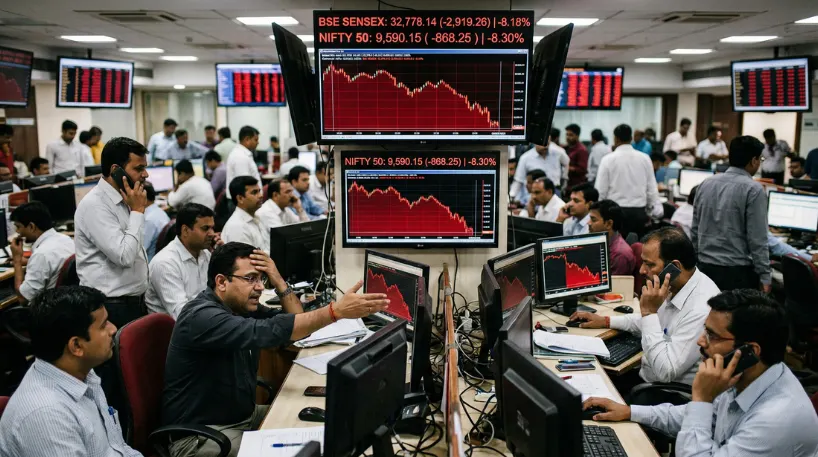
There are market days that feel bad and market days that feel genuinely alarming. Last Thursday was the second kind for a lot of investors. Red screens across the board, indices dropping sharply, notifications arriving faster than you could process them, and that particular queasy feeling that comes from watching something you’ve built take a sudden hit.
The session is already being called Black Thursday in market circles. And while that label captures the mood, it doesn’t really explain the mechanics — why it happened, what drove the intensity, and whether the picture is as uniformly bleak as the closing numbers suggested.
Let’s work through it properly.
It Started With Trump and Iran — and Oil Did the Rest
The trigger for the global selloff was a set of strong statements from U.S. President Donald Trump regarding potential military escalation against Iran. The specifics matter less than the immediate market interpretation, which was swift and consistent across asset classes: geopolitical risk is rising, and the most direct financial expression of that risk is oil.
Brent crude surged past $105 per barrel. That number lands differently depending on which country you’re in. For the United States — now a net energy exporter — expensive oil is complicated but manageable. For India — which imports approximately 85% of its crude oil needs — $105 Brent is a direct and significant cost increase that works its way through the entire economy.
Higher crude means a larger import bill. A larger import bill means more pressure on the current account deficit. More pressure on the current account means more demand for dollars to pay for those imports, which weakens the rupee, which makes the imports more expensive in rupee terms, which adds to inflationary pressure. It’s a chain reaction, and each link in it creates problems for Indian equities from a different angle.
Investor sentiment turned cautious almost immediately. When global uncertainty rises sharply, the reflex in most institutional portfolios is to reduce exposure to emerging markets — which brings us to the next part of the story.
The FII Exodus — and Why DIIs Mattered More Than Usual
Foreign Institutional Investors pulled approximately ₹8,331 crore out of Indian equities on April 1 alone. That’s not a number to gloss over. That kind of outflow in a single session creates immediate, concentrated selling pressure that pushes prices down regardless of what the underlying fundamentals of individual companies look like.
FII behaviour during geopolitical risk events follows a fairly predictable pattern. When global uncertainty rises, international investors reduce their emerging market positions and move toward perceived safe havens — U.S. treasuries, gold, the dollar. This isn’t a judgement on India specifically. It’s a portfolio risk management response that happens to hit Indian markets hard because FIIs hold significant positions here.
What was different this time — and genuinely worth noting — was the scale and consistency of DII buying.
Domestic Institutional Investors, primarily mutual funds deploying the steady inflow of SIP money that now enters Indian markets every month, were buying into the weakness. Not enough to prevent the decline, but enough to absorb a meaningful portion of the FII selling and prevent the kind of capitulation that can turn a bad day into a genuine crash.
This DII stabilisation role is becoming more pronounced with each significant market correction. The retail investor base in India has grown substantially over the past five years, most of it channelled through SIPs that continue regardless of market conditions. That creates a reliable bid in falling markets that didn’t exist a decade ago. It doesn’t make corrections painless — last Thursday was painful — but it does change the severity of the floor.
The Rupee at 94.70 — What That Number Means
The Indian Rupee hovering around 94.70 against the U.S. Dollar is a symptom of the same pressures driving the equity selloff, but it creates its own additional problems rather than just reflecting the existing ones.
Three things are pushing the rupee down simultaneously. Rising crude prices generate demand for dollars to pay import bills. FII outflows mean capital is physically leaving the country, converting rupees to dollars in the process. And global risk aversion generally strengthens the dollar as investors move toward safe haven assets — which mechanically weakens everything that isn’t the dollar.
The RBI has been intervening in currency markets — selling dollars from its reserves to support the rupee and prevent excessive volatility. These interventions can smooth the currency’s movement and prevent panic-driven overshooting, but they can’t sustainably hold the rupee at a level that the underlying economic flows don’t support. The RBI is managing the pace and volatility of the adjustment, not the direction.
For everyday implications: a weaker rupee makes imports more expensive, which adds to inflation. It increases the cost of foreign education, overseas travel, and imported goods. For companies with significant dollar-denominated debt or import costs, it compresses margins in ways that eventually show up in earnings. For exporters, it’s actually a tailwind — their dollar revenues buy more rupees — which is why IT services companies and pharmaceutical exporters were among the relative outperformers even on a day when most things were falling.
The Green That Was Hiding in All That Red
Here’s the thing about broad market selloffs that gets lost in the headline numbers: they’re rarely uniform.
When the Nifty drops 2% on a given day, that aggregate masks an enormous amount of variation at the sector and stock level. Some things fall more than 2%. Some things fall less. And some things — if the catalyst for the selloff happens to be bullish for their specific business model — actually go up.
Last Thursday was a perfect illustration of this. While the Nifty was deep in the red, the Nifty Energy Index was up approximately 2%. The reason is simple: when oil prices surge past $105 per barrel, the companies involved in oil production, refining, and energy services see their revenue and profit outlook improve. Rising crude is a cost for airlines, paints companies, and logistics businesses. It’s a revenue driver for ONGC, Oil India, and energy sector companies with upstream exposure.
Pharma held up relatively well too — it tends to be defensive in risk-off environments because healthcare spending doesn’t disappear when markets fall. IT exporters, as mentioned, benefit from a weaker rupee. Commodity-linked stocks in sectors with pricing power were similarly mixed rather than uniformly negative.
The practical implication for investors is that Black Thursday was not a day when everything went wrong. It was a day when globally risk-sensitive, import-cost-sensitive, and FII-heavy sectors went wrong — and a day when energy, defensives, and exporters quietly absorbed the chaos rather better than the index suggested.
What Long-Term Investors Should Actually Do With This
The honest answer is: probably less than the headlines suggest.
Market corrections driven by geopolitical sentiment are typically faster and more violent on the way down than they are persistent over time. The Iran situation, like most geopolitical risk events, has a range of possible outcomes — escalation that sustains high oil prices, negotiation that brings them back down, or extended uncertainty that keeps markets nervous without resolving cleanly in either direction.
What doesn’t change in any of these scenarios is the underlying reality of the Indian economy — domestic consumption growth, corporate earnings trajectories, the structural story of a large and increasingly affluent middle class driving demand across multiple sectors.
If you have a well-constructed portfolio with a long horizon and you’ve been running SIPs consistently, last Thursday was an uncomfortable day that your strategy was designed to absorb. The SIP that went in during the correction bought units at lower prices than the week before. The companies you own in fundamentally strong sectors didn’t suddenly become worse businesses because FIIs were selling emerging market exposure.
If you’re an active trader or you have positions that were specifically vulnerable to the conditions that materialised — oil-importing businesses, FII-heavy large caps, rupee-sensitive importers — then last Thursday required specific responses depending on your position and your view.
For everyone else, the most useful thing Black Thursday did was remind you that markets can move sharply and that your risk tolerance as a felt experience in real time may be different from your risk tolerance as a concept when filling out a financial planning form.
That gap — between how much risk you think you can handle and how much you can actually handle when your portfolio is down — is worth knowing about. And you only find out by going through a day like last Thursday.
The Part Worth Remembering
Corrections hurt. They’re meant to. The discomfort is the mechanism by which weak hands sell and strong hands buy — and the investors who build serious long-term wealth are disproportionately the ones who can sit through days like last Thursday without making decisions driven by the red on their screen rather than the logic of their portfolio.
That’s easier to say than to do. It requires having a strategy you genuinely trust, understanding why you own what you own, and having enough conviction in the long-term thesis that a sharp short-term correction doesn’t feel like a fundamental invalidation of your thinking.
The geopolitical situation will evolve. Oil prices will find a new level. The rupee will stabilise at whatever point the RBI and market forces agree it should. FIIs will return to Indian equities when the risk-off mood passes, because the structural case for India hasn’t changed in a week of market volatility.
Black Thursday was dramatic. It was real. It had genuine consequences for specific portfolios and specific positions.
But it was also, in the long arc of market history, a day — and days pass.