
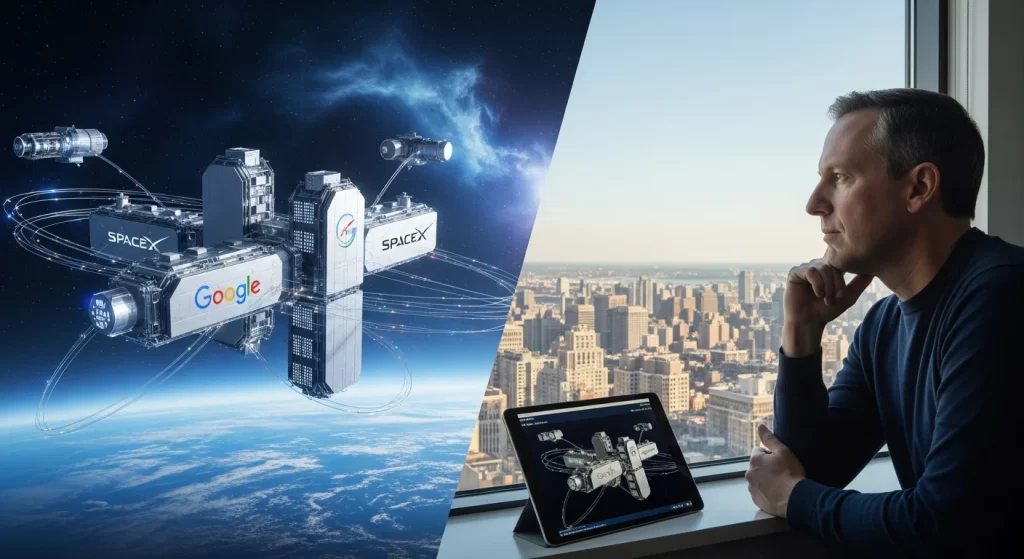
The energy problem sitting at the heart of modern AI computing is real and it’s getting harder to ignore. Training large language models, running real-time analytics, powering the cloud infrastructure that the entire digital economy depends on — all of this consumes electricity at a scale that is straining power grids and driving data center operators to increasingly unusual solutions.
How unusual? Google and SpaceX are apparently considering orbit.
The Space Cloud Idea — Impractical Until You Understand Why It’s Not
The collaboration between Google and SpaceX on experimental orbital data centers sounds like the kind of announcement that belongs in a science fiction treatment rather than an infrastructure planning document. But the logic behind it is more grounded than the concept initially appears.
Traditional data centers have two enormous ongoing costs: electricity for processing and electricity for cooling. The cooling requirement alone accounts for a significant portion of operational expenses — keeping servers from overheating requires constant, energy-intensive climate management. In space, you get two things for free that are prohibitively expensive on Earth: effectively unlimited solar energy and natural cooling through the vacuum surrounding the hardware.
If you can eliminate or dramatically reduce two of your largest cost centres while also removing your dependence on terrestrial power grids that are already under pressure, the economics start looking less absurd. Launch costs have fallen significantly as SpaceX has developed reusable rocket technology. Low Earth orbit is considerably more accessible in 2026 than it was five years ago.
The technical challenges are real and substantial — maintenance in orbit is not straightforward, hardware reliability in extreme conditions is a genuine engineering problem, and the latency implications of space-based computing affect certain applications significantly. But the direction of the thinking is a rational response to a genuine constraint.
Sam Altman Disagrees — and His Alternative Is Worth Taking Seriously
OpenAI’s CEO has been publicly sceptical about orbital data centers, and his counterargument deserves attention rather than dismissal.
Altman’s position is essentially that the energy problem should be solved on Earth, through nuclear power rather than through space infrastructure. Advanced nuclear reactors — both the established large-scale variety and the emerging small modular reactor designs — offer stable, scalable, carbon-minimal energy that doesn’t require solving the extraordinary engineering challenges of orbital deployment.
This creates a genuinely interesting philosophical divide in how the industry is thinking about AI’s energy future. The Google-SpaceX vision goes up and out — move the infrastructure to where the constraints don’t exist. Altman’s vision goes down and deep — solve the energy problem at the source through better terrestrial generation.
Both are serious responses to the same real problem. Which approach proves more practical and more economically viable will become clearer over the next several years as both paths develop.
Meanwhile in India, AI Is Doing Something Quietly Important
While this high-altitude debate unfolds between tech billionaires, India Post launched APT 2.0 today — an AI-driven logistics platform designed to modernise rural delivery networks across one of the world’s most complex last-mile delivery challenges.
APT 2.0 uses real-time demand intelligence to automate routing, anticipate parcel load fluctuations, and reduce operational delays across India’s vast postal network. For village branch offices that have operated on largely manual processes, this represents a genuine operational transformation — not orbital, not nuclear, just carefully applied machine intelligence making daily work measurably better.
The contrast between these two stories is the most interesting thing about the technology moment we’re in. The same underlying wave of AI capability is manifesting simultaneously as billion-dollar debates about space infrastructure and as routing optimisation for rural postal workers.
One is about scaling intelligence beyond Earth. The other is about bringing it to the last mile. Both matter. Both are real. And 2026 is somehow the year they’re both happening at once.
Something fundamental shifted in digital marketing this year and a lot of brands haven’t caught up yet.
For two decades, the game was straightforward enough. Write content, build backlinks, optimise for keywords, rank on page one, get clicks. The entire industry — agencies, tools, strategies, careers — was built around that logic. And it worked, mostly, for a long time.
Then AI search happened at scale. And the click stopped being the point.
The New Competition Nobody Fully Prepared For
When someone asks an AI assistant a question today, they often get a direct answer without visiting a single website. No click. No traffic. No chance to make your case in front of them. Just an AI-generated response that either cites your content or doesn’t — and if it doesn’t, you effectively don’t exist for that interaction.
This is the Answer Engine Economy, and it’s reshaping where marketing budgets go and what content strategy actually means. Brands are no longer asking only “how do we rank?” They’re asking “how do we become the source AI systems trust enough to quote?”
That’s a genuinely different question. And it requires genuinely different answers.
What AI Systems Actually Prefer
The content that gets cited by AI tools in 2026 doesn’t look like the content that dominated search rankings in 2019. Long, keyword-stuffed articles that were optimised for crawlers but painful for humans to read are actively losing relevance. AI summarisation engines process information differently — they reward clarity, structure, factual density, and genuine expertise.
Practically, this means shorter sentences. Clean formatting. Strong headers that make the content’s structure immediately legible to both humans and machines. Question-and-answer formatting that directly addresses what people are actually asking. Specific facts and data rather than vague assertions padded to hit a word count.
What it really means is that good writing and machine-readable writing are converging. The content that earns AI citations is also, usually, the content that humans actually find useful. That’s not a coincidence — it reflects AI systems getting better at identifying the same quality signals that thoughtful readers have always responded to.
The AI Slop Problem and Why It Creates Opportunity
The internet in 2026 is genuinely flooded with what the industry has started calling AI slop — mass-produced content that looks like an article but contains no real expertise, no original insight, and no reason to exist beyond filling a page. It was generated quickly, optimised superficially, and published in volume because the old logic said more content meant more traffic.
That logic is breaking. Search engines and AI models are getting meaningfully better at distinguishing between content that reflects genuine knowledge and content that patterns-matches the surface features of genuine knowledge without containing any of the substance.
This creates a real opportunity for brands and creators who actually know what they’re talking about. In an environment saturated with shallow content, depth and authentic expertise stand out more than they have in years. The brands investing in real subject matter experts, original research, and carefully structured communication are outperforming automated publishing strategies in ways that are measurable and growing.
The Honest Takeaway
Answer Engine Optimisation isn’t a tactic you layer onto your existing strategy. It’s a reorientation of what the goal is. The goal is no longer to rank — it’s to become the source that intelligent systems trust enough to cite when someone asks a question you should be answering.
Trust, in 2026, is the ranking signal that matters most.
That’s a higher bar than the old SEO game required. It’s also a more sustainable one.