
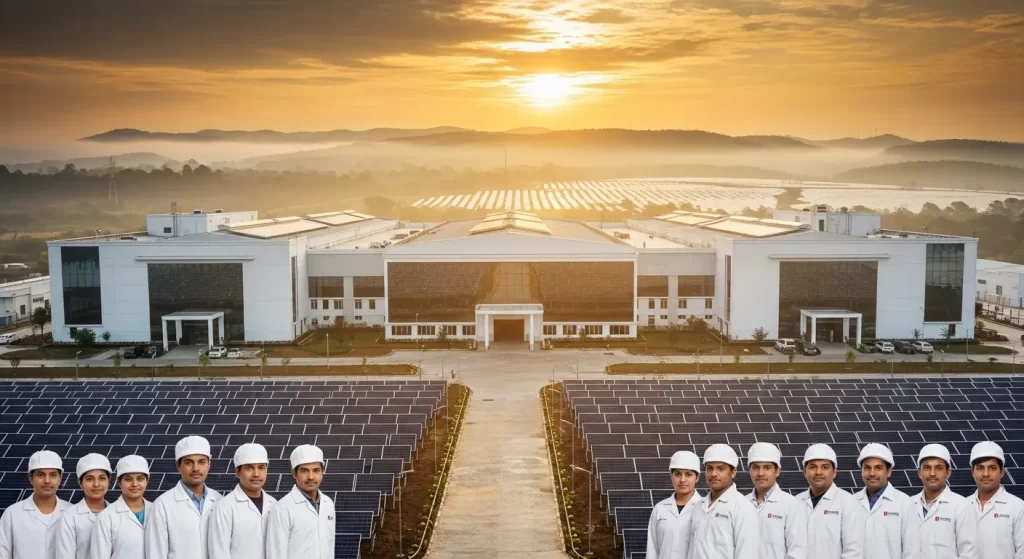
There’s a factory tucked into the hills of Khopoli, Maharashtra, that most people haven’t heard of. But what’s happening inside it could shape how India powers itself for decades to come.
A 3 GW solar module manufacturing plant has been commissioned here — and it’s not your average assembly line. It uses AI, runs on next-generation cell technology, and sits within the IndoSpace industrial corridor that’s becoming one of western India’s most important manufacturing hubs. Together, these pieces tell a story not just about solar panels, but about where Indian industry is heading.
Why the tech inside actually matters
If you’ve followed solar energy at all, you’ve probably heard of PERC — the cell technology that drove the industry’s growth over the last ten years. The Khopoli plant leaves that behind. It’s built around something called TOPCon — a newer architecture that squeezes more electricity out of the same sunlight, with typical efficiency rates crossing 24%.
That might not sound dramatic until you think about it at scale. Across thousands of panels installed across rooftops and solar farms, even a 2–3% efficiency improvement adds up to significant extra power — without needing any more land or investment. And because TOPCon modules hold up better in high heat and cloudy conditions, they’re actually well-suited to the wide range of climates across India.
The G12R wafer format used here is a newer, optimized size that fits neatly into standard installation setups. No retrofitting, no compatibility headaches — just better output.
AI on the factory floor
Here’s something that might surprise you: the plant has reduced its manufacturing defect rate by 15% using AI-powered quality inspection. Cameras and sensors monitor every panel at every stage, catching microscopic flaws that human eyes simply can’t catch consistently at this speed and volume.
Beyond quality checks, the plant uses digital twins — virtual replicas of actual machines — to predict when equipment might break down. Instead of waiting for something to fail, maintenance happens before the problem starts. It keeps the line running, cuts costs, and reduces waste. This is what Industry 4.0 looks like when it actually works.
A deal that signals something bigger
The plant recently signed a 125 MWp supply agreement with ENGIE, one of the world’s major energy companies. On the surface, it’s a procurement deal. But it’s also a vote of confidence — a global player deciding that Indian-made solar modules are good enough, reliable enough, to bet on.
That matters in a world where supply chain disruptions have become routine. India building domestic solar manufacturing capacity isn’t just a national story; it’s a practical answer to a global problem.
The human side of a high-tech plant
Here’s what doesn’t always make it into press releases: the Khopoli-Pali belt, for all its industrial promise, still faces real challenges. Logistics can be inconsistent. Skilled workers are in short supply. Infrastructure lags behind ambition.
The Khopoli plant doesn’t pretend otherwise. Local hiring and upskilling programs are running alongside the automation — because you can’t run a sophisticated factory without people who understand it, maintain it, and adapt when things go sideways. The AI handles precision. People handle everything else.
What this adds up to
India has set itself a target of 500 GW of renewable energy by 2030. That’s an enormous goal, and it won’t happen through imports alone. Plants like this one — combining advanced technology with local manufacturing — are how the country gets there.
Khopoli won’t make headlines every day. But it’s doing something important quietly: building the foundation that India’s clean energy future actually runs on.