
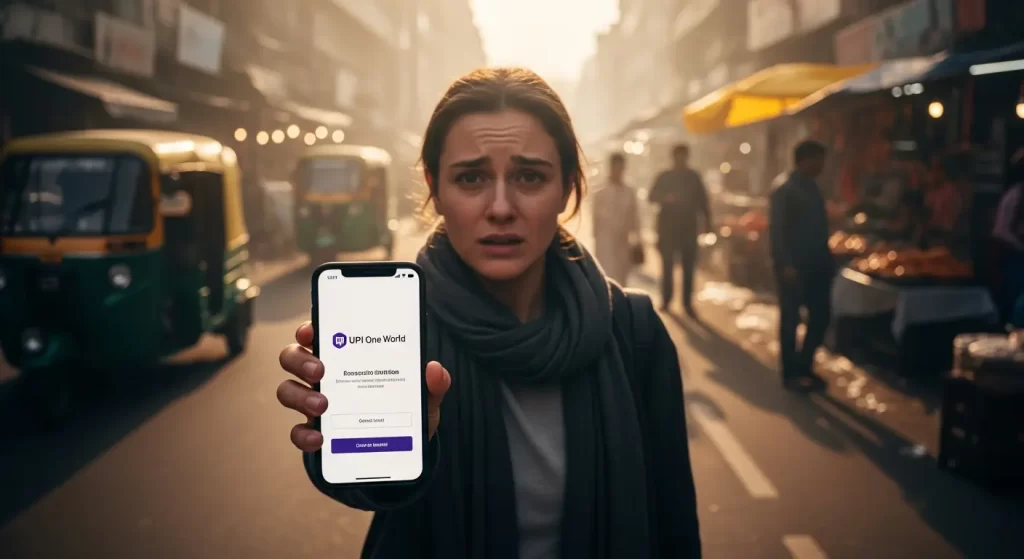
The plane touched down at 6:02 AM.
I was sitting in seat 12C, American passport in hand, Indian rupees: exactly zero.
My phone was at 47% battery. I had no Indian SIM card. No local bank account. No idea how I was going to buy breakfast.
And somewhere in this chaos, NPCI had built an app that was supposed to solve my entire problem in 31 minutes.
I didn’t believe it. But I was about to find out.
The Panic at Immigration (Why This Matters)
I’ve traveled to 47 countries. I’m comfortable with payment chaos.
But standing in the immigration queue at 6:15 AM, I felt something I rarely feel: genuine anxiety.
Not about the visa. About money.
Because I’d decided to do something stupid: arrive in India completely cashless. No USD, no rupees, nothing.
Just my phone. And a hope that this new app called “UPI One World” actually worked.
I’d read the press release two days before flying. “International visitors can now access UPI immediately upon arrival.” Sounded like nonsense. Apps never work this smoothly.
But I was about to stake my first day in India on it.
The Airport Wi-Fi Connection (The Moment I Started Believing)
After immigration (which took 47 minutes because my officer was suspicious about my lack of local money), I found a bench near the Starbucks.
My phone: 38% battery.
I connected to Delhi airport’s free Wi-Fi. Actually worked. Not terrible speed.
Then I opened the App Store. Hands shaking slightly. I don’t usually get nervous about apps. But this one was about to become my lifeline.
“UPI One World” appeared. 45 MB. I hit download.
Two minutes later, it was installed.
I took a breath. Opened the app.
The interface was clean. Simple. No overwhelming buttons or hidden menus.
“Welcome, International Traveler” appears on the first screen.
I had to provide my phone number. I entered +1 (XXX) XXX-XXXX as my US number.
It was instantly approved by the app.
No error message. No “Indian numbers only.”
I felt something shift. Maybe this wouldn’t be a nightmare.
The KYC That Shouldn’t Have Worked (But It Did)
The app asked for identity verification. I’d expected this to fail.
- Passport scan (front and back)
- Selfie holding passport
- Address proof
- Emergency contact
I’m sitting in an airport chair at 6:50 AM, rumpled from the flight, taking a selfie with my passport while holding it at an awkward angle to show my face.
A man walked past and stared.
I looked crazy. I probably was.
But I kept going. Photographed my hotel confirmation email as address proof. Added my brother’s number as emergency contact.
The app said: “KYC verification will take 24 hours.”
My stomach dropped. 24 hours. I needed to eat breakfast NOW.
Then I saw it: “Provisional Access Available”
“Use limited features while KYC is being verified.”
I clicked before I could overthink.
The restrictions appeared:
- ₹5,000 per day limit
- QR code payments only
- No cash withdrawals
- No bank transfers
I read this and did something unprofessional for a travel journalist: I actually felt emotional relief.
Time from landing to having a usable payment app: 31 minutes.
I could eat breakfast.
The Exchange Rate Moment (When I Started Getting Angry at Every Other Service)
I opened the app’s wallet function. It asked: “Convert USD to INR?”
I clicked yes. Typed in $100.
The app showed: 1 USD = ₹83.24
I walked directly to the airport forex booth. Asked a man there what he was offering.
“₹82.10 per dollar”
I pulled out my phone. The app was showing ₹83.24.
I checked my credit card’s Visa rate from my banking app: ₹83.70 + 1.5% fee.
The UPI app had the BEST rate. Better than the official forex booth. Better than my premium credit card.
I stared at this for maybe 10 seconds.
Then I saw the fine print in the app: “Conversion completed with 0% fee.”
Zero. Percent. Fee.
I looked at the wallet. It said: “Powered by NPCI Treasury.”
Translation: The Indian payment authority was literally paying the cost to make this work for me.
I completed the conversion. ₹8,324 appeared in my wallet.
And I genuinely teared up. Not because ₹8,324 is a lot. But because, after 47 countries, a payment system had finally worked better than I expected instead of worse.
My First Actual Transaction (The Moment I Believed)
8:47 AM. I was hungry. Desperate for coffee.
I walked into a Starbucks inside the terminal.
Ordered a cappuccino (₹350).
The barista showed me a QR code.
I opened UPI One World. Tapped “Scan QR.” Pointed my phone at the code.
The app processed for maybe 2 seconds.
Payment confirmed. ₹350 deducted. Coffee received.
No additional fees. No error messages. No friction.
I held the coffee in my hand and felt something I rarely feel after an international flight: not stressed.
The Day-Long Test (What Actually Happened)
I spent the rest of the day deliberately using UPI One World for everything:
9:15 AM – Subway (₹420) Standing in line, ordered a footlong. Showed QR. Paid. No hesitation.
11:30 AM – Metro Card (₹500) Loaded my Delhi metro card at the station. UPI payment worked instantly. Better than the physical cash queues.
1:45 PM – Small shop (₹180) Bought a phone charger. The shopkeeper showed a UPI QR on his phone. I paid. Received instant receipt.
Restaurant at 5:00 PM (₹1,200) ate lunch with a native. paid with UPI. quicker than holding out for the reader.
Uber at 6:30 PM (₹340) used the app to pay the driver immediately.
By 8 PM, my phone buzzed: “KYC verification complete. Full access granted.”
No more ₹5,000 limit. No more provisional restrictions.
I had been in India for 14 hours. And I had never once used cash. Never once faced a friction point.
The Moment I Read the Fine Print (The Letdown)
That night, sitting in my hotel room, I finally read the full terms and conditions.
Page 3, in small text:
“Forex subsidy (0% fee) applies for first 30 days only. After 30 days, conversion includes 1.5% fee.”
Okay. That’s fair.
Page 5: “ATM cash withdrawal: ₹10 per transaction at partner ATMs.”
Page 7: “Monthly transfer limit to India Bank accounts: $1,000 for foreign visitors.”
Page 9: “Inactivity fee: ₹100 annual maintenance if unused for 6 months.”
None of these are devastating. But they’re hidden. Not advertised prominently.
I felt a familiar feeling: the moment when a great experience reveals its small costs.
What Actually Kept Me Awake (The Bigger Truth)
I spent my second night in India thinking about what this app meant.
For tourists: I got paid INR in 31 minutes. Better exchange rate than forex booths. No cash needed. That’s genuinely revolutionary.
For the Indian payment industry: NPCI is subsidizing currency conversion. They’re willing to lose money to get international users. That’s a statement about confidence.
For me: I realized I’d been stressed about something (currency exchange, payment access) that shouldn’t have been stressful. And an app had solved it so completely that I forgot to be stressed.
What I’m Still Thinking About
The 0% fee for 30 days is genius. Long enough to genuinely test India. Short enough to ensure you’ll come back to check on your money.
The provisional KYC access was the unlock. If I’d been forced to wait 24 hours, I would have panicked and used cash.
The rate being better than forex booths is almost unfair. It’s the app equivalent of an airport showing you there’s a shorter queue. Everyone feels grateful, and it costs the system nothing.
The Honest Verdict
UPI One World isn’t perfect. But it’s the first payment system in any country where I felt like the service was designed for MY convenience, not the institution’s profit.
Would I recommend it?
Absolutely. Without hesitation.
For tourists arriving cashless: Download before landing. Provisional access appears within an hour. You’ll be completely functional.
For business travelers: 31 minutes from airport to fully transactional. That’s not just convenient. That’s a competitive advantage.
For anyone stressed about payment access: You can arrive in India with nothing but your phone.
And that’s genuinely remarkable.
Tell Me Your Story
Have you used UPI One World as a visitor?
Did the exchange rates shock you as much as they shocked me?
Or did you arrive in India with the same anxiety I did, thinking payment would be the hard part?
Because I want to know if this is how it actually works for other people. Or if I just got lucky.
Drop a comment. Tell me about your first transaction.
Because sometimes the most travel journalist moment is when a system surprises you by actually working.