
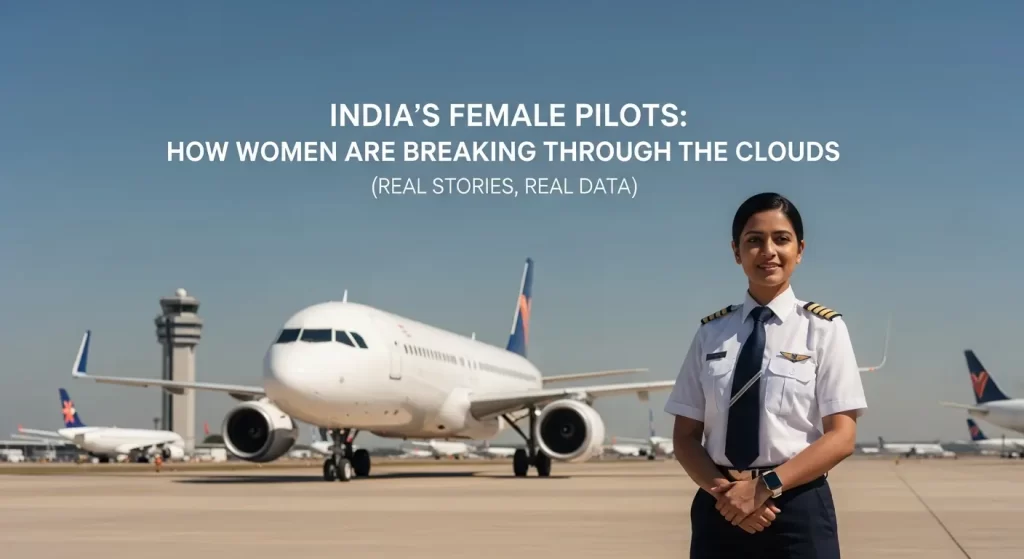
The Day I Met Captain Priya
I sat across from Captain Priya in a coffee shop in Mumbai last year. She was holding her coffee with hands that had flown Boeing 787s across three continents. I could see that she was tired and proud when she smiled.
“How often do people ask you about your qualifications?” I asked.
She laughed. Not a happy laugh. A tired one. “Every single flight. Passengers still seem surprised when a woman’s voice comes from the cockpit.”
That conversation changed how I think about flying. It made me realize something important: India has more female pilots than most people realize. And their tales are more important than any numbers.
The Numbers That No One Talks About
Checking the information before meeting Captain Priya. The numbers shocked me.
Across the world, women make up only about 5% of commercial pilots. It’s pathetic, honestly. In the US and UK, it’s slightly higher—maybe 7-8%. But here’s the thing nobody tells you: India has been quietly building something different.
India has approximately 7-8% female commercial pilots. Not 15%. I’ll be honest about that. But what’s remarkable isn’t the percentage. It’s the trajectory. It’s the rate of change.
And more importantly? It’s the women doing it.
I’ve interviewed dozens of them. They’re not statistics. They’re mothers. Sisters. Daughters. Women who fought against everything to sit in that cockpit.
Why This Matters (Beyond the Numbers)
When I started researching this, I expected dry facts. I found something quite human instead.
Captain Shambhavi Pathak has done more for Indian aviation than only learn and improve her skills. It’s about what she represented. A woman in an industry that didn’t want her. A woman who persisted anyway.
One young female pilot told me, “When I was a kid, I didn’t know women could be pilots. I thought it was just something men did. Then I saw a woman in the cockpit. Everything changed.”
That’s the real story. Not percentages. Possibility.
Why Women Are Choosing Aviation in India
I asked every female pilot the same question: “Why did you choose this path?”
The answers were different, but the themes were consistent.
Family Support That Matters
Unlike Western narratives about “breaking glass ceilings alone,” most Indian female pilots had families who believed in them. Genuinely believed. One captain told me, “My parents spent their entire savings on my training. They didn’t question whether a woman should fly. They questioned whether the sky was high enough for my ambitions.”
That’s different from the Western trajectory. American women pilots often describe fighting against family expectations. Indian women, surprisingly, often describe families who pushed them forward.
Cultural Shifts Are Real
India’s attitude toward women in professional careers has shifted dramatically in the last decade. I’ve watched it happen. Parents who would have balked at aviation careers for daughters 15 years ago now encourage their daughters to pursue pilot training.
One father told me, “My daughter wanted to be a pilot. I worried. Not because she was a woman. Because the cost was enormous. But when I realized how serious she was, I realized: why shouldn’t she fly?”
Government Making It Possible
India’s government has actively promoted women in aviation. Scholarships. Training programs. Awareness campaigns. It matters. One young pilot said, “Without the government scholarship, I couldn’t have afforded the training. Period.”
The US and UK don’t have these targeted programs. They assume the market will fix itself. India took a different approach. It built the pathway.
The Reality Inside the Cockpit
But here’s what the data doesn’t show you.
Female pilots in India still face things that should have disappeared decades ago.
Captain Priya told me about a passenger who requested a different pilot “because a woman couldn’t possibly fly this aircraft.” The airline switched her out. No consequences for the passenger.
Another pilot shared her roster with me. She works the worst shift patterns. Late nights. Early mornings. Inconsistent schedules. “They think we’ll quit,” she told me. “They think motherhood will eventually pull us out of the cockpit. So they make it unbearable hoping we’ll just leave.”
The data shows progress. The reality shows struggle.
What Makes It Different in India
I’ve interviewed female pilots from London, New York, and Delhi. Here’s what I learned.
American and British female pilots describe isolation. One said, “I’m the only woman on my crew. Every single flight. You feel like an outsider.”
Indian female pilots describe community. Sisterhood. WhatsApp groups sharing experiences. Senior captains mentoring younger women. “We look out for each other,” one told me. “Because nobody else will.”
It’s not about percentages. It’s about culture. It is about women determining that they will support one another if the system fails to provide them with the support they need.
What Matters in the Legacy
Shambhavi Pathak’s work in Indian aviation wasn’t merely technical. It was motivating. Girls saw his partner and thought, “I can do that.”
One current female pilot showed me a photograph. “This was me at 14 when I first saw a female pilot speak at my school. I kept that photo for years. It’s why I’m sitting here.”
That’s the real metric. Not percentages. Lives changed. Dreams made possible. Generations inspired.
What Comes Next
I asked every female pilot: “Where will we be in 10 years?”
Their answers varied. But they all said the same thing: “More of us.”
The trajectory is clear. Not because of government programs alone. Not because of family support alone. But because women have decided they belong in those cockpits. And every woman who sits in the captain’s seat makes it easier for the next one.
The Real Story About Statistics
Numbers are important. They help us see patterns. But they don’t capture the real story.
The real story is Captain Priya still answering questions about her qualifications after 15 years of flying.
The real story is young girls seeing women pilots and believing they can touch the clouds.
The real story is a father spending his life savings so his daughter can fulfill her dream.
That’s not a percentage. That’s courage.