
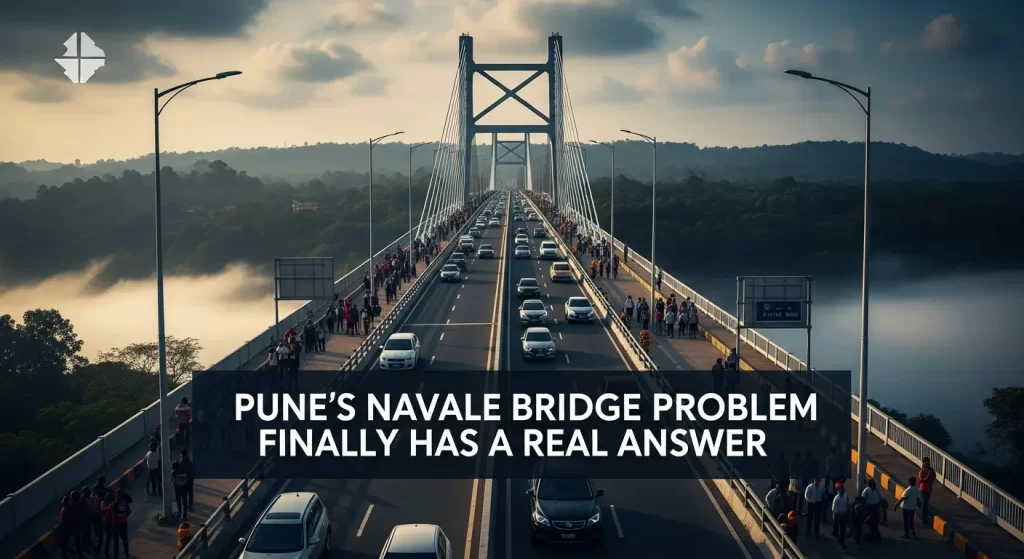
Let’s be honest. If you’ve ever been stuck on Navale Bridge at 9 in the morning, you didn’t need a traffic report to tell you something was wrong. You could feel it — engine idling, ten minutes passing without moving, the faint hope that the jam would clear around the next bend, and then it didn’t. For a huge chunk of Pune and Pimpri-Chinchwad, this has simply become part of the daily routine. Wake up, get ready, lose an hour to Navale Bridge, repeat.
That’s not a small inconvenience. That’s a quality of life problem. And it’s been building for years.
Why This Bridge Became Such a Headache
The Navale Bridge bottleneck didn’t happen overnight. It’s the product of a road network that was designed for a very different city — one that didn’t have Hinjewadi pulling tens of thousands of IT workers westward every morning, or the kind of freight traffic that the Mumbai–Bengaluru Highway now handles daily.
Local vehicles, intercity trucks, office commuters, and delivery vans all end up funnelled through the same narrow stretch at the same time. There’s no separation, no alternative, and nowhere for the pressure to go. The result is what every Punekar already knows by heart.
Authorities tried fixing it the short way in 2024 — tweaked signals, temporary diversions, minor road adjustments. And to their credit, those measures weren’t useless. But they were the equivalent of putting a bandage on something that needed surgery. The congestion always came back, usually worse than before.
The Plan That Actually Addresses the Root Cause
What’s been proposed now is genuinely different in scale and intent.
A 15.87 km elevated corridor stretching from Dehu Road to Sutarwadi — six lanes wide, running above the existing ground-level traffic along the Mumbai–Bengaluru Highway. The National Highways Authority of India is driving the project, and the core idea is elegantly straightforward: pull the through-traffic off the ground and give it its own road above the chaos.
Once that happens, the vehicles that were never meant to be mixing with local Pune traffic — long-haul trucks, intercity buses, highway travellers — have a dedicated path that doesn’t cross or compete with the daily movement of people just trying to get to work or pick up their kids from school.
The project also includes widening of service roads alongside the corridor. That detail matters more than it sounds. A lot of elevated highway projects ignore what happens at ground level, and then the local roads become the new bottleneck. Addressing that from the planning stage shows a more complete understanding of how this corridor actually functions.
The People Who’ll Feel This the Most
Ask anyone living in Wakad, Balewadi, or Baner what their morning looks like, and the Navale Bridge story comes up within the first two minutes. These neighbourhoods grew quickly — largely because of Hinjewadi — but their road infrastructure didn’t keep pace. The elevated corridor directly addresses that mismatch.
For IT professionals who currently budget an hour or more for a commute that should take twenty minutes, this is genuinely life-changing in the most ordinary, everyday sense. That’s not an exaggeration. Getting forty minutes back every morning — and again every evening — changes how tired you are, how much time you spend with your family, and how you feel about the city you live in.
Freight operators working the Mumbai–Bengaluru Highway will also breathe easier. Delays on this corridor don’t stay local — they ripple into supply chains, delivery schedules, and logistics costs across the region.
What This Really Signals
Pune is growing fast. Faster, in many ways, than its roads and systems have been able to keep up with. For a long time, the response to that growth was reactive — wait for a problem to become unbearable, then look for a quick fix.
The Navale Bridge elevated corridor feels like a departure from that pattern. It’s a long-term structural answer to a long-term structural problem. It won’t fix everything, and no single project ever does. But it’s the kind of investment that shows a city beginning to plan ahead rather than just catch up.
For the commuters who’ve sat in that jam more times than they can count — and honestly, who hasn’t — it’s simply about time.