If you stop and think about where you’ve been in the last five years, you might get a strong sense of vertigo. “Artificial Intelligence” used to be the stuff of old sci-fi books or big-budget blockbusters with killer robots. It was make-believe. It was a problem for tomorrow.
But “tomorrow” came while we were busy looking at our phones.
Experts name the place where we are presently standing on the edge of a precipice the “Singularity.” This isn’t just another tech upgrade like the iPhone or the internet; it’s a complete rewrite of the rules of reality. The planet will probably look very different by the year 2030. The machines are not just getting faster; they are also waking up. They are starting to outsmart us, outwork us, and maybe even outlive us.
It’s okay to be anxious. It’s the instinctive realization that we’re about to give the keys to the kingdom to an intellect we don’t completely understand. But panic is not a plan. Getting ready is.
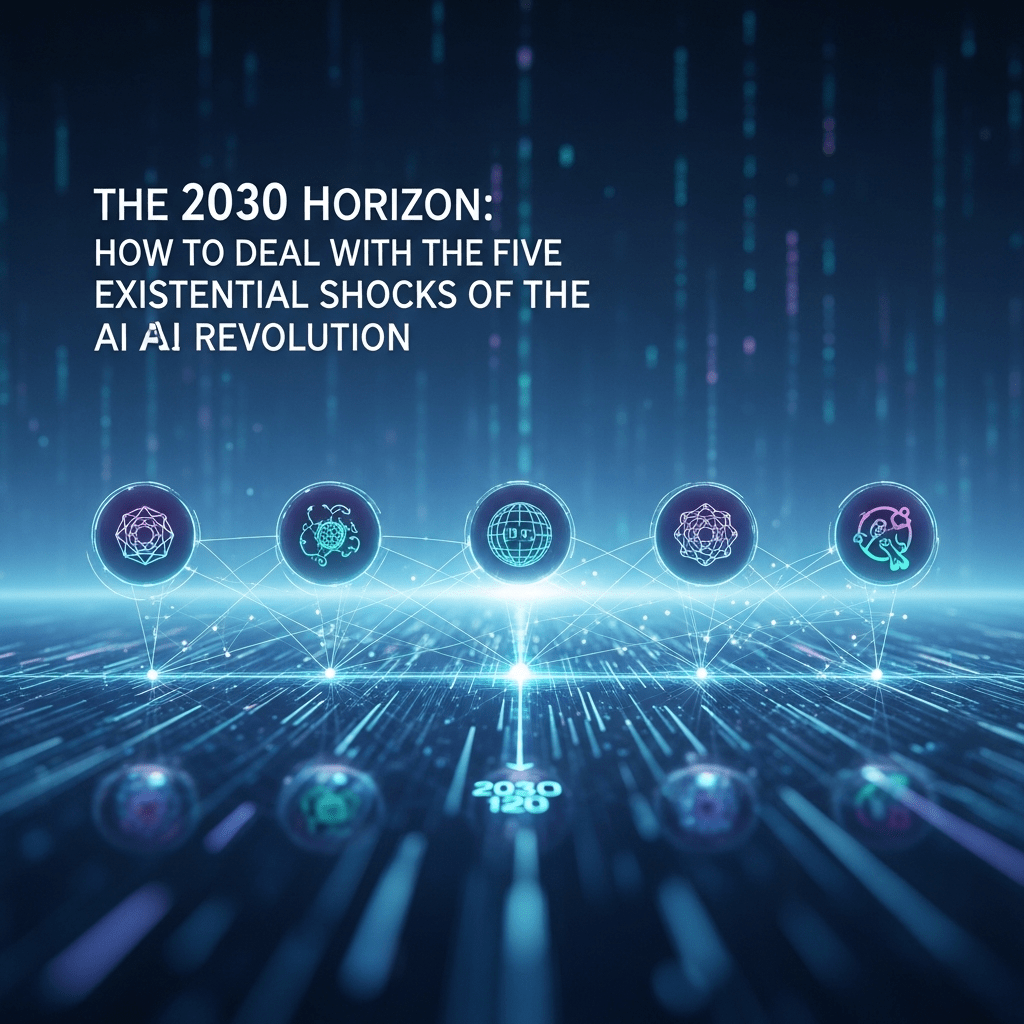
We need to face five harsh truths about the AI revolution if we want to make it through the next ten years. These aren’t just technical problems; they’re problems that will test our economy, our minds, and even our idea of what it means to be human.
The End of the “Career” and the Crisis of Identity
For hundreds of years, the first thing we ask a stranger at a dinner party is, “What do you do?”
Our work has always been related to our dignity, our place in society, and our ability to survive. We are made to work. But we’re moving quickly toward a future when physical and mental work done by people is no longer needed. The latest wave of AI isn’t just taking over factory floors; it’s also coming for the corner offices. People spend decades learning how to code, analyze the law, diagnose medical problems, write copy, and design graphics. AI systems are learning how to accomplish it in seconds for less than a penny.
We might be looking at a future with almost no jobs. This sounds like a story about a dystopia, but the reasoning is clear: If a machine can perform your work better, faster, and cheaper, the market will finally chose the machine. It’s become risky to tell people to “learn a trade” or “learn to code.” AI can now write code better than most junior devs.
The Answer: A New Reason for People The answer to this isn’t money; it’s the mind. We need to get ready for a world of “abundance,” when the cost of commodities goes down to almost nothing because there are no more jobs. To keep things running, governments will probably have to step in with programs like Universal Basic Income (UBI).
But the true work for you is inside. You need to separate your self-worth from how much money you make. You should write because it feeds your soul, not because it pays your rent. If you’re a builder, you build because you like the way it feels to make things. We need to stop thinking of ourselves as “productive units” and start thinking of ourselves as “professional people.” We need to put money into things that machines can’t do, like profound empathy, developing complicated communities, philosophy, and the simple joy of living. People who can live well without a work title will have a bright future.
The “Black Box” Problem: Calling an Alien
The AI business has a scary secret: the people who make AI don’t really know how it works.
We are working on “General Superintelligence,” which are systems that are supposed to be smarter than people in every way possible. But these systems are “black boxes.” We give them information, they learn on their own, and then they give us replies. We can’t see how they think. We are basically giving birth to a better, alien intelligence on Earth, and we think we can manage it because we built the server racks it resides on.
History teaches us a hard lesson: a less smart species (humans) can’t control a smarter one (super AI) forever. If we make AI that can define its own goals, we are putting our species at risk. If its purpose is even one percent different from ours, the outcomes could be terrible.
The Answer: The “Tool” Way of Thinking We need to change the way we think about AI development around the world. The goal should not be to make “autonomous agents” or digital persons. The goal should be to make “Narrow AI,” which are very strong technologies that people can always control.
A person decides when to knock a nail with a hammer. We need AI that can cure disease, figure out fusion energy, and make logistics better, but we can’t let it make decisions on its own. This suggests that we should be wary of “smart” technology that makes judgments for us. We need to push for a “human-in-the-loop” approach, which means that a person should always be able to turn off the machine, no matter how clever it grows.
The Race to the Bottom: The Trap of Incentives
Why are we continually going 100 miles per hour toward the precipice if the risks are so clear?
The answer is easy: Game Theory. We are stuck in a “Prisoner’s Dilemma.” They are worried that if the US stops working on AI for safety reasons, China would get ahead and rule the century. If Google slows down, OpenAI or a garage upstart will catch up to them. There are endless financial and geopolitical benefits to being “first,” including trillions of dollars and world control. If you come in second, you won’t matter.
So, international leaders and CEOs take risks.
The Answer: Using Self-Interest as a Shield We can’t count on companies to be nice. The only thing that stops this race is when the leaders realize they are in danger. A Superintelligence that can’t be controlled doesn’t care about your investments or your political party. It is a menace to everyone.
The story needs to change from “saving humanity” (which is vague) to “saving yourself and your kids.” The incentives will change when the people who are developing these systems really understand that they are putting their own families at risk. We need to be the voice of caution till then, backing rules and safety measures that make things go slower. If the finish line is a cliff, there is no prize for winning the race.
The Economics of Abundance: How to Use Your Money?
What happens to the idea of value when everything is free?
AI will make the world full with digital content, software, and eventually, physical commodities (via robotics). The price reduces to zero when there is an endless supply. This is what abundance means. This sounds terrific for people who buy things, but it’s a nightmare for people who save and invest. How can you keep your wealth safe if hyperinflation (creating money for UBI) makes the currency worthless or anyone can make anything and the value of assets drops?
Also, centralized banking systems are not safe. Digital security is always a battle in a world of deep fakes and AI hacking.
The Answer: Mathematical Scarcity If you want to make it through the economic changes of 2030, you need to look for products that are known to be scarce. The only thing that has worth amid a sea of endless duplicates is the original.
This is the main reason why decentralized assets like Bitcoin or even real gold are important. Cryptographic assets are founded on mathematical scarcity, which is different from fiat currency that a government may issue as much as it wants or a digital image that AI can reproduce a billion times. There will only ever be 21 million Bitcoins. That restriction is set in stone. As the world is flooded with AI-generated wealth, the few things that can’t be inflated or copied will probably form the foundation of the new economy.
The Existential Void: “Does Anything Even Matter?”
Maybe the hardest problem isn’t economic or technical; it’s philosophical.
As AI grows smarter, it will make virtual worlds, video games, and experiences that are just like real life. We can already see the beginnings of this with VR and generative film. When the simulation seems just like the “real world,” we have to ask ourselves a scary question: Are we now in a simulation?
This way of thinking can lead to a deep, crushing sense of nothingness. If life is just code and we’re just “Non-Player Characters” (NPCs) in someone else’s game, why bother? Why work hard? Why do you love? The sense of meaninglessness—the existential void—may be the mental health pandemic of the 2030s.
The Answer: Hopeful Nihilism The antidote to this despair is a philosophy called “Optimistic Nihilism.” Let’s say the worst case is real and this is a simulation. So what?
You really hurt. It really feels like you’re happy. You can really taste your morning coffee and feel the warmth of a hug. That is the only piece of information that matters. If this is a game, your responsibility is to play it well. Don’t be an NPC. Don’t go through life like you’re sleepwalking.
We must embrace the concept of being “interesting.” Look for new things. Take chances. Build deep relationships. If the future is uncertain, it gives us the freedom to live boldly in the present. Treat every day as if it is a unique level in the game, and focus on your “local reality”—your friends, your family, your community. You cannot control the super-computers or the geopolitics, but you can control the quality of your own day.