
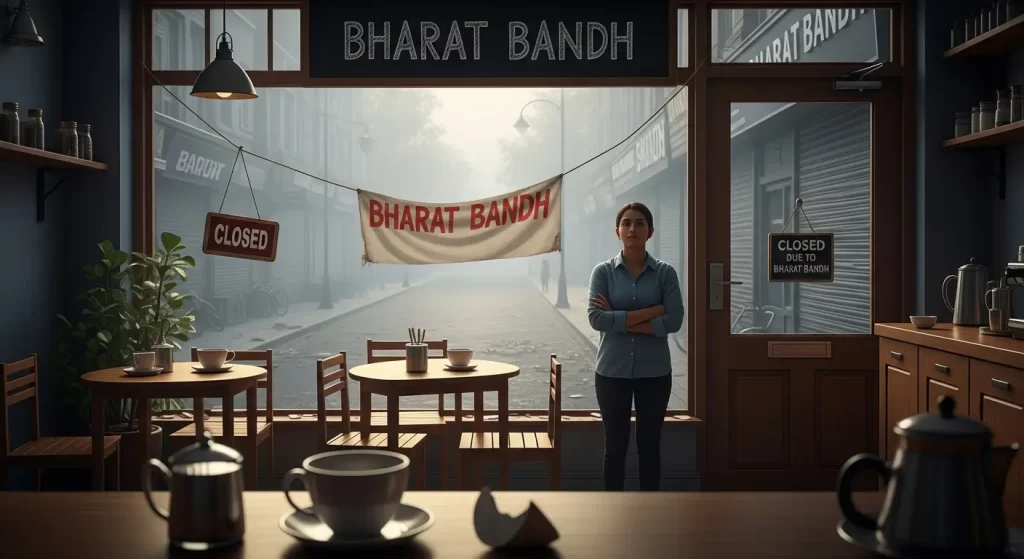
Rahul got the text at 5 AM on February 12.
“Bandh tomorrow. Delivery partners not coming. Transportation shut down.”
He read it three times. Then called me. His voice was shaking.
“I don’t know what to do,” he said.
I met him at the cafe at 6 AM. He was standing in the kitchen staring at nothing.
The Panic Starts (Before the Strike Even Begins)
By 6:15 AM, his supplier called. Not a text. A call. That’s when you know it’s bad.
“Rahul, I can’t get your delivery to you today. The roads are blocked. My drivers aren’t coming. The whole state is shutting down.”
I watched his face. Actually watched it change.
His sugar delivery—the one he’d been counting on for the chocolate cakes he sells—gone. His tapioca pearl packaging—stuck at the warehouse, unreachable. His coffee beans that were supposed to arrive—delayed indefinitely.
By 7 AM, the texts started coming in. His employees.
“Can’t come today. Public transport shut. Roads not safe.”
Three of his five employees. Just… not coming.
He looked at me. “I have to open. I have customers expecting to come in.”
So he called his wife. She came in. Angry. Frustrated. Because she has her own job. But she came anyway.
What Actually Happened (The Hours I’ll Never Get Back)
They opened at 9 AM with half a menu. No bubble tea—his highest-margin item. No specialty drinks. Just basic coffee and tea.
Usually, they serve 300 people a day. That day? Maybe 100.
“We served maybe 100 people,” Rahul told me, staring at his register. “Maybe. I honestly lost count because there were so few.”
He kept checking his phone. His food delivery apps. Zomato. Swiggy. Usually, 40% of his revenue comes from delivery orders.
That day? Zero. Delivery partners weren’t working. Customers weren’t ordering to empty streets.
Let me show you the math. And understand—these aren’t theoretical numbers. These are the numbers Rahul was staring at in real time.
Normal day: ₹12,000 in revenue.
February 12: ₹3,600.
That’s a 70% drop. In one day.
February 13 was slightly better. ₹4,200. But still catastrophic.
Two days combined? He lost ₹12,000 in revenue.
But the real damage wasn’t visible on the register. It was visible on his face.
What Nobody Talks About (The After-Effect)
The strike ended. Roads opened. Delivery partners came back.
But customers? They didn’t automatically come back.
They’d broken their routine. They’d gone somewhere else. They’d gotten used to not having Rahul’s bubble tea.
Trust isn’t instant. It takes weeks to rebuild when someone’s habit is broken.
“I lost customers,” Rahul said quietly on February 14. “People who came here every day. They went to another cafe. Why would they come back?”
He was doing the math on his own. ₹12,000 in direct losses from the strike. But add in:
- Lost customers (estimated ₹3,000 a week)
- Spoiled inventory he couldn’t sell before it expired (₹2,000)
- His wife’s lost wages while she helped (₹1,000)
- Staff wages he had to pay even though he made almost no money (₹3,000)
By end of month: ₹20,000+ gone.
For context: Rahul has ₹40,000 in his business account. That’s it. That’s his entire cushion for emergencies, repairs, restocking.
One strike took half of it.
What the News Showed vs. What Actually Happened
I watched the news coverage. Thousands of workers protesting. Valid demands. Important labor issues. Worker protection. All of it real. All of it matters.
The camera never showed Rahul’s cafe.
It never showed him wondering, “Can I pay rent next month?”
It never showed his wife frustrated. His employees worried about their own wages. His customers discovering they liked the coffee shop two blocks away better.
It never showed that for Rahul, “Bharat Bandh” isn’t about labor codes or trade deals.
It’s about whether he eats this month.
The Bigger Picture (Which Is Terrifying)
Rahul’s cafe is one of 3 million food businesses in India.
Every single one lost money. Every single one is right now doing math like Rahul. Every single one is wondering when the next strike comes.
A barber shop down the street: Lost customers. Can’t make rent.
A clothing vendor: Couldn’t get stock delivered. Lost a week of sales.
A printing press: Transportation shut down. Can’t deliver client orders.
A vegetable vendor: Couldn’t get wholesale supplies. Sold nothing.
Multiply ₹20,000 across 3 million businesses.
That’s ₹60 billion in economic loss. In two days.
Nobody’s talking about that number.
What Rahul Actually Wants (And It’s Reasonable)
He’s not asking for the strike to not happen.
He’s not against worker rights. He actually said this: “I support workers. I’m not anti-strike. But I’m also drowning right now.”
He’s asking for something practical.
“Give us 48 hours notice. Let us prepare. Let supply chains adjust. Let small business owners figure out what to do with our inventory. Let us communicate with our customers. Don’t just shut everything down overnight.”
That’s it. That’s his ask.
Right now, a nationwide strike affects a tech company with ₹10 crore in the bank the same way it affects Rahul with ₹40,000.
They’re not the same. The tech company has resources. Rahul has hope.
The Truth Nobody Wants to Say
I’m sitting across from Rahul. He’s holding his head.
“I support worker rights,” he says again. Like he needs permission to also care about his own survival.
“Worker protections matter. Labor codes matter. The strike was valid.”
He takes a breath.
“But I also need to pay my staff next month. I also need to make rent. I also need to keep this cafe open because this community depends on it.”
Both are true. Both matter.
The political strike? Necessary. Important. Valid.
The cafe owner’s survival? Also necessary. Also important. Also valid.
Right now, we’re choosing. We’re saying worker rights matter more than small business survival.
What if we said both matter?
The Question Nobody’s Asking
If Rahul’s cafe closes—and it could, with one or two more strikes like this—what happens?
His five employees lose their jobs.
The neighborhood loses their local gathering space.
A small piece of the economy disappears.
And then we act surprised when small businesses keep closing.
We act surprised when entrepreneurs stop trying.
We act surprised when entire communities change.
But we don’t act surprised about what happened to Rahul on February 12-13.
Because we didn’t see it on the news.
Tell Me What You Think
Are you a small business owner? Did the Bharat Bandh hit you too?
What happened to your revenue? How are you surviving?
Because I need to know I’m not the only one watching this. That Rahul’s not the only one wondering if next month’s rent is possible.
Drop a comment. Tell your story. Because stories like Rahul’s need to be heard.
Not to say the strike was wrong. But to say: small businesses matter too.