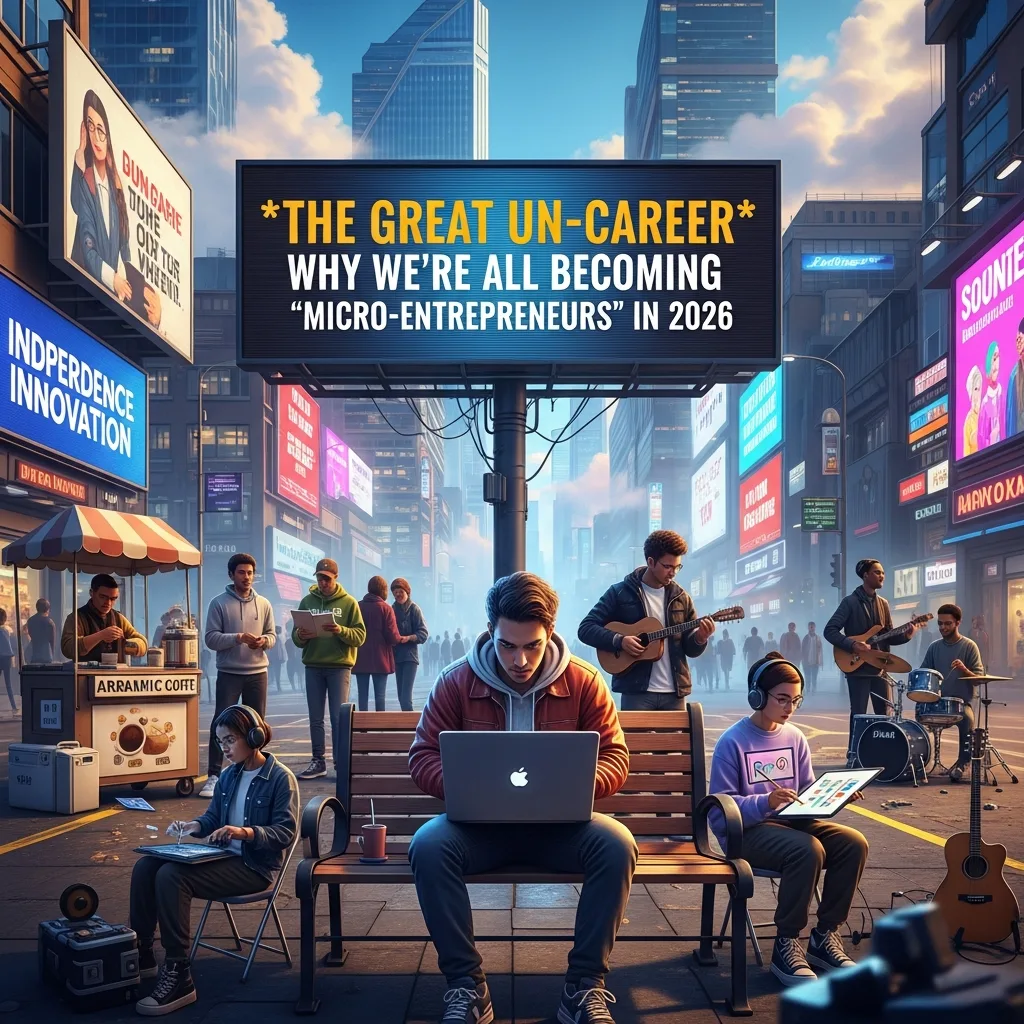
Let’s be honest for a second. In early 2026, the traditional “career” feels a bit like a ghost story we tell ourselves to feel safe.
We grew up believing that if we got the right desk job and put in the 40 hours, the world would take care of us. But if the last year has taught us anything, it’s that relying on one single paycheck from one single company is actually the riskiest move you can make. Between the AI boom and the way the economy is shifting, the “corporate ladder” has started to look more like a treadmill—you run fast, but you stay in the same place.
That’s why so many of us are opting out. Not out of work, but out of the system.
Welcome to the era of Micro-Livelihoods. It’s not about “hustling” until you burn out; it’s about building a life where your income comes from three or four different places, most of which you actually enjoy.
1. Selling What You Know (The Digital Asset)
We all have that one thing people ask us for help with. Maybe you’re the person who knows how to make a WordPress site look incredible, or you’ve mastered the art of anime-style digital art. In 2026, you don’t need a boss to give you a project. You can package that knowledge into a template, a guide, or a workflow and let it live online. It’s a quiet thrill to wake up and see that you made ₹2,000 while you were asleep because someone across the world needed exactly what you built.
2. The Return of the Physical (Hyper-Local Brands)
Paradoxically, the more digital our lives get, the more we want things we can actually touch. We’re seeing people in our own neighborhoods starting “Nano-Brands.” I’m talking about the guy making custom streetwear for local gaming groups or the small-batch boba tea manufacturer selling through quick-commerce apps. These aren’t massive factories; they’re people in small studios doing something they love and selling it directly to their community.
3. The ‘Bridge’ Consultant
There is a massive gap right now between “High-Tech” and “The Real World.” Local businesses—your favorite cafe, the neighborhood clothing boutique, the family-run clinic—all need to modernize, but they don’t have time to learn the latest tools. If you can spend a Saturday afternoon helping them automate their bookings or set up a smarter ad campaign, you’re not just a “freelancer.” You’re the reason they’re staying in business.
4. The Human Filter
We are absolutely drowning in content. There are too many movies, too many news stories, and too much “advice.” The new luxury is having someone you trust tell you what’s actually worth your time. We’re seeing a rise in “curators”—people who spend their time finding the best resources in a specific niche (like sustainable fashion or tech-stacking) and sharing it. When you provide the signal in all that noise, people value that more than a fancy degree.
The Reality Check: Is it Hard?
I’m not going to tell you it’s “easy money.” Building your own ecosystem takes more brainpower than sitting in a cubicle and waiting for instructions.
But there’s a specific kind of peace that comes with it. When you have four different income streams, you stop being afraid of a “layoff.” If one stream slows down, you just turn up the volume on the others. You aren’t “fragile” anymore.
How to Actually Start
Don’t go out and quit your job tomorrow. That’s a movie trope, not a life strategy.
- Look for the ‘Small’ Problems: Stop trying to change the world and start trying to fix one annoying thing for ten people.
- Use the Tools: 2026 is the year of automation. Use the agents and the AI tools we have now to handle the boring stuff like your invoices and your social media scheduling.
- Keep it Human: The one thing an AI can’t do is build a relationship. Talk to your customers, understand their specific needs, and show up as a real person.
The Bottom Line
The “9-to-5” isn’t going to disappear entirely, but for many of us, it’s no longer the goal. The goal is freedom. The goal is waking up on a Tuesday morning and deciding you’d rather work from a cafe in the hills than an office in the city.
In 2026, wealth isn’t about how much you have in the bank—it’s about how much of your time you actually own.