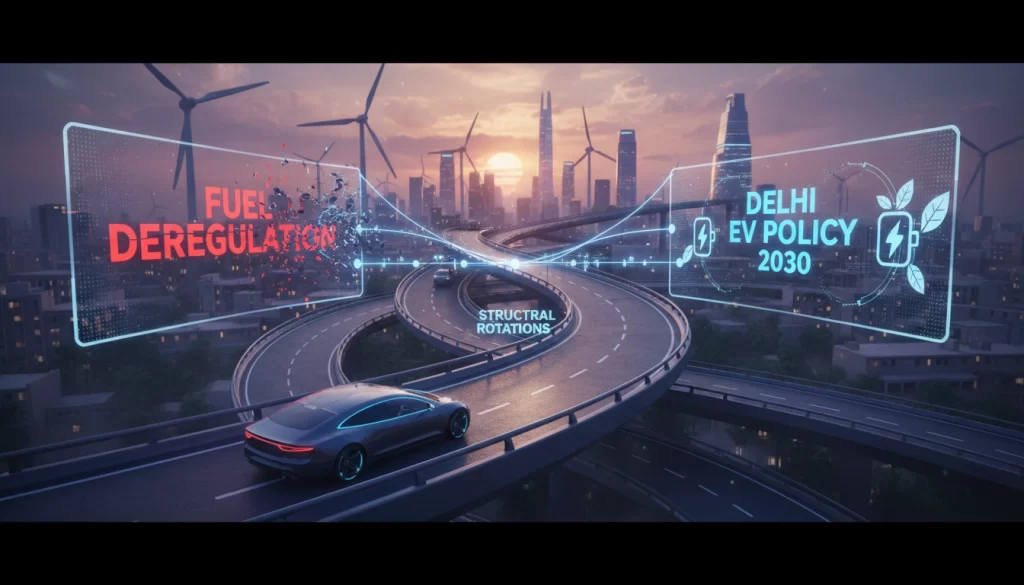

India’s car market right now is actually crazy. You’ve got luxury brands like Volvo raising prices every quarter. At the same time, you’ve got Toyota coming out with the Urban Cruiser Ebella—a proper electric SUV that costs less than half a Volvo sedan. Meanwhile, charging networks are popping up everywhere.
For someone actually shopping for a car in 2026? It’s overwhelming. And honestly, a little confusing.
The Volvo Adjustment: A ₹1 Lakh Increase That Feels Way Bigger Than It Sounds
So Volvo’s raising prices by up to ₹1 lakh starting May 1. On the surface, that’s not a huge percentage if you’re already looking at ₹40-60 lakh cars. But here’s what’s actually happening in the real world:
A buyer who was sitting on the fence? That ₹1 lakh just pushed them off. They’re not buying the Volvo. They’re looking at other options.
Someone who already committed? They’re reconsidering. “Is this car actually worth ₹1 lakh more? Or could I get something similar elsewhere?”
The rupee’s weak. Commodity prices are up. Supply chains are still messed up. These are real costs that Volvo has to pass down. It’s not greed—it’s economics. But that doesn’t make it easier for buyers to swallow.
What’s actually concerning is that this is becoming routine. Hyundai raised prices. Mercedes raised prices. BMW raised prices. It’s happening so often that people are just… accepting it. Or worse, giving up on the luxury segment entirely.
And when people give up on luxury cars? They don’t just stop buying. They look at alternatives. They ask themselves: “Why am I spending this much anyway? What am I actually getting?”
That’s the dangerous question for luxury brands right now.
The “Ebella” Entry: Toyota’s Mass-Market EV Push (And It’s Changing Everything)
While Volvo and other luxury brands are raising prices, Toyota’s launching the Urban Cruiser Ebella. It’s positioned as a practical electric SUV. Expected price? Around ₹25-30 lakh. So basically half what you’d pay for a comparable luxury sedan.
And people are actually paying attention. Real attention.
The thing that’s shocking people is that this car doesn’t feel like a “budget” option. The design is modern. The tech is solid. The range is legit—400+ km on a charge. It’s not fancy, but it’s competent. And competent is what most people actually need.
For years, the EV space was full of early adopters—people who were willing to take a risk, deal with teething problems, figure out charging logistics. It was almost a lifestyle choice.
But now? EVs are just… becoming normal cars. People aren’t buying them because they’re cool or because they want to save the environment. They’re buying them because they make sense. The math works. ₹15,000 less per month on fuel. Lower maintenance. Better driving experience.
A person buying an EV in 2026 isn’t thinking “I’m buying an electric car.” They’re thinking “I’m buying a practical SUV that happens to be electric and is way cheaper to run.”
That’s the shift. That’s what’s scary for luxury carmakers.
Charging Infrastructure 2026: The 9,000-Point Milestone (It’s Actually a Big Deal)
One of the biggest worries people had about EVs? “What if I can’t find a charging station?”
That’s getting solved. The Mercedes-Benz CHARGE network just crossed 9,000 charging points across India. And there are other networks too—ChargeGrid, Tata Power, others.
Here’s what’s actually happening: people are feeling confident about EV ownership now. Not hopeful. Confident.
Someone considering an EV can actually check the charging app and see: “Okay, there are 20 charging stations within 10 km of my home. There’s a network along the highway to my parents’ house.” It stops being theoretical. It becomes real infrastructure you can rely on.
And here’s the interesting part—luxury brands like Mercedes are building this infrastructure. Not just for their own cars, but it benefits everyone. A Tesla owner can use CHARGE. A Tata EV owner can use CHARGE. It’s collaboration that actually works.
When infrastructure gets this solid, the anxiety dies down. When anxiety dies down, people stop overthinking the decision. When people stop overthinking, they buy.
And right now, most people are buying EVs, not luxury sedans.
The Buyer’s Conundrum: Elegance vs. Smart Value (What People Are Actually Choosing)
Let’s talk about what’s actually happening in people’s heads when they’re shopping.
Someone’s got ₹50 lakh to spend on a car. A year ago, the choice was simple: luxury sedan or nothing. Now? The choices are completely different.
Option 1: Get a Volvo sedan. Premium badge. German engineering. Good safety ratings. Comfortable. But now with the price hike, you’re really feeling the cost.
Option 2: Get a Toyota Urban Cruiser Ebella EV. Modern design. Solid tech. Way lower running costs. No maintenance headaches. You save ₹15,000-20,000 every month on fuel. Plus government incentives. Plus no oil changes, fewer mechanical parts to break.
Option 3: Get a Kia Seltos Hybrid. Good value. Decent fuel efficiency. Familiar brand. Still has a petrol engine so no charging anxiety.
For someone buying a car in 2026, they’re actually running the numbers. Long-term ownership cost. Resale value. Service network. Running costs. The luxury badge? That’s almost… not factoring in anymore.
Some buyers still want that luxury experience. They like the way Volvo feels. They like the prestige. For them, the ₹1 lakh is worth it. They’re willing to pay for it.
But a lot of buyers? They’re looking at that ₹1 lakh hike and thinking: “Actually, no. The EV makes more sense.”
The problem is that they are most likely correct.
A Changing Market (And What It Signifies for Purchasers)
In actuality, most people are unaware of how quickly the Indian auto industry is evolving.
Luxury brands are raising prices because they have to. But every price hike is pushing someone away. Someone who was 80% sure about buying a Volvo is now 60% sure. And they’re browsing EV options. And realizing those options are actually pretty good.
Mass-market EVs are improving rapidly. A couple of years ago, buying an EV was a statement. Now it’s a logical choice. The numbers work. The infrastructure is there. The cars are reliable.
For luxury brands, this is the real crisis. Not the economics. Not the supply chain. The crisis is that their core value proposition—the premium experience—is starting to feel less relevant when the alternative is so much cheaper and increasingly practical.
Buyers in 2026 are asking harder questions: “What am I actually paying for? Am I paying for the car? Or am I paying for the badge? Is the badge worth ₹1 lakh extra?”
For some people, yes. For most people? Probably not anymore.
The future of car buying in India isn’t going to be defined by luxury vs. non-luxury anymore. It’s going to be defined by practicality, value, and what actually makes sense for your life.
Volvo’s price hike isn’t just about economics. It’s a signal that the old way of thinking about cars is ending.
And for buyers actually shopping right now? That’s good news. More options. Better value. Real competition.
The bad news? The decision just got harder. Because now you actually have to think about what you’re buying, not just dream about what you want.
I wasn’t expecting to be moved by a photograph of devotion in quite the way I was last week. I’d gone to the Vadehra Art Gallery with the kind of mild curiosity that accompanies a free afternoon in Delhi — interested but not particularly invested, expecting to look at some prints and leave within forty-five minutes.
I stayed for almost two hours.
Max Vadukul’s Echoes of Devotion does something that almost no exhibition I’ve attended recently has managed to do in quite the same way. It slows you down against your own intentions. You walk in with your usual gallery pace — that slightly brisk, slightly self-conscious movement from frame to frame — and then something stops you. Not a single dramatic image. Just a gradual accumulation of quiet.
What Film Photography Does That Digital Can’t Replicate
The prints are shot on film. This matters more than it sounds like it should, and I’ve been thinking about why ever since I left.
We’ve become so accustomed to digital perfection — the clean resolution, the precise colour reproduction, the ability to shoot a hundred frames and select the one that’s exactly right — that we’ve stopped noticing what was lost in the transition. Film photographs have grain. They have a slight softness at the edges. They have the evidence of a specific moment with specific light conditions that couldn’t be entirely controlled, which gives each image a particularity that digital precision often irons away.
Standing close to one of Vadukul’s prints, I noticed the texture in a way that I rarely notice texture in photography anymore. It had weight. It had physical presence beyond the paper it was printed on. It felt like something that had been made rather than something that had been produced — and the distinction between those two verbs matters enormously right now.
Because we are living through an extraordinary moment for produced images. Generative AI photography in 2026 is genuinely impressive — fast, adaptable, capable of creating visuals that are technically flawless and aesthetically sophisticated. What it can’t do is make something that carries the evidence of a particular human being paying careful attention to a particular subject at a particular moment in time. Vadukul’s statement that “attention is a form of respect” sounds like something you’d put on a gallery wall without necessarily meaning it very literally. But looking at these photographs, you understand that he means it exactly and completely.
The devotion in the images isn’t just the subject matter. It’s in the way the photographs were made.
The Quiet Fatigue That Nobody Is Admitting To
There’s something happening with AI-generated images that I think a lot of people feel but aren’t quite articulating yet. A kind of low-level visual exhaustion.
When the feed is endless and the images are flawless and the generation is instant, the individual image stops registering as something worth pausing for. Your brain learns that the next image is coming in three seconds regardless of what you do with this one, so it stops engaging deeply with any of them. The visual world becomes wallpaper.
Echoes of Devotion is the opposite of wallpaper. It’s the opposite of a feed. There are a finite number of photographs in a finite physical space. Each one is in front of you for as long as you choose to stay with it, and then it’s gone — you move on and you don’t scroll back. That scarcity creates attention in a way that abundance simply can’t.
Film photography in particular enforces this scarcity at the point of creation. A film roll ends. The exposure is made once. The light conditions of that specific afternoon exist only in that specific frame. The constraint isn’t a limitation the photographer is working around — it’s the substance of what they’re making. The limitation is the honesty.
Two Other Exhibitions Worth Your Weekend
If the Vadukul is the exhibition that will stay with you longest, there are two others currently showing that offer their own completely different but equally worthwhile experiences.
Subodh Gupta’s A Fistful of Sky at the NMACC in Mumbai is working at a completely different scale — large, immersive, immediately striking in a way that Vadukul’s work deliberately isn’t. What I found unexpectedly moving about it wasn’t the scale itself, which you can read about in any review, but the lighting. It shifts as you move through the space. Reflections appear and disappear. The same object looks different from different positions, which means the work is actually different depending on how you approach it and when. That’s a more sophisticated achievement than it initially appears.
Ranbir Kaleka’s Circle of Stories in New Delhi blends video and painting in a way that I struggled to categorise — and struggling to categorise something is often a sign that it’s doing something genuinely original. His work doesn’t quite behave like video and doesn’t quite behave like painting. It exists in a space between them that has its own particular quality of attention. I found myself lingering in front of pieces for longer than I’d planned, caught in the rhythm of the movement, not sure whether I was watching something unfold or looking at something fixed. That productive uncertainty is the exhibition’s greatest achievement.
Between these three — Vadukul in Delhi, Gupta and Kaleka in Mumbai — there’s enough serious contemporary Indian art on display right now to constitute a genuine cultural moment rather than just a typical gallery season.
The Thing That Happened at NMACC That I Keep Thinking About
At the Subodh Gupta exhibition, I spent a while watching other visitors rather than the work. Not in a detached, observational way — more the kind of passive noticing that happens when you’re in an interesting space and your attention drifts.
People were slowing down. Couples were walking through at a pace that was noticeably different from how they must have walked in from the street. A family with children who had presumably been dragged to a gallery against their preference was actually stopping, pointing, discussing. A group of young people who arrived talking loudly to each other went quiet within a few minutes of entering the main space.
That collective deceleration is the thing that galleries do that nothing else quite replicates. It’s not just about the art objects — it’s about the environment that the art creates around itself. Physical space, natural light, the slight echo of footsteps, the social permission to move slowly and look carefully at things without appearing to be wasting time. These are conditions that online images, however beautiful and however AI-enhanced, simply cannot create.
The slight glare on the glass covering some of the Vadukul prints — the way it forced you to shift your position slightly to see the image clearly — is a perfect example of the kind of thing that sounds like a flaw but is actually part of the encounter. You move. The image changes slightly. Your body is involved in the looking. That embodied engagement is part of what makes the experience of a gallery different from the experience of a screen, and it’s part of what these exhibitions are, perhaps unconsciously, preserving.
The Conversation That’s Actually Worth Having
The AI art versus human art debate gets framed as a competition that one side needs to win. I don’t think that’s the right frame, and the exhibitions showing in India right now suggest a different way of thinking about it.
Generative AI will keep producing images. It will get better. It will be used for commercial work, for design, for visual communication at scale, for all the applications where speed and volume and adaptation matter more than the particular quality of attention that comes from a human photographer spending time with a subject.
What it won’t do is make work like Echoes of Devotion. Not because the algorithm couldn’t produce technically similar images — it probably could — but because the value of the work isn’t separable from the fact that Vadukul made it. The devotion he was photographing was met with devotion in the making. That meeting is what you’re in the presence of when you stand in the gallery.
In a world where images are increasingly abundant and increasingly divorced from the specific human attention that once produced them, work that carries that evidence of attention becomes more valuable rather than less. The patience becomes the rarity. The limitation becomes the gift.
I left the Vadukul exhibition thinking about what I give my own attention to and whether it’s enough. That’s not a thought a feed has ever produced in me.
That’s probably the point.