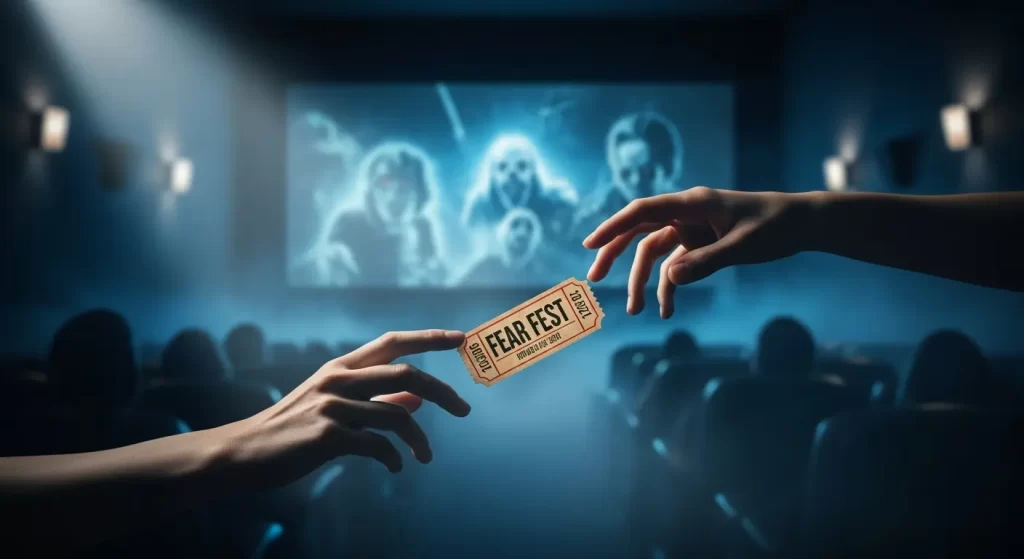
I watched a horror movie last night. Jumped at every sound. Gripped the armrest so hard my hand hurt.
Halfway through, I realized something: I was having fun.
This is the paradox of fear. We evolved to avoid danger. Yet we voluntarily seek it out. We pay for tickets. We dim the lights. We invite terror into our living rooms.
And somehow, that terrifies us while thrilling us.
Why Horror Makes Billions (And Why We’re Drawn to It)
The horror industry generates over $16 billion annually. Worldwide. People don’t just watch horror—they crave it.
This seems absurd. Our entire nervous system is designed to avoid fear. To flee danger. To survive.
Yet we’ve built an entire entertainment industry around deliberately triggering that survival mechanism.
The question isn’t: “Why do some people enjoy horror?” It’s: “Why is this such a universal human impulse?”
Something deeper is happening.
The Biological Contradiction (Fear We Can’t Escape)
Your amygdala—the fear center of your brain—doesn’t care that you’re sitting safely in a theater.
When a serial killer emerges from the shadows onscreen, your amygdala screams danger. Your heart rate spikes. Adrenaline floods your system. Your body activates the fight-or-flight response.
You’re genuinely afraid. Physiologically, chemically, neurologically afraid.
Your conscious mind knows it’s a movie. But your ancient survival system doesn’t distinguish between real danger and perceived danger. It just responds.
This is the first half of the paradox. We’re experiencing genuine terror while knowing we’re safe.
Excitation Transfer Theory (Why The Fear Feels Good)
Here’s where it gets fascinating: Excitation Transfer Theory explains the paradox.
When you’re scared, your nervous system activates. Cortisol and adrenaline are released by your body. Your level of arousal is elevated.
But then something happens. The threat passes. The killer is defeated. The protagonist survives.
Your prefrontal cortex—your logical brain—evaluates the situation and confirms safety. The danger was false. You’re alive.
But your nervous system hasn’t downshifted yet. You’re still in an elevated state of arousal. Still flooded with chemicals. Still on guard.
Then, an amazing thing happens: the lingering arousal turns into ecstasy. Relief floods in. You survived. Your body celebrates the survival.
That moment—the transition from fear to safety to euphoria—is what you’re actually paying for.
The Thrill Isn’t Fear (It’s the Escape From Fear)
Here’s the key insight: you don’t enjoy the fear itself.
You enjoy the relief. You enjoy the triumph. You enjoy surviving the experience.
Think about a jump scare. The moment something terrifies you is unpleasant. But the moment after—when you realize it was just a cat or just the wind—that’s satisfying.
You got scared. You survived. Your body rewards that survival with chemicals.
In a horror movie, this cycle repeats dozens of times. Each scare → relief → euphoria. By the end, you’ve experienced controlled, survivable danger repeatedly.
Your body rewards each survival. Each relief. Each moment of “I’m okay.”
This is why people describe horror as “thrilling” rather than “enjoyable.” The enjoyment isn’t in the fear. It’s in the repeated pattern of fear followed by confirmed safety.
Why Horror Satisfies Something Real
In modern life, we experience stress without resolution. Work stress. Social stress. Existential stress. These anxieties linger.
Horror offers something different: clear danger followed by clear resolution.
You’re scared. Then it ends. You survived. Your body gets the chemical reward.
In two hours, you’ve experienced multiple cycles of fear and survival. Your nervous system gets what it craves: the experience of danger overcome.
Real life doesn’t offer this catharsis often. Horror does.
What Horror Reveals
Horror isn’t an escape from fear. It’s a controlled experience of fear.
It’s your nervous system getting the satisfaction it evolved for: recognizing danger and surviving it.
The paradox isn’t that we enjoy fear. It’s that we enjoy surviving fear.
Reflect on Your Own Experience
When was the last time you felt genuinely scared by a horror movie?
Did you enjoy the fear itself? Or did you enjoy the moment you realized you were safe?
What does your attraction to horror say about what your nervous system needs?
Share your favorite horror film and why it terrifies you.