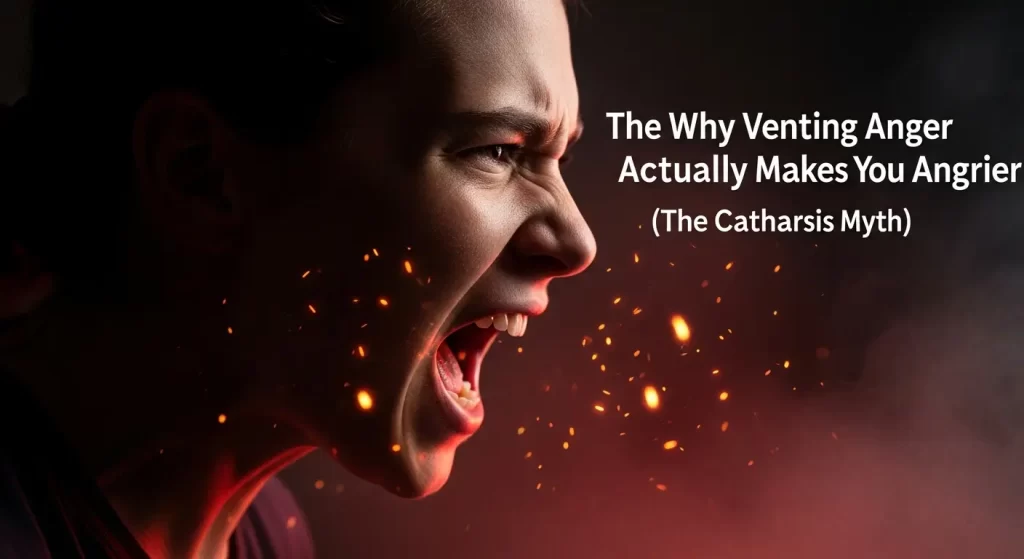
I watched my colleague Mike punch his desk yesterday. Hard.
“I needed to get that out,” he said, shaking his hand.
Twenty minutes later, he was angry again. Even angrier than before. Now furious at the pain in his hand.
This is what we’ve been taught: venting anger releases it. Like letting steam out of a pressure cooker. Punch something. Yell. Rant to a friend. Get it out of your system.
The science says you’re making it worse.
The Catharsis Myth (And Why We Believe It)
We’ve inherited a dangerous lie: anger is a buildup that needs release.
It feels true. When you’re angry and yell, you feel temporarily lighter. When you rant to a friend, they validate you. You feel understood.
So we conclude: venting works.
But what you’re actually experiencing isn’t catharsis. It’s distraction. The anger is still there. You’re just not focused on it for a moment.
Neuroscience research has consistently shown the same finding: venting anger doesn’t reduce it. It amplifies it.
The Social Media Rant Epidemic
Open any social platform. Count the angry rants in your feed.
People posting about terrible customers. Abusive bosses. Annoying family members. Each post is a venting session. Hundreds of comments piling on. Thousands of people validating the anger.
We’ve created a system designed to maximize venting. We’ve gamified it. Likes and shares reward anger. Comments escalate it.
And everyone feels better temporarily. Everyone believes they’ve processed their anger.
They haven’t. They’ve rehearsed it.
Cognitive Rehearsal (Why Venting Backfires)
Here’s the psychological mechanism nobody talks about: cognitive rehearsal.
When you vent, you’re not releasing anger. You’re rehearsing it. You’re taking the angry thought pattern and running it through your brain again. And again. And again.
Each time you tell the story, you’re strengthening the neural pathway. Making it easier to access next time. Making the anger more automatic.
Think of it like this: every time you replay that frustrating conversation, you’re not draining anger. You’re practicing anger. You’re training your brain to be better at being angry.
Neuroscientists call this “emotional priming.” The more you activate an angry neural pathway, the more readily it activates in the future.
You’re literally rewiring yourself to be angrier.
The Aftermath (Why Mike Got Angrier)
Mike punched his desk to “get the anger out.”
But here’s what actually happened:
- Anger activated
- Action (punch) reinforced the anger pathway
- Physical pain added new frustration
- He replayed the entire incident in his mind (cognitive rehearsal)
- Each replay strengthened the angry neural pathway
- Anger increased, not decreased
This is why people who yell and punch often become angrier. Each venting session is training. Each rant is practice. Each punch is reinforcement.
The anger doesn’t go anywhere. It gets stronger.
The Consequence (Anger Begets Anger)
Venting keeps anger activated in your brain longer than letting it pass.
When you rant, you’re extending the emotional experience. You’re making your brain spend more time in angry mode. You’re strengthening the connections between trigger and angry response.
This has downstream effects. You become quicker to anger.Things that used to irritate you only slightly suddenly make you angry. Your threshold for anger decreases.
Your brain has been conditioned to become more irate more frequently.
What Actually Works
Venting feels good temporarily. But it’s like scratching an itch—it makes the itch worse.
What actually reduces anger:
- Distraction (genuinely engaging in something else, not just scrolling)
- Physical exertion (exercise that requires focus, not destructive venting)
- Cognitive reframing (changing how you think about the situation)
- Time and space (allowing anger to naturally decay without rehearsal)
The counterintuitive truth: the best thing for anger is to not talk about it. To not rant. To not rehearse.
Just… stop.
Your Anger Management Moment
Have you noticed that after a good rant, you feel briefly lighter but then angrier?
Have you watched anger increase in people who yell and punch?
What if you stopped venting for one week? What if you sat with anger without rehearsing it?
Your brain might surprise you.
Anger naturally fades when you stop feeding it. It only grows when you vent.
Stop the venting. Watch the anger disappear.