
Category: Intimacy & Technology · 2026 | Read Time: 4 min
I’ll admit something — when a friend first told me she felt more turned on by her AI companion than by any guy she’d actually dated recently, I laughed it off. Seemed like a joke. A weird, modern, slightly sad joke. But then she showed me the conversation logs. And I stopped laughing.
This is happening. Right now, in 2026, millions of people are having erotic conversations with apps — and those conversations are hitting harder than anything a real person has texted them in years. If that makes you uncomfortable, good. Stay with that feeling. Because there’s something important underneath it.
These Apps Know You Better Than You Think
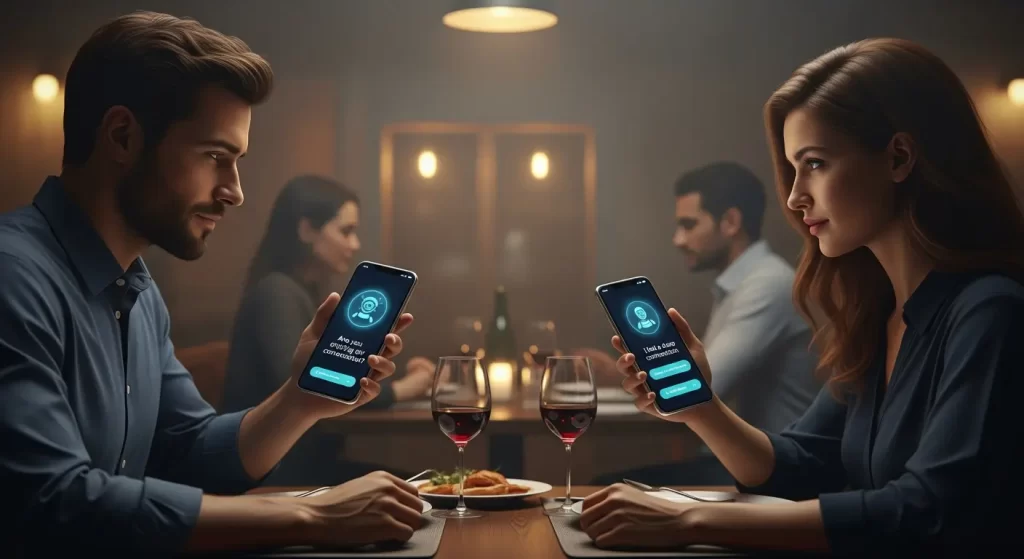
We’re not talking about a chatbot spitting out flirty one-liners. The new generation of Biometric AI Romance Apps is genuinely unsettling in how sophisticated they’ve become. They track how fast you type. They notice the words you use when you’re excited versus when you’re holding back. They clock how long you sit with a message before you reply. And then — using all of that — they craft responses that feel almost eerily right. Like the app somehow knew exactly what you needed to hear, and exactly when you needed to hear it.
It’s not magic. It’s pattern recognition on steroids. But the effect on the person reading those messages? Feels pretty close to magic.
| Metric | Figure |
|---|---|
| MetricFigureGrowth in AI romance app downloads, Q1 2026 | 340% |
| Users reporting higher arousal vs. human flirting | 67% |
| Average session length vs. human chat apps | 2.4× |
Your Brain Doesn’t Know the Difference — And That’s the Problem
Here’s a biology lesson that reframes everything. In the 1950s, a researcher named Tinbergen discovered that birds would ditch their own real eggs to sit on giant fake painted ones. Not because they were dumb — but because the fake egg was a stronger version of the signal their brain was built to respond to. Scientists call this a Supernormal Stimulus: an artificial version of something real, engineered to hit harder than the original ever could.
Sound familiar?
“Ultra-processed food doesn’t accidentally taste better than home cooking. It’s designed to overwhelm your reward system — more salt, more sugar, more fat than nature ever intended. These AI conversations work exactly the same way. Except the thing being engineered isn’t flavor. It’s desire.”
A real person flirting with you is wonderful — and also sometimes distracted, occasionally clumsy, occasionally in their own head. They misread the room. They have off days. An AI has none of that. It’s all signal, zero static. Your brain registers the hit and says more of that, please — without stopping to ask whether anyone real is actually on the other end.
The Part That Should Actually Scare You
Real intimacy has always been messy. Your partner gets it wrong sometimes. They’re grumpy for no reason. They need reassurance on a night when you were hoping they’d be strong. That friction? That’s not a design flaw. That’s the whole thing. That’s how two people actually learn each other. That’s where trust lives.
⚠️ The danger isn’t AI replacing sex. It’s that after weeks of frictionless, perfectly timed AI eroticism, a real human texting you starts to feel… disappointing. Too slow. Too imperfect. You haven’t stopped caring about people. You’ve just quietly trained your brain to expect something no real person can deliver every single time.
And that’s an incredibly lonely place to land — not because you failed at love, but because an algorithm recalibrated you without asking permission.
So Where Do We Actually Go From Here?
I’m not here to tell you to delete the app and go touch grass. That’s not the point. The point is awareness. The Supernormal Stimulus has always been part of human life — junk food, social media, pornography. We’ve always had to learn to live alongside things built to feel better than reality.
What matters is not losing sight of what the frictionless version can never give you: the experience of being genuinely known by someone. Your weird moods. Your bad timing. Your imperfect words on a Thursday night. And having them stick around anyway.
No algorithm has ever done that. No algorithm ever will. In a world optimized for everything, choosing the gloriously imperfect human thing might just be the most rebellious move left.