Category: Entertainment & Psychology · 2026 | Read Time: 4 min
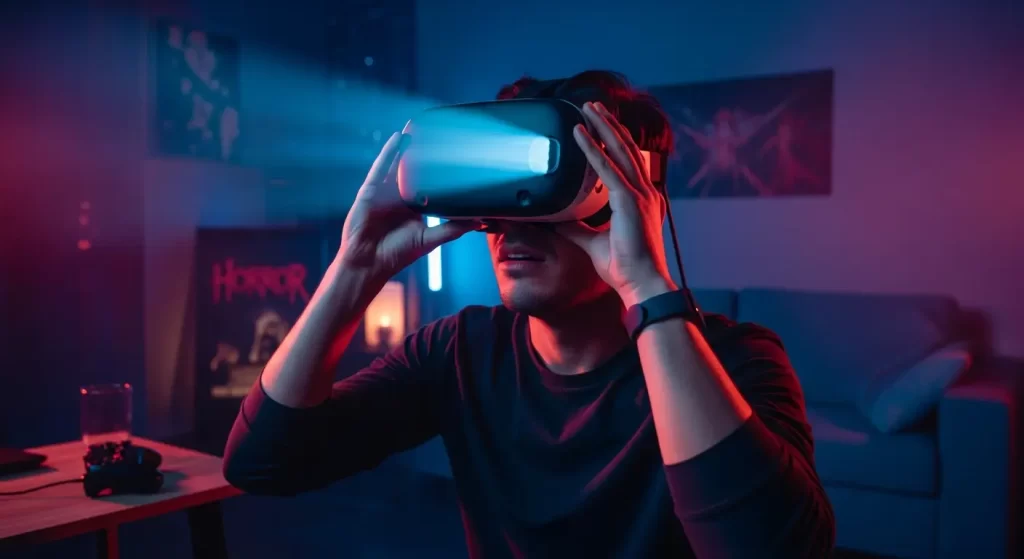
Last Friday, my friend Priya finished a brutal 10-hour workday, poured herself a glass of wine, and spent the next two hours playing a survival horror game where she had to outrun a collapsing AI system in a burning building. When I asked her why — genuinely baffled — she shrugged and said, “It’s the only time my brain actually shuts up.”
That sentence has been living in my head ever since.
Because she’s not alone. In 2026, some of the most popular entertainment experiences are specifically designed to stress you out. Jitters — the tech-horror release that everyone’s talking about right now — uses your own biometric data to make the experience more terrifying the more anxious you get. Hyper-realistic survival games that offer zero hand-holding and very real moments of panic are dominating the charts. And the people flocking to these experiences aren’t adrenaline junkies. They’re regular, exhausted, already-anxious people who’ve had a long week.
Which makes absolutely no sense. Until it does.
The Stress You’re Carrying Doesn’t Feel Like Stress
Here’s the thing about modern anxiety that nobody really talks about — it doesn’t feel urgent. It doesn’t feel like danger. It feels like fog. A full inbox that never quite empties. A performance review circling the back of your mind for two weeks. That formless, low-grade dread that follows you from your laptop to your phone to your bed at night.
Your nervous system is under constant pressure. But it never gets a moment of sharp, clear, this is the threat, deal with it now focus. Just endless, diffuse noise.
And here’s what that does over time — it numbs you. Psychologists call it anhedonia: when the nervous system, exhausted from sustained low-level stress, slowly turns down its sensitivity to pleasure and feeling. The things that used to excite you start feeling flat. Life becomes a little muted. You’re stressed, but you can’t feel much.
That’s the trap. And stress-simulation entertainment is, weirdly, the way out of it.
Why Terror Wakes You Up When Nothing Else Can
When you’re 20 minutes into a survival horror game and something comes at you from the dark with zero warning, your brain does something it probably hasn’t done all week: it completely clears.
Every thought about Monday’s meeting, the awkward email you need to send, the bill you’ve been ignoring — evicted. Gone. Because your nervous system has just decided that surviving the next thirty seconds is the only thing on the agenda.
That’s called the Flow State — total, present-moment focus where the brain is fully absorbed in an immediate challenge. It’s what athletes describe as being “in the zone.” And for a generation whose baseline is chronic, foggy anxiety, the only stimulus strong enough to trigger it is something genuinely, acutely alarming.
“The brain doesn’t care whether the threat is real. It just needs the signal to be loud enough to cut through the noise.”
Simulated terror delivers that. And on the other side of it — when you finally put the controller down, heart rate slowing — you feel something you haven’t felt all week: resolution. The threat came. You dealt with it. It’s done. Your nervous system gets to complete a cycle that modern stress almost never allows.
This Isn’t Running Away. It’s Resetting.
I think we’ve had the wrong idea about what escapism actually is. We assume it means running away from reality into something easier. But stress-simulation entertainment isn’t easier. It’s just different — and that difference is the whole point.
You can’t hold the dread of Monday’s meeting and the immediate need to survive a virtual disaster at the same time. The acute wins. The quiet dread gets crowded out. And when real life slides back into focus, it somehow feels lighter — not because anything changed, but because your brain finally got the reset it had been begging for.
Priya wasn’t being reckless on that Friday night. She was doing maintenance. In a world that generates endless, unresolvable, low-level pressure, sometimes the only answer is something loud enough to drown it out — just long enough to breathe again.