Category: Horror Culture & Trends · 2026 | Read Time: 4 min
I was reading Cold Storage on a Sunday afternoon — bright day, windows open, cup of tea — and I had to put it down and just sit for a minute. Not because something jumped out at me. Because nothing did. Because the horror in that book doesn’t have a face or a motive or a name. It just spreads. Quietly. Patiently. Like it has all the time in the world.
Which, to be fair, it does.
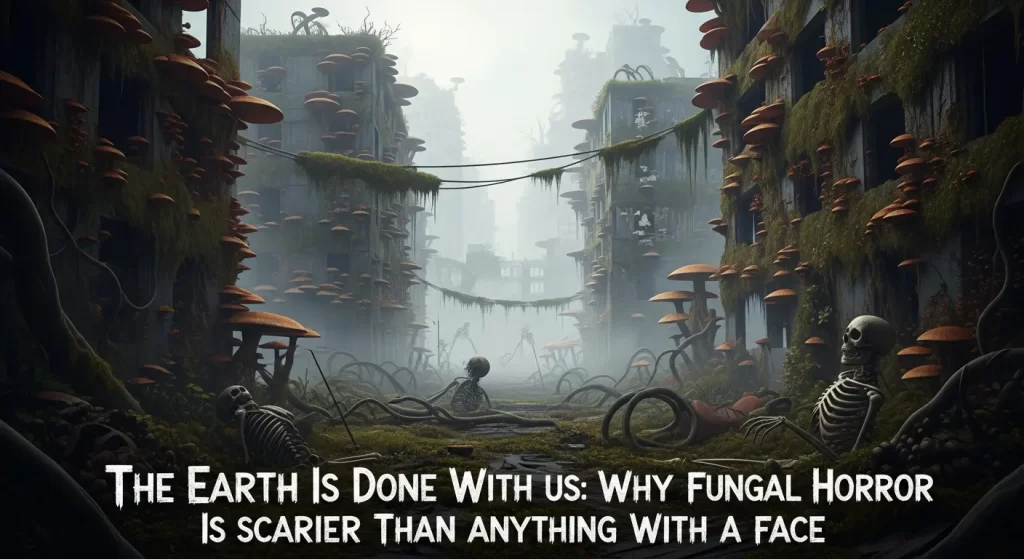
Eco-horror is having a serious moment in 2026, and fungal horror is leading the charge. Cold Storage has been passed around horror reading circles like a warning. The Midnight Muse is one of the most anticipated film releases of the year. And across indie fiction, sentient mold, parasitic fungi, and hostile landscapes have become the genre’s most-discussed obsession. Something in the cultural water has shifted — and I think I know what it is.
Ghosts Haunt You. Fungi Don’t Notice You.
Traditional horror is personal. A ghost has unfinished business with someone. A killer chooses victims. Even the scariest monsters tend to hunt — which means, somewhere in the logic of the story, you matter to the thing coming for you.
Fungal horror removes that entirely. The mold in Cold Storage doesn’t want revenge. It doesn’t hate anyone. It expands the way fungi always have — following the logic of its own biology — and the humans in its path aren’t enemies. They’re just matter. Temporarily organized matter that happens to be in the way.
That’s a different kind of fear. Being hunted means you’re significant. Being consumed by something that doesn’t register your existence is something colder, something that takes a minute to fully land.
And when it lands, it doesn’t let go.
We Made This Bed
Here’s the part that makes eco-horror specifically uncomfortable in 2026: it feels like consequence.
We’re living through a real, ongoing, daily reckoning with what human activity has done to the planet. Wildfires. Flooding. Species collapse. The news delivers fresh evidence constantly, and most of us carry a low-level awareness of it that we can’t fully process and can’t fully ignore. Psychologists call it species-level guilt — that diffuse, unresolvable shame of knowing your species broke something enormous while feeling personally too small to fix it.
Eco-horror gives that guilt somewhere to go. When the forest turns hostile, when the fungi reclaim what was taken, there’s a dark logic to it that part of you quietly recognizes as earned. That’s not the same as enjoying it. It’s more uncomfortable than that. It’s the horror of consequence — and consequence lands in a way that random monsters never quite do.
The Fear Underneath the Fear
But the deepest thing fungal horror is doing — what The Midnight Muse is reportedly doing in ways that have early viewers genuinely unsettled — is attacking something more personal than guilt.
Fungi don’t operate as individuals. The mushroom you see is just the surface. The real organism is underground, distributed, networked, ancient. There’s no center. No self. Just the network, expanding.
For a generation that has built its entire identity around individuality — my body, my choices, my carefully maintained sense of self — the idea of a parasitic infection that doesn’t kill you but absorbs you is uniquely devastating. The hive mind horror of these stories isn’t about death. It’s about dissolution. The terror of waking up one morning and finding that the I you’ve always been is slowly becoming we.
“A ghost threatens your life. A fungal network threatens your selfhood. For a culture obsessed with individuality, the second fear goes deeper.”
That’s the horror that 2026 has quietly earned. Not something with teeth. Something with roots. Something that was here long before us, will be here long after, and is only now — in our fiction, in our nightmares — beginning to notice we’ve been careless guests.
Check the walls.
Not for cracks. For spores.