Category: Gaming & Psychology · 2026 | Read Time: 4 min
I want to describe a specific moment that happened to me about three weeks ago.
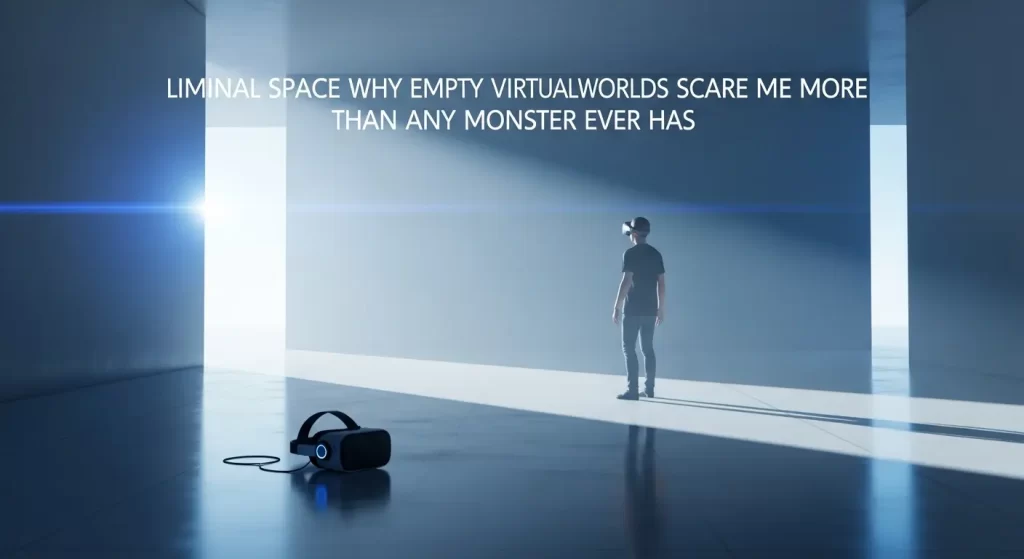
I was playing a liminal space VR game — the kind with no enemies, no objectives, no music. Just an empty shopping mall at what felt like 2am. Fluorescent lights humming. Escalators running for nobody. A food court with all the chairs still tucked in. And I was standing at the top of a staircase, completely frozen, absolutely convinced that I should not go down there.
Nothing was down there. I knew that. The game had no monsters. I knew that too.
I stood there for almost four minutes before I took the headset off.
The Scariest Games Right Now Have Nothing In Them
Traditional horror gives your brain something to work with. Monster appears. Adrenaline spikes. You run, or fight, or hide. The fear is real but it’s also bounded — there’s a thing, and you’re responding to the thing.
Liminal Space VR takes all of that away.
No creatures. No jump scares. No horror-movie soundtrack swelling to warn you something’s coming. Just… a place. A recognizable, ordinary place — a school hallway, a hospital corridor, an office after hours — that looks exactly right and feels completely, profoundly wrong.
And your brain absolutely cannot make peace with that.
Why Your Brain Refuses to Relax
Here’s what’s actually happening when you walk through an empty virtual mall and feel your skin crawl.
Your brain isn’t just seeing spaces — it’s constantly predicting what should be in them. A shopping mall means crowds and noise and movement. A school corridor means lockers slamming and footsteps. An airport terminal means announcements and rolling luggage. These expectations are so deeply embedded that you don’t even notice them — until they’re violated.
When the environment looks right but sounds and feels wrong, something in your brain hits pause. That pause is discomfort. And discomfort, when it has nowhere to go, slowly becomes dread.
Then a second thing kicks in: hyper-vigilance. It’s the brain’s threat-detection system, and it evolved for very good reasons — in a real forest, sudden silence usually meant a predator had just made every other creature go quiet. Your nervous system learned, over millions of years, to treat unusual stillness as a warning.
Liminal VR is built almost entirely out of unusual stillness.
So your brain starts scanning. Every corner. Every shadow. Every flicker in the peripheral vision. It’s looking for the thing that must be causing the wrongness. And here’s the part that makes this genre so genuinely effective: the thing never comes. The brain never gets closure. The threat-detection system stays active, humming at full intensity, with nothing to resolve it.
You’re not scared of what’s there. You’re scared of what your brain is absolutely certain must be there, just out of sight.
VR Makes It So Much Worse
In a flat-screen game, there’s still a frame. You’re watching a character walk down a hallway. In VR, you are walking down the hallway. Your peripheral vision is doing real work. The sound is coming from actual directions around your head. Your body forgets the distinction between real presence and simulated presence — and your nervous system responds accordingly.
That mall staircase I couldn’t make myself descend? On a screen, I probably would have just walked down. In VR, my legs were genuinely reluctant. That’s not a graphics achievement. That’s the brain being outsmarted by emptiness.
The Scariest Monster Is the One You Invent
What liminal VR horror understands — and traditional horror often doesn’t — is that the imagination is a more reliable terror engine than any creature a developer could design.
Give someone a monster and they’ll be scared for thirty seconds. Give someone an empty room that feels wrong and they’ll be scared for the rest of the night. They’ll be scared in their own hallway when they get up for water at 3am. They’ll glance at their own office corridor and wonder, just briefly, why it looks so quiet.
The space doesn’t attack you. The game doesn’t threaten you.
Your brain does the rest. And your brain, it turns out, is extraordinarily good at this.