Category: Home & Living · Energy | Read Time: 4 min
My mother-in-law noticed it first. She’s the one who actually tracks when we order cylinders, how long they last, and what they cost. And last month she mentioned — casually, over tea, in the way she mentions things that are actually bothering her — that the cylinder was lasting noticeably fewer days than it used to, and the price had gone up again.
She wasn’t wrong. LPG prices have been climbing across much of Asia through 2026, and if you’ve been refilling cylinders recently you’ve felt it without necessarily knowing why.
Here’s the short version of why, and more usefully, what actually helped us at home.
Why Your Gas Bill Is Suddenly Higher
The reason sounds abstract until you trace it: disruptions near Kharg Island in the Persian Gulf — a major hub for oil and gas exports — have been sending ripple effects through global energy supply chains. When shipments from key terminals slow down or reroute, traders react, supply becomes uncertain, and prices adjust upward almost immediately.
India imports a significant portion of its LPG, which means what happens in distant shipping lanes shows up on your kitchen bill within weeks. The good news is that the government and the Indian Navy have been working to keep supply routes secure — vessels like INS Shivalik are actively protecting energy shipping corridors — so a full shortage is unlikely. But prices staying elevated for a while? That’s probably realistic.
Which means the practical question is: what can you actually do at home?
6 Things We Changed That Made a Real Difference
These aren’t dramatic lifestyle overhauls. They’re small habit adjustments that, collectively, have meaningfully stretched how long our cylinder lasts.
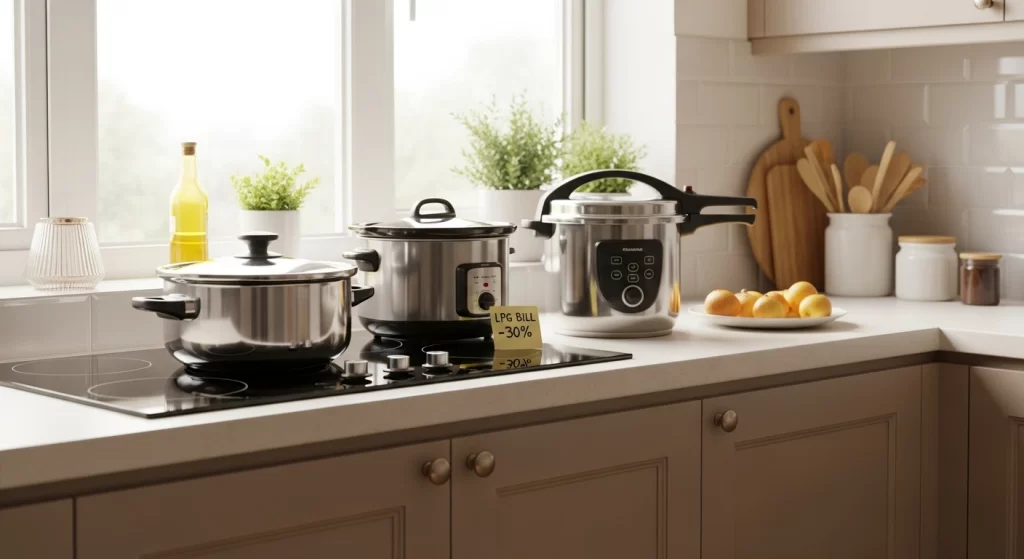
1. Pressure cooker for almost everything. This one made the biggest single difference. Lentils, rice, potatoes, chickpeas — anything that used to simmer for 30–40 minutes now takes 8–12 minutes. The pressure cooker traps heat and steam so efficiently that it uses a fraction of the gas. If yours is sitting unused in a cabinet, take it out.
2. Soak before you cook. Soaking lentils, beans, or whole grains for 20–30 minutes before cooking softens them enough to cut cooking time significantly. It sounds minor until you do it every day and realize how much gas those extra minutes were consuming.
3. Lids on, always. Cooking without a lid lets heat escape constantly, which means the burner works harder and longer to cook the same food. A properly fitting lid keeps heat inside the pot where it actually does something. It’s an obvious thing that’s surprisingly easy to forget.
4. Clean the burner. If your flame is looking more yellow-orange than blue, the burner isn’t burning efficiently. A quick clean — removing food debris from the ports — restores proper airflow and noticeably improves how cleanly the gas burns. We do this about once a week now.
5. Stop using the gas stove for reheating. Reheating leftovers on an open burner uses a disproportionate amount of gas for what it actually achieves. A microwave or induction cooktop handles reheating faster and far more efficiently. Save the gas stove for actual cooking.
6. Batch cook when you can. Cooking a larger quantity once — dal, rice, a curry base — and reheating portions through the week uses significantly less total gas than cooking fresh every single time. It also, as a side benefit, makes weeknight dinners much less stressful.
The Bigger Picture, Briefly
None of this makes the global energy situation less complicated. Prices in interconnected markets respond to things none of us individually control, and that’s genuinely frustrating when it lands in something as basic as cooking for your family.
But the kitchen is one of the few places where small, consistent changes actually compound into something meaningful. The cylinder my mother-in-law was tracking? It’s lasting about a week longer now.
For a bill that’s already gone up, that matters.