
There’s something almost surreal about the IPL in 2026. On one level you have state governments announcing hundred-thousand seat stadiums and billion-dollar franchise valuations. On another level you have a captain at Eden Gardens quietly worrying about whether he has enough bowling options for the last four overs of a chase.
Both of these things are happening at the same time. Both of them matter. And understanding how they connect tells you something interesting about what cricket in India has actually become.
The Stadium Announcement That Made Everyone Do a Double Take
Maharashtra’s proposal for a 1 lakh capacity cricket stadium in Mumbai is the kind of announcement that takes a moment to fully process.
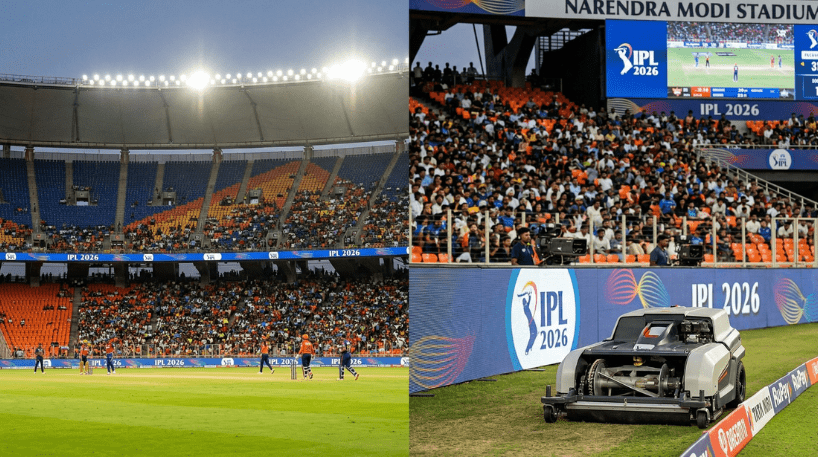
Wankhede holds around 33,000. DY Patil, which already feels enormous when it’s full, holds about 55,000. The proposed stadium would seat 100,000 — nearly triple Wankhede’s capacity and almost double DY Patil’s. For context, that would make it one of the largest cricket stadiums on earth, comparable to the Narendra Modi Stadium in Ahmedabad which currently holds that distinction.
The instinct to ask whether India actually needs this is reasonable. Mumbai already has multiple quality cricket venues. The IPL’s television and streaming numbers dwarf its in-stadium attendance in terms of actual viewership. Does a 1 lakh seat stadium solve a problem that exists?
The honest answer is that it’s not really about solving a capacity problem. It’s about positioning — Mumbai positioning itself as a global sports destination capable of hosting events at a scale that current venues simply can’t accommodate. International tournaments, multi-sport events, concerts, the kind of spectacle that generates tourism and broadcast revenue and the particular prestige that comes with having infrastructure that almost no other city in the world has.
The economic logic is real even if the cricket logic is somewhat secondary. A stadium of this scale is an infrastructure investment in the broadest sense — in Mumbai’s identity as a world city, in Maharashtra’s ambition for the state’s sporting footprint, and in the broader narrative of Indian sports infrastructure keeping pace with the league’s global commercial growth.
Whether it gets built on the announced timeline, and whether it delivers the projected benefits, are separate questions. Indian infrastructure announcements have a complicated relationship with timelines. But the ambition behind this one is coherent and the direction is right.
Eden Gardens, Slow Pitches, and the Return of Ajinkya Rahane
While stadium planners are thinking in decades, KKR’s team management is thinking in overs. And the KKR versus SRH fixture at Eden Gardens is shaping up to be one of the more tactically interesting matches of the IPL 2026 season so far.
Ajinkya Rahane’s return to the KKR lineup is the most talked-about selection development ahead of this fixture. Rahane is a different kind of cricketer from most of the names that generate excitement in the IPL — no highlight-reel sixes, no aggressive music behind his batting compilations on social media. What he brings is something quieter and often more valuable: the ability to read a situation and bat accordingly, to hold an innings together when wickets are falling around him, and to make sensible decisions under pressure without needing the adrenaline of a crisis to function well.
At Eden Gardens specifically, this matters. The pitch there tends to be slow and receptive to spin — not the flat, high-scoring surface that suits pure power hitters. On a turning track, a batter who plays spin intelligently and doesn’t try to hit through the line every ball becomes much more valuable than on a surface where any reasonable contact produces runs. Rahane is exactly that kind of batter.
For KKR at home, the combination of local crowd advantage, a familiar pitch, and a returning experienced middle-order presence makes this a fixture where they should feel confident. The question is whether their overall squad construction supports that confidence or creates vulnerabilities that SRH can exploit.
The Impact Player Rule and the Problem Nobody Is Admitting
The Impact Player rule has been genuinely divisive among cricket purists and broadly embraced by franchise owners and broadcasters — which probably tells you everything you need to know about whose interests it serves most directly.
The mechanics are straightforward: teams can substitute a player during the match, typically to bring in a specialist who wasn’t part of the original eleven. In practice this has meant that most teams have used the rule to strengthen their batting lineup — bringing in an extra batter at the expense of a bowling option, particularly in situations where they need quick runs or when chasing.
The cumulative effect of this across both KKR and SRH’s squad strategies this season is what you might call a bowling vacuum — a situation where the aggressive prioritisation of batting depth has left both teams slightly thin in their bowling resources, particularly in the death overs and in high-pressure defensive situations.
This kind of imbalance doesn’t always show up clearly in individual match scorecards. KKR or SRH might win a game convincingly with bat and you’d look at the result and think the squad balance seems fine. But across a sixteen-match tournament where conditions vary, where you encounter pitches that don’t suit big hitting, where you sometimes need to defend a modest total and simply can’t — the accumulated cost of a slightly thin bowling attack becomes visible in losses that shouldn’t have happened and totals that were defended when the arithmetic said they shouldn’t have been.
The timing of the Impact Player substitution is also an underappreciated skill gap. When exactly do you bring in the extra batter? If you do it too early you might be committing to a batting-heavy approach on a day when the pitch demands bowling. Too late and the advantage of the rule is diminished. Captains who get this decision consistently right will have a measurable edge over the course of the tournament. Captains who default to the same approach regardless of conditions will be exposed on the wrong kind of day.
What These Two Stories Have in Common
A 1 lakh seat stadium and a bowling vacuum in a Twenty20 cricket team seem like they’re operating in completely different universes. One is about infrastructure at a generational scale. The other is about whether a captain has enough bowling options in the seventeenth over.
But they’re connected by the same underlying dynamic: the IPL has grown so commercially successful, so deeply integrated into both national culture and global entertainment economics, that decisions at every level — from stadium design to squad selection — now carry weight and attention that cricket never attracted before in India.
The stadium announcement gets made because the IPL’s global profile has reached a point where a world-class venue is a credible infrastructure investment rather than a vanity project. The bowling vacuum exists because the franchise model creates incentives to maximise entertainment value — big hitting, high scores, dramatic chases — that don’t always align perfectly with the tactical requirements of winning cricket.
Both are responses to the same phenomenon: cricket becoming something much larger than cricket.
The Match Itself — What to Actually Watch For
When KKR and SRH face off at Eden Gardens, the technical questions worth watching are fairly specific.
How does each team deploy the Impact Player rule given the pitch conditions? If the pitch is turning, a team that brings in an extra spinner rather than an extra batter is making a smarter contextual call than one that defaults to batting reinforcement regardless of conditions.
How does Rahane manage the middle overs for KKR on a surface that should suit his style? If he’s playing a genuinely pivotal role in anchoring the innings, that’s the kind of contribution that shows up in the match result rather than the highlight package.
And how do both teams manage their death overs bowling? The bowling vacuum, if it exists to the degree that close observation suggests, will be most visible precisely when pressure is highest — in the final four overs defending a total, or in the eighteenth and nineteenth overs of a chase that’s still alive.
Those are the moments where squad construction philosophy stops being an abstract discussion and starts being a live match result.
Eden Gardens will be loud, the cricket will be fast, and the evening will be entertaining regardless of how the tactical questions resolve themselves. But if you want to watch with more than just spectacle in mind, those are the threads worth following.
The Bigger Picture
IPL 2026 is doing what the IPL has always done well — operating simultaneously as entertainment, sport, business, and infrastructure story, with each layer influencing the others in ways that aren’t always obvious from any single vantage point.
The 1 lakh stadium will take years to build if it gets built at all. The bowling vacuum will either be addressed mid-season or it will cost KKR and SRH in the knockout stages. The Impact Player rule will continue being debated until the BCCI decides it’s done more harm than good or until every team has figured out how to use it optimally.
None of these stories are finished. That’s what makes following the IPL right now — both the cricket and everything surrounding it — genuinely interesting rather than just exciting.