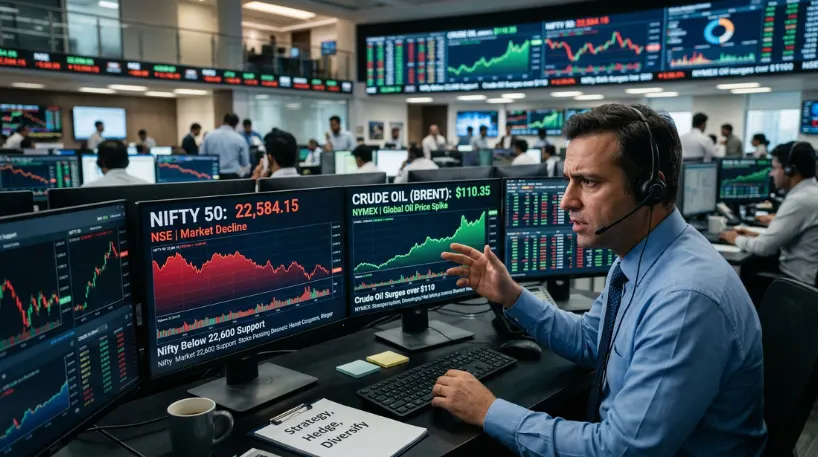
If you checked your portfolio this morning and felt that familiar sinking sensation, you’re not imagining it. Markets opened weak, stayed weak, and the Nifty slipping below 22,600 is the kind of move that gets people asking questions — some useful, some driven by panic, most somewhere in between.
The good news is that this correction has a clear explanation. It’s not random noise. It’s not a sign that something has fundamentally broken in the Indian economy. It’s two specific things hitting at the same time, and understanding what they are makes the whole picture considerably less alarming than red screens suggest.
The Two Things That Caused This — Both at Once
Markets rarely fall sharply for a single reason. Usually it’s a combination of pressures arriving simultaneously that tips sentiment from cautious to genuinely risk-off. That’s exactly what happened here.
The first pressure is Brent crude oil touching $110 per barrel — up about 0.75% from recent levels, driven by renewed geopolitical tension in West Asia and the market’s anxiety about what that tension might mean for supply.
For most countries, a 0.75% move in oil prices is a footnote. For India, it’s something that warrants attention. We import roughly 85% of our crude oil needs, which means that every dollar added to the barrel price shows up somewhere in the Indian economy — higher input costs for manufacturers, more expensive transport, upward pressure on inflation, and a larger import bill that strains the current account and puts downward pressure on the rupee. None of these effects are immediate or dramatic on any single day, but they accumulate — and at $110 per barrel, they accumulate faster than most corporate earnings models were built around.
The second pressure is FII selling on a scale that’s hard to ignore. Foreign Institutional Investors offloaded ₹9,931 crore worth of Indian equities in a single session. That’s not a minor rebalancing. That’s an active, deliberate reduction of emerging market exposure happening in real time, and when that much selling hits the market simultaneously, prices go down — not because Indian companies suddenly got worse at their businesses, but because there’s simply more supply than demand at current prices until the selling pressure exhausts itself.
Together, these two forces — expensive oil and foreign capital exiting — created the kind of session where most things go down and the question isn’t whether you’re losing money on paper, it’s how much and in which parts of your portfolio.
What Held Up — and Why It Matters
Here’s the part that gets lost when you’re looking at an index number that’s dropped through a key support level: the index is an average, and averages hide a lot of variation underneath them.
Pharma and FMCG held up relatively well today. This isn’t surprising and it’s not a coincidence. These are what market professionals call defensive sectors — businesses whose revenue doesn’t collapse when global uncertainty rises because people still buy medicines and household goods regardless of what’s happening in West Asia or what FIIs are doing with their portfolios. When the broader market sells off, investors who want to stay invested but reduce their risk typically rotate money into these sectors. That rotation shows up as relative outperformance even when the absolute price might dip slightly.
The stocks that dragged the index lower are the ones most directly exposed to the specific pressures of today. Reliance Industries carries significant refining and energy exposure — rising crude prices create a mixed picture for a company that’s both a buyer and processor of oil, but market sentiment in a risk-off session tends to lump it in with the negatives rather than the positives. ICICI Bank, along with the broader banking sector, came under pressure partly because rising oil prices and rupee weakness create macro conditions that banks have to navigate carefully — higher inflation limits RBI’s ability to cut rates, which affects the credit environment.
Neither Reliance nor ICICI has become a worse business today than it was yesterday. But they’re bearing the weight of the day’s dominant narrative in their share prices.
The Genuinely Interesting Bit: What Went Up
Amid the red, two names stood out in a way worth paying attention to.
Bharat Electronics Limited and Tech Mahindra both managed to hold their ground or move modestly positive during a session when the broader market was falling.
BEL’s relative strength in a session driven by geopolitical tension is logical once you think about it. Rising tensions in West Asia don’t just push oil prices higher — they also increase the probability of higher defence spending by governments trying to manage security concerns. India’s defence procurement pipeline has been growing steadily, and BEL as a domestic defence electronics manufacturer sits directly in the path of that spending. When geopolitical risk rises, defence stocks often get a quiet bid from investors who see the same logic.
Tech Mahindra’s resilience is a slightly different story. IT companies, particularly ones that are seen as value-oriented relative to their growth potential, tend to have a degree of insulation from domestic macro pressures because their revenue comes in dollars and their costs are largely in rupees. When the rupee weakens — which it does when oil rises and FIIs sell — the rupee value of their dollar revenues increases mechanically, which is good for earnings. It doesn’t protect them from everything, but it gives them a buffer that domestically-focused businesses don’t have.
For investors who follow contrarian strategies — buying when sentiment is negative and selling when it’s positive — sessions like today create specific entry considerations in sectors that are going up for fundamental reasons even while everything else is going down.
The Rupee Angle Nobody Is Talking About Enough
There’s a currency dimension to today’s session that deserves more attention than it typically gets in market commentary.
Crude oil at $110 means India needs more dollars to pay its import bill. FII outflows of nearly ₹10,000 crore means capital is being converted from rupees to dollars and leaving the country. Both of these create demand for dollars that puts downward pressure on the rupee.
A weaker rupee creates a secondary round of effects. Imported inflation goes up. Companies with dollar-denominated debt face higher repayment costs in rupee terms. Consumer goods that have imported components become more expensive. The RBI has to decide whether to intervene in currency markets — selling forex reserves to support the rupee — or allow more movement, each with its own trade-offs.
This currency pressure isn’t a crisis today. But it’s a variable that will influence how the RBI responds to inflation data over the coming weeks, which affects interest rate expectations, which affects bank valuations and the housing market and consumer credit. Markets are pricing some of this chain reaction in advance, which is part of why banking stocks specifically are having a difficult session.
What Should You Actually Do
The most honest answer depends entirely on your situation, but there are a few principles that apply broadly.
If you’re running SIPs, keep them running. A session where the Nifty drops through 22,600 is exactly the session your SIP was designed to take advantage of — you’re buying units at lower prices than last month, which improves your long-term return profile. The entire logic of rupee cost averaging depends on not stopping your SIPs when markets fall, which is precisely when the emotional pressure to stop is highest.
If you’re an active investor looking at your portfolio today, distinguish between positions that are down because of the specific pressures of this session and positions that are down because the underlying business has a problem. Reliance and ICICI down on a day when oil spikes and FIIs sell is a very different situation from a company down because its quarterly results missed badly and management cut guidance. The first category deserves patience. The second deserves a harder look.
If you’ve been sitting on cash and thinking about when to deploy it, corrections like this create opportunities in sectors that are genuinely attractive at lower prices. Pharma, quality FMCG, defence, and export-oriented IT are all worth looking at with fresh eyes after a session like today — not to catch the bottom, which nobody reliably does, but to build positions in businesses you understand at prices that are better than they were last week.
If you’re feeling anxious and the urge to sell everything and wait for clarity is rising, the useful question to ask yourself is: what would make you comfortable buying back in? Because the clarity you’re waiting for almost never arrives at the moment prices are lowest. By the time the uncertainty has resolved and confidence has returned, the best prices are already gone.
The Perspective That Actually Helps
Markets below 22,600 feel uncomfortable. ₹9,931 crore of FII selling in a single day feels alarming. Brent at $110 feels like a lot.
All of these things are true. None of them are the end of the story.
The Indian economy’s domestic consumption story hasn’t changed today. The corporate earnings trajectory for quality businesses in structurally growing sectors hasn’t changed today. The long-term case for equities as a wealth-building asset class over a decade or more hasn’t changed today.
What has changed is sentiment — and sentiment, by definition, overshoots in both directions. It went too positive at some point during the recent rally. It’s going too negative right now in response to real but manageable pressures.
The investors who consistently build wealth through market cycles aren’t the ones with the best timing. They’re the ones who understand what they own, why they own it, and why a bad day in global markets isn’t the same thing as a bad outcome for their long-term financial journey.
Today was a bad day. It wasn’t a bad outcome. There’s an important difference — and holding onto that distinction is worth considerably more than any single trading decision you could make right now.