Category: Entertainment & Culture · 2026 | Read Time: 4 min
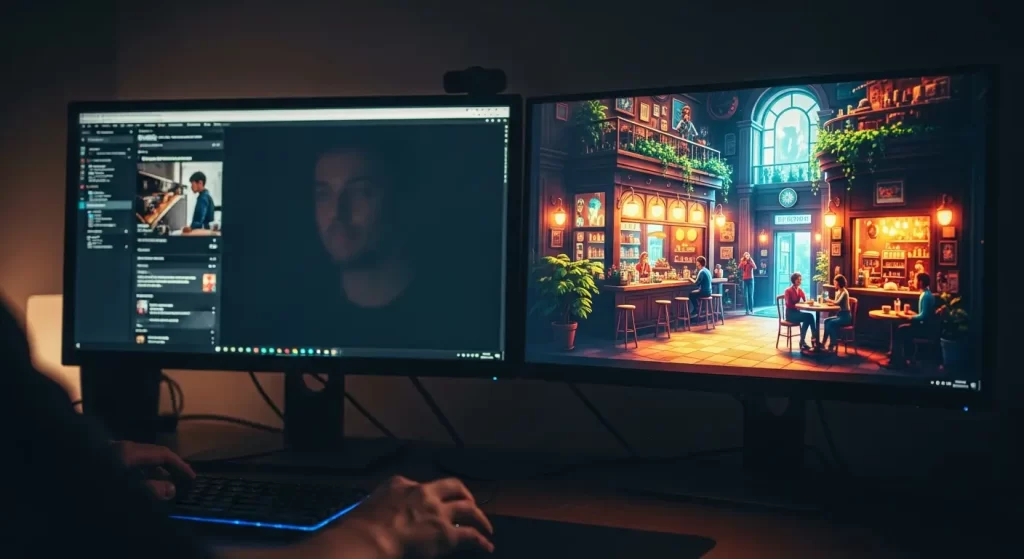
It started as a joke. I was working from home on a particularly grey Tuesday, feeling that specific kind of lonely that doesn’t quite justify calling anyone, and I pulled up an AI-generated coffee shop stream just to have something in the background. Soft ambient sounds, a looping animation of rain on a window, a digital barista doing whatever digital baristas do.
That was three weeks ago. It’s still open on my second monitor right now.
I’m not alone in this, apparently. In 2026, Infinite AI Streams — 24/7 AI-generated ambient environments with no plot, no conflict, no ending — have quietly become one of the most-watched categories of content online. Endless café loops, lo-fi animated neighborhoods, calm rain scenes, virtual libraries where nothing ever happens. Millions of people are keeping these streams open for hours every day.
And nobody can quite explain why. But I have a theory.
We’re Exhausted by Stories That Need Things From Us
Think about what watching a good TV show actually requires. You have to track characters, remember what happened last episode, register emotional shifts, brace for tension, and process whatever devastating thing the writers just did in the final ten minutes. Even when you’re enjoying it, you’re working.
That used to feel like a good trade. You invested attention and got a payoff — suspense, catharsis, the satisfaction of a storyline resolving.
But somewhere in the last few years, that trade started feeling expensive. Because we’re already spending our entire days doing exactly that kind of mental tracking — following threads, managing emotional nuance, processing information, anticipating what comes next. Work does it. Social media does it constantly. The news does it in the worst possible way.
By the time evening arrives, the idea of watching something that demands more of the same feels less like entertainment and less like rest.
Psychologists call this narrative fatigue — the point where a brain that’s already carrying a heavy cognitive load stops wanting content that adds to it.
What the Fake Café Is Actually Doing
Here’s what I’ve noticed about having that stream open: I don’t watch it, exactly. I’m aware of it. The soft hum of it sits at the edge of my attention and does something that’s surprisingly hard to achieve any other way — it makes the room feel less empty without asking me to pay attention to it.
There’s no plot to miss if I look away. No character development happening while I’m making tea. Nothing to catch up on. The virtual rain outside the virtual window is doing the same thing when I check it at 2pm as it was at 10am.
That predictability isn’t boring. It’s the whole point. Experts describe it as cognitive stasis — a mental state where the brain can idle without having to process new information. It’s the digital equivalent of sitting in a real café where you’re not there to do anything specific. Just to exist somewhere that has some ambient life to it.
The Story That Never Starts
For centuries, storytelling meant conflict. A character wants something, something gets in the way, something is resolved. The Hero’s Journey. Rising action, climax, denouement. Even a relaxing film has a shape to it — a beginning, a middle, an end.
Infinite AI Streams have none of that. They’re not telling a story. They’re maintaining an atmosphere. And for a lot of people right now, that turns out to be exactly what they needed from their screens — not a narrative to follow, but a space to occupy.
I finished a whole project yesterday with that café playing quietly in the corner. No drama. No plot twist. No finale.
Just rain on a window that never really stops.
Honestly? Ideal.