
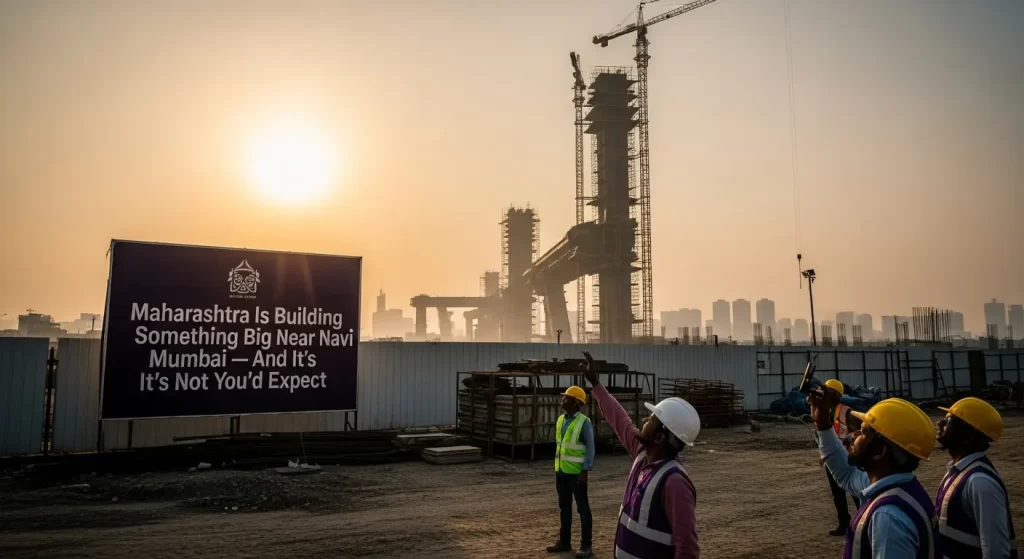
When most people think about major infrastructure announcements in Maharashtra, they picture highways, ports, or metro lines. So when Devendra Fadnavis stood up on March 26 and announced plans for a 50-acre digital hub near Navi Mumbai — dedicated entirely to animation, gaming, visual effects, and comics — it caught a lot of people off guard.
It shouldn’t have. Because if you’ve been paying attention to where the global economy is actually heading, this is precisely the kind of bet that makes sense right now.
What the “Orange Economy” Actually Means — And Why It Matters
The term sounds like something a consultant invented in a boardroom, but the idea behind it is genuinely important. The Orange Economy refers to industries powered by creativity, intellectual property, and digital content — animation studios, game developers, filmmakers, storytellers, designers, and the technology that supports all of them.
Globally, this sector is generating hundreds of billions of dollars annually. Countries and cities that got ahead of this curve early — South Korea with gaming and K-drama, the UK with its creative industries, Canada with its animation incentives — have reaped enormous economic benefits that traditional manufacturing and services simply can’t replicate at the same speed.
India has always had the creative talent. What it has often lacked is the infrastructure, the policy support, and the centralised ecosystem to turn that talent into globally competitive products at scale. That’s exactly what Maharashtra is trying to build.
What’s Actually Being Built
The centrepiece of this announcement is a 50-acre complex near Navi Mumbai, dedicated to the Animation, Visual Effects, Gaming, and Comics sector — collectively known as AVGC.
Think of it less as a single building and more as an entire creative neighbourhood. The plan includes advanced production studios equipped for high-end animation and VFX work, gaming development labs with immersive technology facilities, co-working spaces designed for independent creators and small studios, and training centres built to develop the next generation of digital talent.
That last element is worth dwelling on. Infrastructure without people to use it meaningfully is just expensive real estate. By pairing the physical facilities with training and talent development, the plan acknowledges something that similar initiatives elsewhere have sometimes got wrong — that you need to grow the ecosystem and the workforce together, not one after the other.
“Third Mumbai” and What It Means for Startups
This digital hub doesn’t exist in isolation. It sits within the broader “Third Mumbai” development vision — a planned urban expansion that is meant to grow alongside, rather than simply extend, existing Mumbai and Navi Mumbai.
Being embedded within a new urban development means the infrastructure around the hub — transport, housing, commercial spaces — is being designed with it in mind, rather than retrofitted around it afterward. That’s a meaningful difference for founders and teams who need to attract talent, build partnerships, and operate day-to-day without the friction that comes with being dropped into an already-congested area.
The state is also signalling policy support and funding access for startups operating within this ecosystem. For a young game developer, an independent animation studio, or a digital storytelling company trying to break into international markets, having government backing in the form of incentives, infrastructure, and a community of peers in the same building is a genuinely significant advantage.
Gen O — Pixels & Play: The Moment That Made This Feel Real
Policy announcements can feel abstract. Numbers on a press release don’t always translate into a sense of what something will actually look like or who it will serve.
The Gen O – Pixels & Play festival at Bandra Kurla Complex did something important — it made the human dimension of this initiative visible. Gamers, animators, developers, artists, and policymakers in the same space, genuinely engaging with each other rather than sitting through formal presentations.
If you were there, or if you followed it online, you got a glimpse of the community this hub is being built for. Young creators who are already producing remarkable work with limited resources and no dedicated infrastructure. Developers building games that are finding international audiences despite the lack of a proper support ecosystem in India. Artists doing animation work for global studios from makeshift home setups because there’s nowhere better to go.
That’s the talent pool this hub is designed to serve. And seeing it gathered in one place — energetic, skilled, and clearly hungry for exactly the kind of investment being discussed — made the announcement feel less like a political statement and more like a genuine response to something that was already there, waiting.
What Could Still Go Wrong — and Why It Probably Won’t This Time
It’s fair to be cautious about large government-backed infrastructure projects. India has seen its share of announced hubs and special economic zones that took years longer than planned, attracted fewer tenants than projected, or simply never quite delivered on their original promise.
The difference here, arguably, is timing and demand. The AVGC sector in India isn’t a speculative bet on something that might grow — it’s already growing, faster than the infrastructure supporting it can keep up. Indian animation studios are handling work for major global productions. Indian game developers are building products with genuine international traction. The demand for talent, for production space, for co-working and collaboration is already there and already straining against the limits of what currently exists.
Building infrastructure to meet demand that is already proven is a fundamentally different proposition from building infrastructure and hoping demand follows.
Maharashtra Is Playing a Long Game — and It’s the Right One
The honest takeaway from this announcement is that Maharashtra is making a deliberate choice about what kind of economy it wants to build over the next decade.
Traditional industries will continue to matter. Manufacturing, finance, and services aren’t going anywhere. But the state’s leadership appears to understand that the next generation of high-value jobs — the ones that attract and retain young, educated, globally mobile talent — are increasingly going to be in creative and digital sectors.
Building the infrastructure for that future now, while the sector is still in a growth phase rather than a mature one, is exactly the right time to move. The 50-acre AVGC hub near Navi Mumbai isn’t just a facility. It’s a statement about where Maharashtra sees itself in the global creative economy — and based on what was announced on March 26, the ambition behind that statement is serious.
For India’s animators, game developers, VFX artists, and digital storytellers, that’s genuinely good news. The infrastructure they’ve needed for years is finally being built with them specifically in mind.