
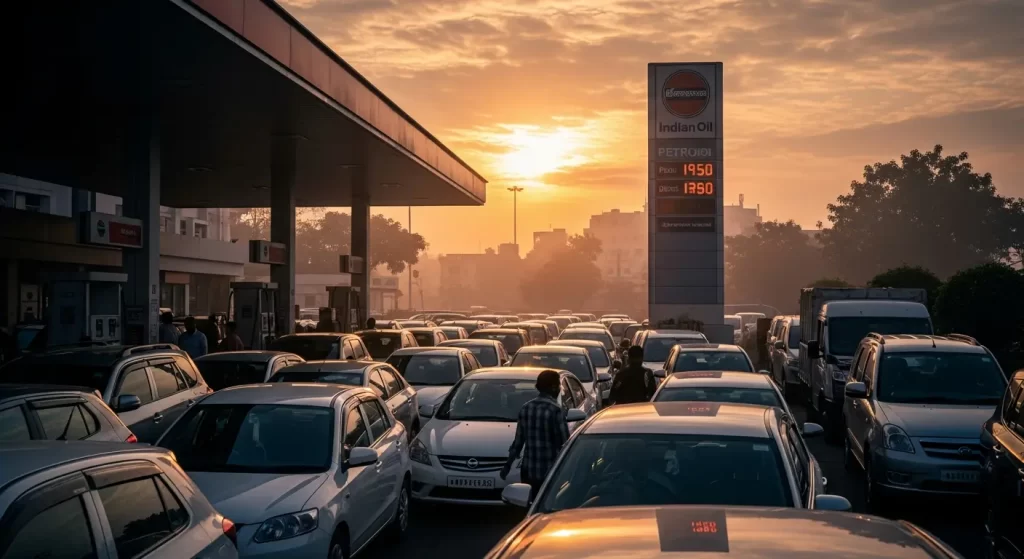
Something odd happened in Hyderabad this morning. In Gachibowli and surrounding areas, petrol pumps that normally handle a steady, unremarkable flow of vehicles were suddenly overwhelmed. Cars backed up onto main roads. Bikes squeezed into every available gap. People sat with engines idling, phones in hand, waiting.
No official shortage had been declared. No supply disruption had actually occurred. But the queues were very real — and they tell an interesting story about how fear travels in the modern world.
It Started With a Rumour, Not a Crisis
Most of the people standing in those queues this morning couldn’t have told you much about the Strait of Hormuz two weeks ago. That’s not a criticism — it’s just how it is. Most of us don’t spend our evenings reading about global oil shipping routes.
But then a few headlines appeared. Some social media posts started circulating. Someone mentioned that Donald Trump had made a comment about Iran and energy flows — something about a “gift,” though nobody seemed entirely sure what he meant by it. And that vague, half-understood unease was enough.
The Strait of Hormuz is genuinely important — a narrow waterway through which a significant portion of the world’s oil supply passes every single day. India imports a large share of its crude oil, which means any real disruption there would eventually show up at Indian petrol pumps. People know this instinctively, even if they don’t know the details.
So when the rumours started, the logic felt sound enough to act on. Better to fill up now than regret it tomorrow.
The government declared, “Calm down, there’s enough fuel.
Authorities responded to the panic promptly. The message was unambiguous and consistent: India has a steady supply of fuel. There isn’t a scarcity. The nation has a variety of import sources, strategic reserves, and backup plans created especially for situations like these.
They were right. There is no shortage. The fundamentals are fine.
But here’s the thing about reassurance — it works slowly. Fear works fast. By the time the official statements had been issued and shared and read, half of Hyderabad had already decided to top up their tanks just in case.
What we witnessed today wasn’t a supply crisis. It was a confidence crisis. And those are harder to fix with a press release.
The Markets Are Feeling It Too
It’s not just petrol pumps showing the strain. Financial markets have been absorbing the same anxiety for weeks now. The NIFTY 50 has dropped roughly 13% recently, with rising Iran-related tensions and oil supply uncertainty among the key contributing factors.
If you invest through SIPs, you’ve probably noticed your portfolio looking a little worse for wear lately. That’s this same story playing out at a different scale. Global uncertainty doesn’t stay neatly contained in the countries where it originates — it moves through oil prices, through market sentiment, through currency values, and eventually lands in your monthly statement.
This is what financial advisors mean when they talk about geopolitical risk. It sounds abstract until it isn’t.
The Very Human Logic of the Petrol Queue
Standing in a queue for forty minutes to fill a tank that still has a quarter left in it might not look rational from the outside. But put yourself in the position of someone in Gachibowli this morning, scrolling through worrying headlines while getting ready for work.
You don’t know for certain there’s no shortage. You do know that if there is one, and you didn’t fill up, you might be stranded tomorrow morning. The downside of not acting feels much worse than the inconvenience of joining a queue.
So you join the queue.
And when enough people make that same calculation simultaneously, the queue itself becomes evidence that something is wrong — which convinces more people to join. The rumour becomes self-reinforcing, even without a single fact to support it.
What Today Actually Taught Us
The Hormuz Effect — as it’s being called — is a useful reminder of something we tend to forget during calm periods. We live in a deeply interconnected world where an ambiguous comment made in Washington, about a waterway near Iran, can produce gridlock at a petrol pump in Hyderabad within days.
That connectivity isn’t going away. If anything, with social media accelerating the speed at which information — and misinformation — travels, moments like today will become more common, not less.
The practical takeaway is straightforward. Stay informed through reliable sources. Understand that panic buying doesn’t protect you — it creates the very shortage it’s trying to avoid. And remember that the biggest disruptions are often not the crises themselves, but the way we collectively respond to the fear of them.
For now, the fuel is there. The systems are holding. Take a breath — and maybe let your tank run a little lower before the next fill-up.