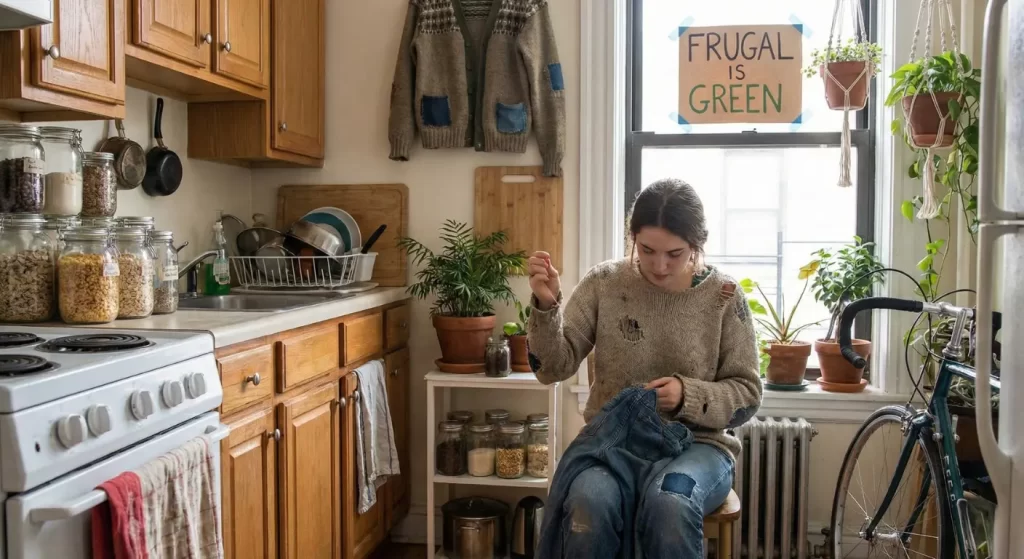
I got broke and accidentally became an environmentalist.
That’s the honest story. I didn’t wake up one day thinking about the planet. I woke up realizing I couldn’t afford to buy groceries.
My rent went up 30%. My groceries went up 40%. My salary didn’t move. And suddenly, all those things I bought without thinking became impossible luxuries.
So I stopped. Not for the planet. For survival.
The Month I Stopped Buying Groceries and Discovered the Obvious
January 2026. I had ₹2,000 left for food for the entire month. I could buy new groceries and be broke by week two. Or I could see what happened if I just… didn’t.
Week 1: Rice and beans. Literally that’s all I ate. I was so bored I considered calling it quits.
Week 2: I found old canned chickpeas, a jar of pesto from last year, frozen vegetables. Suddenly I wasn’t eating like a college student. I was eating okay. Actually, I was eating better than before because I was actually cooking instead of ordering takeout.
Week 3: I made a stir-fry with cabbage, chickpeas, and rice. It was genuinely delicious. And I realized something terrifying: I’d been throwing away hundreds of rupees every month on food I didn’t even want. I was just buying stuff because shopping felt normal.
Week 4: I hadn’t starved. I’d saved ₹8,000. And I felt weirdly proud of myself.
The weird part? It was good for the environment because I produced almost no food waste. But I only cared about that part after the fact. Before that, I just cared about not being hungry and not being completely broke.
The Electric Car Math That Broke My Brain
My friend spent ₹18 lakhs on an electric car. I asked him if he was insane.
He showed me a spreadsheet. His old petrol car cost him ₹4,000-5,000 per month just in fuel. The electric car? ₹2,000-2,500 per month in home charging costs.
“So you’re saving what, ₹2,000 a month?” I asked.
“Times 12 months. Times 7 years until the car pays for itself. Then it’s all savings,” he said.
I did the math. ₹18 lakhs upfront. But after 7 years, he’d actually be ahead. That’s if he can afford to wait 7 years. Most of us can’t.
Then he mentioned solar panels. ₹2.5 lakhs more. But if you use them to charge the EV instead of plugging into the grid? The payoff drops to 4 years instead of 6.
It’s not that electric vehicles are cheaper. It’s that if you have enough money to wait, they become cheaper eventually. The poor can’t afford to save the planet that way. We can only afford to save ourselves by doing what we’ve always done: repair instead of replace.
The Thing I Didn’t Know About Fixing Stuff
My laptop broke. I expected to pay ₹20,000. The repair guy fixed it for ₹5,000.
I asked him why more people don’t just repair things.
“Because companies don’t want them to,” he said.
He showed me YouTube tutorials on DIY home repair. He explained how right-to-repair is becoming a movement. He told me about repair cafes in the city where people help you fix broken stuff for free.
I’d never heard of any of this. But suddenly I understood: Repairing is the original sustainable living. My grandparents did this because they had to. Now we’re doing it because we have to again. And somehow, it’s trendy.
The Real Truth
Sustainable frugal living in 2026 isn’t noble. It’s necessary.
We’re broke. Inflation broke us. And the survival strategies for being broke—buying used, repairing things, cooking with what you have—these accidentally help the environment.
So now when I tell people I’m living sustainably, it sounds like I’m making conscious choices. Sounds like I care about the planet. Really, I’m just… eating what’s in my pantry because I can’t afford new groceries.
But you know what? The result is the same. Less money spent. Less waste created. Less damage to the planet.
And somehow, that feels like a win.