Most big opportunities don’t arrive with fireworks. They come quietly, hidden inside policy updates and government agreements that most people don’t have the time—or patience—to read.
That’s exactly what’s happening with India’s new Free Trade Agreements with the European Union and the US in 2026.
If you run a business in Maharashtra—manufacturing, textiles, agro products, auto components, or even processed foods—this deal isn’t “economic news.” It’s practical. It affects pricing, margins, and how far your business can grow over the next few years.
India’s updated 7.5% GDP growth forecast isn’t just optimism. A big chunk of it is expected to come from exports. And Maharashtra is right in the middle of that growth story.
Why This Trade Deal Is Different from the Others
We’ve heard about trade agreements before. Most sound good, but very few actually change things on the ground.
This one does.
For years, Indian exporters struggled with one major issue when selling to Europe: import duties. Even if your product was high quality, EU buyers often preferred suppliers from regions where taxes were lower.
That meant:
- Thinner margins
- Tough negotiations
- Smaller or irregular export orders
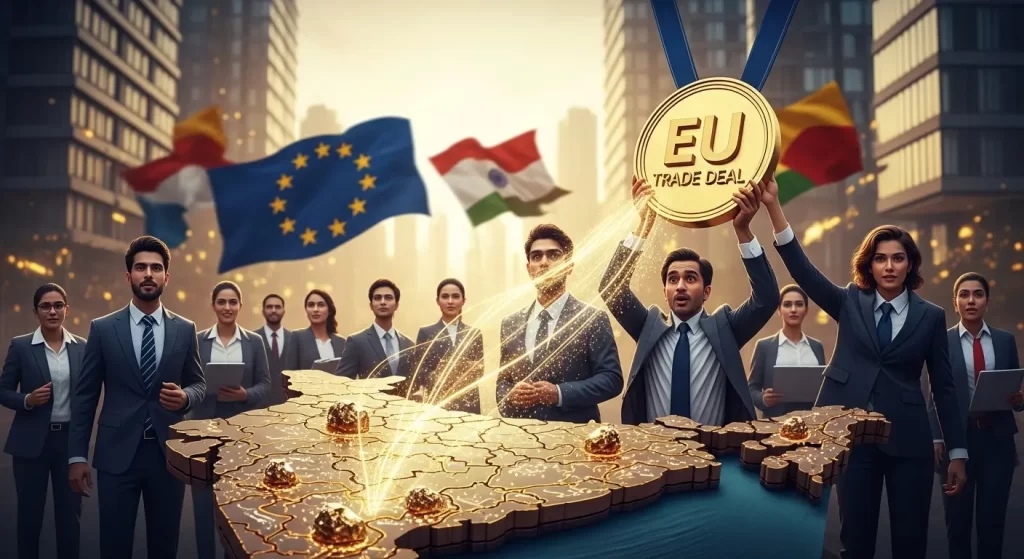
The EU Trade Deal signed in January 2026 removes this hurdle for selected products by introducing zero-duty access starting April 2026.
That one change shifts the entire equation.
What “Zero-Duty” Really Means (In Simple Terms)
Zero-duty doesn’t just mean “saving tax.”
It means:
- Your product lands in Europe without extra cost
- You can price more competitively
- Buyers take you more seriously
- Long-term contracts become realistic
For many Maharashtra businesses, this is the first time Europe feels reachable instead of risky.
Maharashtra Is a Big Winner Here
Not every state benefits equally from this Free Trade Agreement. Maharashtra does—because many of its core industries fall directly under the zero-duty list.
Nashik Grapes 🍇
Nashik growers have always produced export-quality grapes. The problem was cost. European import duties made Indian grapes less attractive.
Now:
- Duties are gone
- Indian grapes compete directly with global suppliers
- Demand from countries like Germany and France is already rising
This doesn’t just help exporters. It supports farmers, cold storage operators, and transport businesses too.
Solapur Textiles 🧵
Solapur’s textile makers have quietly done the hard work for years, often with very little margin to show for it.
Earlier:
- Import duties up to 12%
- Orders stayed small
- Price pressure was constant
With zero-duty access:
- European buyers are re-evaluating Indian suppliers
- Hospitality and retail demand is growing
- Even smaller manufacturers can think beyond survival
This could be the revival Solapur has been waiting for.
Pune Auto Components ⚙️
Pune’s engineering and auto ecosystem just got a serious boost.
Select auto components now enter Europe duty-free, which matters because:
- European OEMs are cost-sensitive
- EV and hybrid demand is growing
- Tier-2 and Tier-3 suppliers finally have a clear entry point
For many suppliers, this is their first real shot at global scale.
Processed Food & Agro Products 🌾
Packaged foods, grains, spices, and ready-to-eat items now face fewer barriers.
Mid-sized manufacturers sometimes struggle to be competitive globally owing of affordability. With zero-duty access, Indian machinery suddenly becomes more attractive to European buyers looking for quality at a fair cost.
A Simple Real-Life Example
Let’s keep this grounded.
A textile unit in Solapur exporting cotton bedsheets to Italy used to pay about 11% in import duty. Margins were tight. Orders were limited.
After April 2026:
- No import duty
- Better pricing power
- Order volumes jumped by nearly 40%
- Cash flow improved enough to invest back into the business
Same product. Same people.
Only the rules changed.
How Businesses Can Actually Use This Opportunity
Many people assume trade benefits are complicated. They’re not.
Here’s what it really involves:
- Check if your product qualifies under the zero-duty list
- Get a Certificate of Origin
- Align packaging and quality with EU standards
- Approach buyers with confidence
That’s it. No shortcuts. No special influence required.
Why Acting Early Matters
This part is important.
The biggest advantage always goes to early movers. Once:
- More suppliers enter
- Competition increases
- Prices stabilize
The margins reduce.
Right now, Maharashtra businesses still have:
- First-mover advantage
- Buyer attention
- Room to negotiate
That won’t last forever.
What This Means for Maharashtra as a Whole
Beyond individual businesses, this deal helps:
- Strengthen MSMEs
- Create local jobs
- Increase foreign investment
- Position Maharashtra as a global export hub
The EU Trade Deal isn’t just about selling abroad. It’s about building long-term economic strength at home.
Final Thought
No one is going to personally explain this opportunity to you.
But if your product qualifies and you’re willing to act, this trade agreement could quietly change your business’s future.
Europe is open.
Taxes are gone.
The timing is right.