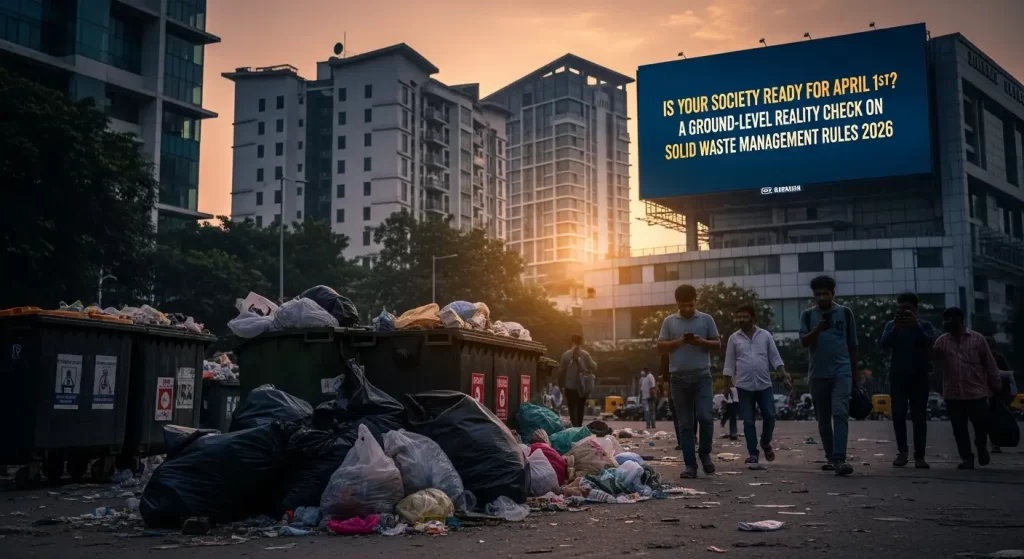
April 1, 2026, is quietly creeping closer, and most housing societies don’t realise how big a shift it’s going to bring. The new Solid Waste Management Rules 2026 are not just another circular that gets ignored after a week. This time, enforcement is real, inspections are serious, and penalties will directly hit society funds.
The uncomfortable truth?
Most societies think they’re ready. After visiting and auditing five housing societies in our area, it became clear that preparation exists mostly in theory—not in practice.
Garbage is being collected daily, cleaners are doing their rounds, and bins are visible. But under the new rules, that’s not enough anymore.
Why These Rules Matter More Than Ever
For years, waste segregation was treated like a “good habit” rather than a legal requirement. Municipal bodies issued warnings, not fines. That phase is ending.
From April 1, 2026:
- Housing societies will be audited regularly
- Non-compliance will be documented
- Fines will be imposed monthly, not once
- Repeat violations will cost more
And the responsibility will fall squarely on the managing committee, not individual residents.
The 4-Bin Rule: Everyone Knows It, Few Follow It
The backbone of the 2026 rules is the 4-Bin waste segregation system. On paper, it’s simple:
- Wet Waste – kitchen waste, food leftovers
- Dry Waste – paper, plastic, metal, glass
- Hazardous Waste – sanitary pads, diapers, medical waste
- E-Waste – batteries, chargers, small electronics
During audits, almost every chairman said,
“Yes, yes, we already follow this.”
But when we actually checked:
- Wet and dry waste were mixed in the same bin
- Sanitary waste was thrown in plastic bags with dry waste
- E-waste had no designated bin at all
- Cleaning staff mixed waste again during collection
Under the new rules, even one of these lapses counts as failure.
What We Saw During Real Society Audits
Across five societies, different sizes and layouts, the same problems kept repeating:
- Residents weren’t properly informed about segregation
- Housekeeping staff had never been trained
- No color-coded bins on each floor
- No written waste management process
- Committees assumed the contractor would “handle it”
The biggest misconception?
That compliance is automatic if garbage is picked up daily.
It isn’t.
The Cost of Ignoring the Rules (This Is Where It Hurts)
Many societies delay action because fines don’t feel “real” yet. So let’s break it down simply.
Under the 2026 framework, penalties start small but compound fast:
| Issue Found | Monthly Fine |
|---|---|
| No proper 4-bin system | ₹10,000 |
| Mixed waste at collection | ₹5,000 |
| No awareness signage | ₹3,000 |
| Repeat violations | ₹15,000+ |
That’s not a one-time payment.
That’s every single month until the issue is fixed.
In a year, that can easily cross ₹1–2 lakh, straight out of society maintenance funds.
The Good News: Compliance Is Easier Than You Think
Here’s the part most people don’t talk about—fixing this does not require big money. It requires structure and consistency.
1. Put the Right Bins in the Right Places
Not just near the gate.
- Every floor
- Common areas
- Clear color coding
- Clear labels in simple language
2. Educate Residents Like Humans, Not Notices
Posters help. WhatsApp helps.
But nothing works like:
- A short meeting
- Simple explanations
- Visual examples of what goes where
People cooperate when they understand why.
3. Train the Housekeeping Team Properly
This is critical.
- Teach them not to remix waste
- Explain the 4-bin logic
- Assign clear responsibilities
One trained supervisor can change the entire system.
4. Appoint 1–2 Waste Volunteers
Not inspectors. Just coordinators.
- Monitor segregation
- Answer questions
- Handle audit visits calmly
This alone reduces 80% of problems.
Why This Is Bigger Than Just Fines
Yes, avoiding penalties is important. But societies that manage waste properly see other benefits too:
- Cleaner premises
- Fewer rodents and insects
- Better hygiene
- Smoother municipal interactions
- Improved reputation of the society
In many cities, compliant societies are already being recognised and prioritised.
Final Thoughts: Don’t Wait for a Notice
The Solid Waste Management Rules 2026 are not a suggestion. They’re a deadline-backed mandate.
Societies that act now will adjust smoothly.
Societies that wait will scramble under pressure—and pay for it.
If your society has already started preparing, share what worked.
If you’re confused, ask questions before April 1 arrives.
Because when inspections begin, “we didn’t know” won’t be accepted as an answer anymore.