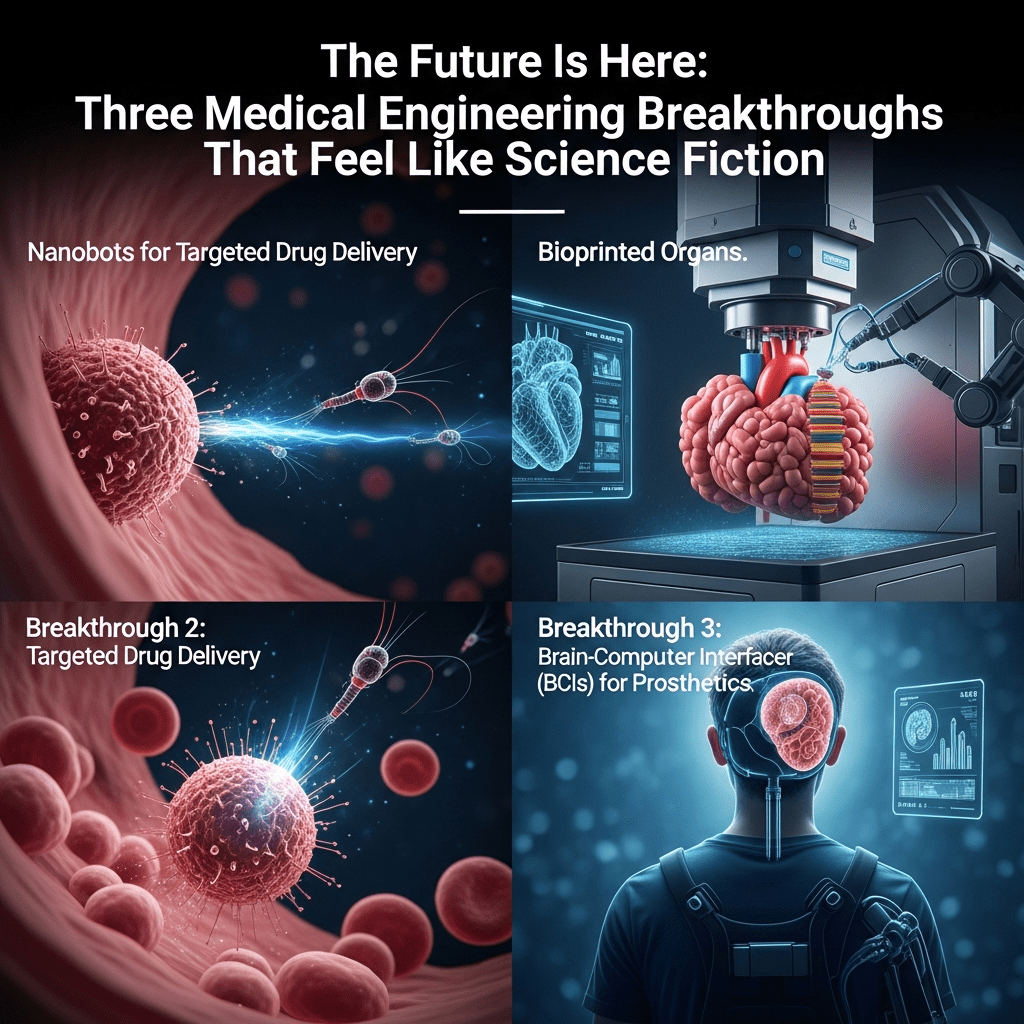
Imagine a world where you can send a text message just by thinking about it, where chemotherapy targets only cancer cells without making you sick, or where a simple electronic pill can hack your hunger hormones without a single chemical side effect. It sounds like the plot of a futuristic novel or perhaps a famously dystopian episode of Black Mirror. But according to a recent gathering at the Royal Geographical Society in London, this isn’t fiction—it is the very near future.
Hosted by the BBC World Service, “The Engineers” brought together three pioneering minds who are rewriting the rulebook of human biology
The Brain: Bluetooth for the Mind
For decades, the idea of connecting a human brain to a computer has been the “holy grail” of neurology. The problem, however, has always been access. To get to the brain, you traditionally have to cut through the skull—a procedure that is dangerous, invasive, and fraught with recovery risks.
Enter Dr. Tom Oxley, a neural engineer and the CEO of Synchron. He posed a radical question: What if we didn’t need to cut open the head at all? What if we could use the body’s existing “highway system”—the blood vessels—to reach the brain?
Oxley’s team developed the “Stentrode,” a device that looks like a tiny mesh stent. Instead of open-brain surgery, a surgeon inserts this device into the jugular vein in the neck and threads it up into a blood vessel called the superior sagittal sinus, which sits right on top of the brain’s motor cortex.
Once parked there, the Stentrode acts like a microphone for the mind. It listens to the “lightning storm” of electrical activity that occurs whenever you think about moving a muscle. Even in patients with paralysis or locked-in syndrome—where the body is broken but the mind is perfectly intact—these electrical signals still fire. The device captures them, sends them wirelessly via Bluetooth to a chest implant (similar to a pacemaker), and translates them into digital commands.
The results are staggering. Patients who cannot move their hands are using this system to control a mouse cursor, send emails, and communicate with their families. It is effectively a “Bluetooth keyboard” for the brain. Oxley hints that while motor control is the first step, the future could hold applications for restoring speech, vision, and even interpreting emotional states, offering a lifeline to those trapped in silence.
The Blood: Sniper Attacks on Cancer
While Oxley navigates the brain, Professor Eleanor Stride from the University of Oxford is revolutionizing how we treat cancer. We all know the horror stories of chemotherapy. It is a brutal, “scorched earth” approach. When you take a chemo pill or get an infusion, the drug floods your entire body, killing healthy cells alongside the cancerous ones. In fact, Stride notes that less than 1% of a drug usually reaches the actual tumor.
Stride’s solution? Bubbles.
Specifically, microscopic bubbles about a 50th the width of a human hair. Stride and her team are engineering these microbubbles to act as microscopic delivery trucks. The idea is elegant in its simplicity: you coat these bubbles with the drug and inject them into the bloodstream. Because the drug is encapsulated, it passes harmlessly through the body, sparing your hair, your stomach lining, and your immune system.
When the bubbles reach the tumor, doctors use a focused beam of ultrasound to vibrate them until they burst, releasing the drug exactly where it is needed. It’s the difference between carpet bombing a city and using a sniper rifle.
But Stride didn’t stop there. She found that many tumors are “hypoxic,” meaning they are starved of oxygen. These oxygen-starved cancer cells enter a “zombie state” where they become incredibly resistant to treatment; neither drugs nor the immune system can kill them. To fight this, Stride’s team figured out how to load the bubbles with oxygen. By delivering a burst of oxygen along with the drug, they “wake up” the zombie cells just long enough to kill them. It is a double-tap strategy that could turn untreatable cancers into manageable conditions.
The Gut: Hacking the “Second Brain”
Finally, we move to the gut, often called our “second brain” because it contains the second-largest collection of neurons in the body. Khalil Ramadi, a bioengineer at NYU Abu Dhabi, is working on a way to talk to this second brain without using chemicals.
We take pills for everything—headaches, hunger, diabetes. But like chemotherapy, chemical pills are messy. They dissolve in the stomach and affect tissues they weren’t meant for. Ramadi asks: What if we could just use electricity?
His innovation is an “electroceutical” pill called “Flash.” It looks like a standard omega-3 capsule, but inside, it holds a tiny battery and coiled wires. When swallowed, it detects when it touches the stomach lining and delivers a micro-zap—a tiny electrical nudge that you can’t even feel.
This zap tricks the gut into releasing specific hormones. In early experiments, Ramadi’s team focused on ghrelin, the hunger hormone. By stimulating the stomach lining, they could spike ghrelin levels, which could be a game-changer for people suffering from severe appetite loss or eating disorders. Conversely, the technology could eventually be tuned to suppress appetite or manage insulin for diabetics, all without the systemic side effects of drugs like Ozempic.
The best part? It’s temporary. The pill does its job for about 30 minutes as it moves through the system and is then passed naturally. Ramadi envisions a future where electronics are made of edible materials, so the “pill” simply dissolves after it has delivered its digital message.
The Convergence
What makes these three stories so compelling is not just the technology, but the shift in philosophy. We are moving away from the era of “fixing” the body with brute force and entering an era of “communicating” with it.
Oxley is listening to the brain; Ramadi is talking to the gut; Stride is negotiating with cells via the blood.
During the panel, an audience member asked if these technologies could work together. The answer was a resounding yes. You can imagine a future where a brain implant detects a seizure or a chemical imbalance, signals a gut implant to release a specific hormone, while targeted bubbles repair damage in real-time.
Of course, challenges remain. There are ethical concerns about privacy—if a computer can read your motor thoughts, what else can it read? There are questions about access—will these become enhancements for the rich, creating a “superior class” of humans? And there is the timeline; while human trials are starting, widespread availability is likely still a decade away.
However, the trajectory is clear. The boundary between biology and engineering is dissolving. We are no longer just treating the human body; we are learning to engineer it, upgrading our natural hardware with a sophistication that was once pure fantasy. As these technologies mature, the question isn’t just “can we cure this disease?” but “what is the limit of human potential?”
The Future Is Here: Three Medical Engineering Breakthroughs That Feel Like Science Fiction