
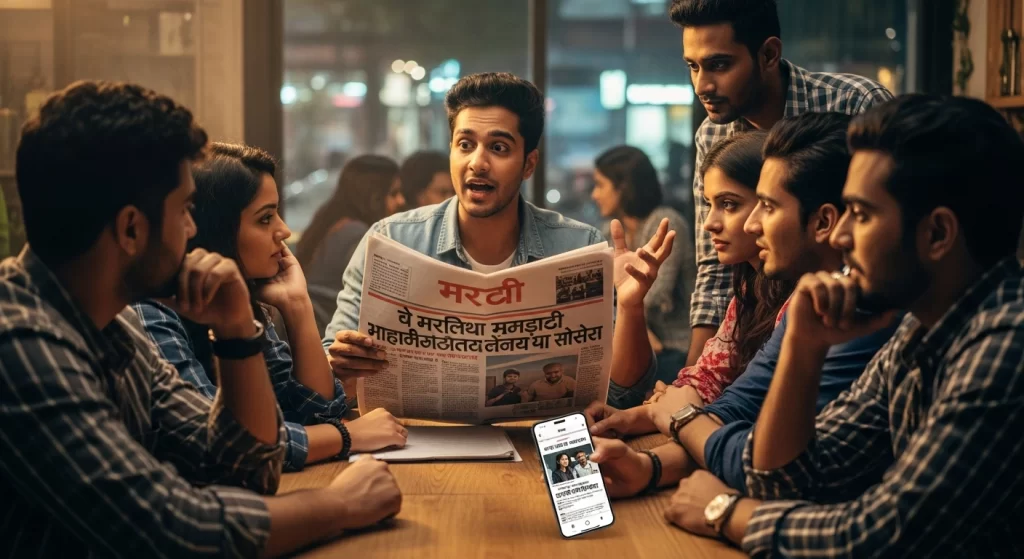
You know that feeling? You’re running 10 minutes late, you flag down an auto, and you’re desperately trying to explain where you need to go. The driver’s looking confused. You’re pointing at your phone. He’s nodding but clearly has no idea. Five minutes later, you’re on the complete opposite side of the city.
Yeah. That’s about to change. Maybe.
On April 14, Maharashtra’s government basically said: “Enough is enough. Starting May 1, every auto and taxi driver needs to actually speak Marathi.” No exceptions. No grace period.
Sounds simple, right?
It’s… not.
And honestly? It’s way more complicated—and way more interesting—than it sounds.
Okay, So What’s Actually Happening?
May 1. That’s it. That’s the deadline.
No “phased rollout.” No “we’ll give everyone a year.” Just a straight-up hard stop. From May 1, if you want to drive an auto or taxi in Maharashtra, you gotta speak Marathi. Period.
If you’re someone fresh, applying for a driver’s license for the first time? Congratulations—Marathi proficiency is now on your checklist. Right alongside passing the driving test and not having a criminal record. It’s just part of the job application now.
But here’s the kicker: it’s not just new drivers. There are literally millions of auto and taxi drivers already running around Mumbai, Pune, Nashik, and everywhere else. They’ve been doing this job for 5, 10, 15 years. And now they ALL have to go get tested and certified.
It’s not a “let’s gradually improve the system” kind of thing. It’s a “we’re flipping the switch and everyone’s coming with us” situation. Which, I’ll be honest, is pretty wild.
How Is This Actually Going to Work?
Transport Minister Pratap Sarnaik has a plan. Not a vague one—an actual, structured plan.
The government’s set up 59 Motor Transport Department offices across the state. These aren’t random offices tucked away somewhere. They’re gonna be the official language testing centers. Drivers show up, take the test, prove they can speak/read/write Marathi, and boom—they’re cleared.
It sounds orderly on paper. But think about it for a second. We’re talking about testing thousands and thousands of drivers. Organizing schedules. Hiring examiners. Making sure the process is actually fair and not just a rubber stamp situation.
I mean, imagine you’re running one of these offices. Day 1 of testing arrives and 500 drivers show up because they’re all panicking and trying to get tested ASAP before the deadline. Your staff is drowning. People are getting frustrated. Forms are getting lost.
Welcome to government implementation, folks.
The good news? The government is at least trying to do this properly. The bad news? It’s a massive logistical headache that could go sideways pretty quickly.
Okay, So What Happens If You Don’t Comply? (This Is Important)
Let’s be real: there are teeth to this policy.
If you’re a driver and you don’t pass? Your license gets cancelled. We’re not talking about a warning letter or a fine. They literally take away your ability to work. For a lot of drivers, this isn’t just a “side gig”—it’s their entire livelihood. It’s how they feed their families. So this is serious in a way that’s actually kind of scary.
There’s this guy I know, Ramesh, who’s been driving an auto for 12 years in Pune. He came from Chhattisgarh initially, picked up some Marathi over the years, but he’s not exactly fluent. When I asked him about this new rule, he looked genuinely stressed. “What if I fail?” he asked. “What do I do then?”
That’s not a rhetorical question for him. That’s his reality.
And it’s not just drivers getting the pressure. If you’re a government official and you’re caught issuing licenses to drivers who clearly can’t speak Marathi? You’re getting in trouble too. We’re talking disciplinary action, getting called out, the whole thing.
So there’s this two-way accountability that the government is trying to build. Make drivers take it seriously. Make officials not cut corners. In theory, genius. In practice? We’ll see.
Let’s Talk About What Could Actually Go Wrong
Because here’s the thing nobody wants to say out loud: this could get messy.
In Mumbai especially, there are SO many drivers from other states. I’m talking Uttar Pradesh, Bihar, Karnataka, Andhra Pradesh—you name it. They came to Maharashtra looking for work. They’ve been here for years. Some of them speak decent Marathi. Some of them really don’t.
Now imagine you’re a 45-year-old driver who’s been doing this job for 8 years. You know the roads inside-out. You’re reliable. You take care of your auto. Your passengers like you. But your Marathi? Eh. Your pronunciation is off. You mix in Hindi a lot. And now you’re being told: “Sorry buddy, you’ve got 2-3 weeks to become fluent or you lose everything.”
That’s not reasonable. That’s actually kind of brutal.
I heard about this guy—Vikram—from Belgaum. He moved to Pune in 2020. He’s been driving taxis ever since. He understands Marathi pretty well. He can get by. But when we were talking, he was genuinely panicking about the test. “What if they ask me something I don’t understand?” he asked. “What if I mess up and lose my license?”
Then there’s the admin side. Testing thousands of drivers is not a joke. You need enough examiners. You need fair testing standards. You need to process results quickly. You need to make sure corruption doesn’t creep in. And you need to do all this in, what, 2-3 weeks?
Spoiler alert: that’s not a lot of time.
And here’s what nobody’s really talking about: what if a bunch of drivers don’t pass? What if 15-20% of autos and taxis just… disappear from the roads because drivers are waiting for retests or have given up?
Have you ever tried to find an auto during rush hour when there are fewer autos available? It’s a nightmare. For people commuting to work, to the hospital, to important meetings—it could be a real problem.
Plus, here’s the thing that really bugs me: can you really measure someone’s ability as a driver through a Marathi proficiency test? A driver could speak Marathi like a poet but still be reckless. Another driver might have a thick accent but be the safest, most courteous person on the road. The test is really just testing language. It’s not testing competence as a driver. That’s a gap that nobody really wants to acknowledge.
What About You? (Yeah, You, the Person Who Uses Autos Every Day)
Look, from a passenger perspective, the benefits sound great:
You won’t have that awkward moment where you’re explaining your destination and the driver has zero idea what you’re talking about. Your commute could be smoother. You might actually enjoy your ride instead of just enduring it.
Imagine: you get in an auto, you tell the driver where you need to go in Marathi, and he actually understands. First time. No confusion. No detours. Just a clean, straightforward ride.
That’s the dream, right?
But here’s what might actually happen in the short term:
May 1 rolls around. A bunch of drivers still aren’t certified. They’re panicking. Testing centers are overwhelmed. You’re standing on the side of the road trying to find an auto and there are barely any. When you finally get one, the driver’s stressed out, worried about his certification, and honestly just not in the headspace to give you great service.
Or worse: you get in an auto, the driver tries to speak Marathi and it’s actually pretty awkward because he’s nervous about making mistakes. The ride becomes tense instead of comfortable.
The good stuff might take months to actually show up. The headaches? Those could happen pretty much immediately.
What’s This Really About?
I’ve been thinking about this a lot, and here’s what I think is actually going on below the surface.
This isn’t just about drivers speaking better Marathi. It never is with government policies like this.
This is about identity. About saying: “Maharashtra is a Marathi-speaking state, and if you want to be part of our public transport system, you’re part of that story.” It’s a statement. A pretty bold one, actually.
Language isn’t neutral. It is connected to power, culture, and belonging. When a government makes Marathi mandatory for public service, they’re saying something specific about who belongs in this state and what integration looks like.
Now, I get it. Language is important. Communication matters. And for a lot of Maharashtrians, having their language respected in their own state is a big deal. I understand that completely.
But it’s also kind of a heavy-handed way to do it? Like, there are drivers who’ve lived here for a decade, who are part of the community, who care about the place. And now they’re being told: “Sorry, unless you become fluent in Marathi, you’re out.”
It’s messy. It’s culturally significant and politically important and personally hard for a lot of people all at the same time.
And honestly? That’s what makes policy interesting. It’s never just one thing. When things matter, it’s always about real people, competing values, and how to make things work.
So… What Happens Now?
Honestly? I don’t know.
May 1 is coming. That’s in like 2-3 weeks from now. And I’m genuinely curious—and kind of nervous—to see what actually happens.
Will the testing centers handle the load? Will drivers actually become fluent or will they just manage to pass the test? Will there be auto shortages that make commuting a nightmare? Will the implementation be fair or will corruption and favoritism creep in?
Will passengers actually benefit, or will they just deal with a few weeks of chaos before things settle down?
I think the intention here is good. No one considers what would be fantastic when they wake up. making people’s jobs more difficult.” The government is working to make the system better, provide greater communication, and enhance the public transportation experience.
But intention and execution are two very different things.
And what worries me is the human cost in the middle. Drivers like Ramesh and Vikram, who are solid, dependable, good at their jobs but might lose everything because of a language test. Commuters who might face shortages and chaos for a while. Officials scrambling to implement something massive in a short timeframe.
The policy itself isn’t crazy. But the timeline? The scale? The lack of flexibility for edge cases? That’s where I think things could actually go sideways.
Here’s what I’m watching for:
- How many testing centers actually open and how efficient are they?
- What percentage of drivers pass on their first try?
- Do auto shortages actually happen?
- How long does it take for things to stabilize?
- Does anyone actually lose their license?
Because those numbers will tell us whether this was a well-executed policy or a good-intentioned disaster.
In a city like Mumbai, where millions of people depend on autos and taxis to get to work every single day, even “small” disruptions can have huge ripple effects. One week of 30% fewer autos and the entire city’s commute system falls apart.
So yeah. May 1. Let’s see what happens.
I’ll be paying attention. You should too.