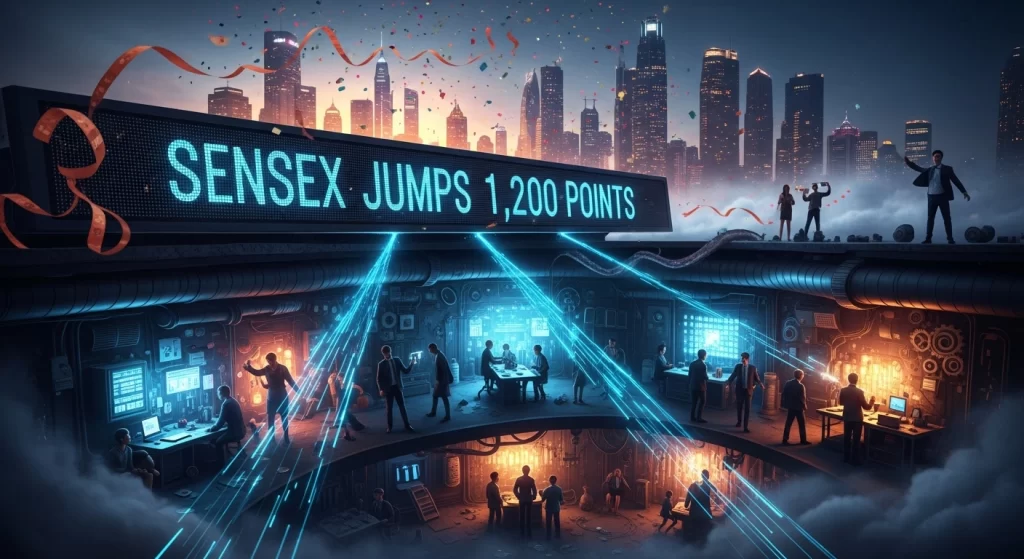
There’s a particular kind of market day that feels almost cathartic after a difficult stretch. The kind where you watch the numbers move upward with the same collective relief that follows a thunderstorm clearing oppressive summer heat. This week delivered one of those days — a 1,200-point Sensex surge that arrived with enough force to remind nervous investors why they stayed in the market through the difficult weeks that preceded it.
But a 1,200-point rally deserves more than a celebratory headline. It deserves an explanation — because understanding what drove it is the only way to know whether it signals something durable or whether it’s the kind of relief bounce that reverses as quickly as it arrived.
The Morning Started With a Signal Most Retail Investors Missed
The story actually began before the opening bell, and if you were watching Gift Nifty in the early hours, you could see it coming.
Gift Nifty — the offshore derivative that trades overnight and gives you a preview of where Indian markets are likely to open — was indicating a gap-up of around 350 points before domestic trading began. For experienced market participants, a gap-up of that magnitude on the derivative is a meaningful early signal. It means institutional and professional money — which trades overnight in global markets while domestic investors are asleep — has already made a directional bet on the session.
When markets opened and the Nifty reclaimed 24,200, it wasn’t a surprise to anyone who had been watching the overnight signals. It was confirmation. And once that level was breached, the mechanics of modern market structure took over — algorithmic systems that are programmed to buy when certain technical levels are cleared, institutional flows that had been held back during uncertainty now finding their moment, momentum traders piling in as the direction became clear. The initial 350-point Gift Nifty indication became a 1,200-point Sensex day partly because of what was happening in global markets and partly because of how market structure amplifies moves once they get going.
The Crude Oil Connection — This Is the Real Story
To understand why Indian markets moved this strongly, you need to look away from Dalal Street entirely and look at what was happening to oil prices.
For the past several weeks, crude oil had been elevated by a risk premium that markets were applying because of tensions in West Asia and specifically concerns about the Strait of Hormuz — the narrow waterway through which a significant portion of global oil supply passes and which becomes extremely vulnerable if the Iran situation escalates beyond a certain point.
That risk premium doesn’t reflect the current physical reality of oil supply and demand. It reflects what traders think might happen to supply if the geopolitical situation deteriorates. When the geopolitical signals improved — when diplomatic language replaced escalatory rhetoric around US-Iran tensions — that risk premium started unwinding. WTI crude dropping toward the $90 mark wasn’t about oil supply suddenly increasing or demand suddenly falling. It was about risk perception declining, and that decline flowing through into price.
For India, this matters enormously and through multiple channels simultaneously. Lower crude directly reduces the import bill, which improves the current account position and reduces pressure on the rupee. It eases the inflationary concern that had been constraining the RBI’s ability to consider rate cuts. It improves margins for industries with significant energy input costs. And it removes the cloud over sentiment that had been discouraging FII investment in Indian equities.
All of those effects arrived at roughly the same time, which is why the rally was as broad and as forceful as it was. It wasn’t one thing improving. It was several interconnected things improving simultaneously because they all trace back to the same root cause — the crude oil risk premium declining.
Why IT Led and Banking Lagged — The Sector Rotation Nuance
Within the broad market rally, the sectoral distribution of gains tells you something more specific about what was driving the move and where the market’s confidence was concentrated.
IT stocks were the clear leaders. TCS, Infosys, and the broader technology sector saw strong buying interest and contributed disproportionately to the Sensex’s gains. This makes sense once you think through the specific conditions of this particular rally.
IT companies generate most of their revenue in dollars from international clients. When global sentiment improves and the rupee stabilises or strengthens slightly — which happens when crude falls and the current account pressure eases — IT companies benefit directly through the currency translation of their earnings. They also benefit from the improved global economic outlook that geopolitical de-escalation implies. If tensions in West Asia are easing, the global growth picture is somewhat better than it was, and better global growth means more enterprise technology spending, which is the primary driver of IT company revenues.
Banking stocks, by contrast, had a more muted day. ICICI Bank and other financial heavyweights participated in the general positive direction but underperformed the broader market. This divergence isn’t alarming — it reflects a sensible sectoral rotation rather than something structurally wrong with banking fundamentals. On a day driven by geopolitical de-escalation and crude oil relief, the most direct beneficiaries are the sectors most sensitive to those specific factors. Banking is more sensitive to domestic credit conditions, the interest rate environment, and asset quality than to the crude oil price. A crude-driven rally naturally sees IT outperform banking.
For investors trying to understand what to do with this information, the key point is that not all sectoral moves in a rally tell the same story. IT outperforming banking on this particular day is not a signal to overweight IT relative to banking for the long term. It’s a signal about the specific catalyst that drove the session — and those session-specific relationships don’t necessarily persist.
The Volatility Crush — The Part That Actually Matters for How You Trade
Here’s the element of this rally that most coverage stops short of addressing, and it’s the one that has the most practical implications for how different market participants should be responding.
India VIX — the fear gauge that measures how much volatility is priced into near-term options — dropped toward 18 during this session. A few weeks ago it was sitting above 20. That decline of a few VIX points sounds modest but has significant practical consequences for anyone involved in options trading.
When VIX is elevated, options are expensive. The premiums reflect the market’s expectation of large price swings, and sellers of options demand compensation for that expected volatility. Buyers of options are paying those elevated premiums to gain protection or to make directional bets, knowing that the volatility could work in their favour by producing the large moves they’re betting on.
When VIX falls — when the volatility crush happens — options become significantly cheaper. The premiums compress. Strategies that were built around elevated volatility — buying calls or puts expecting large moves — suddenly become less viable because the expected large moves are now priced out of the market. The instruments that cost a certain amount a week ago are worth considerably less today simply because the market’s assessment of future volatility has declined.
This shift changes the optimal strategy for different types of market participants. Traders who were using options primarily for directional exposure at high VIX levels might find direct equity purchases more efficient at current VIX levels. Those selling options — collecting premium in exchange for bearing risk — find the premium available has declined, making the risk-reward less attractive than it was. Portfolio managers who were using options for hedging find their hedges cheaper to maintain.
The 1,200-point rally grabbed the headlines. The VIX drop from above 20 to approaching 18 was the quieter but equally important development for anyone who manages risk rather than just tracking index levels.
Reading the FII Signal
Foreign Institutional Investors had been net sellers through much of the correction. The combination of high crude, elevated VIX, and geopolitical uncertainty that makes emerging markets unattractive during risk-off periods had been driving outflows that amplified the downward pressure on Indian equities.
The improved global sentiment of this session reversed that flow. FIIs returning to Indian equities — particularly in the IT sector where their concentration tends to be heaviest — provided a significant portion of the buying volume that drove the rally. When large institutional flows change direction, they can produce outsized moves because of the capital involved.
This FII re-entry is an important signal but also one that requires careful interpretation. Institutional money that moves on geopolitical sentiment can reverse on geopolitical sentiment just as quickly. If the West Asia situation deteriorates again, or if the diplomatic progress that drove today’s optimism stalls, the same FIIs who returned today can become sellers again tomorrow. The structural FII story for India — about long-term growth prospects, demographic dividends, and the improving quality of Indian corporate governance — is separate from and more durable than the session-to-session sentiment-driven flows.
The distinction matters for how you interpret FII activity. Net FII buying on a day like this is a positive near-term signal. It shouldn’t be read as a structural shift in institutional sentiment about India that has permanently changed.
What to Actually Do With a Rally Like This
The most common mistake investors make after a strong rally is one of two extremes. Either they interpret it as confirmation that everything is fine and add risk aggressively at elevated prices. Or they dismiss it as a temporary bounce and wait for the next correction to buy, potentially missing significant further upside.
Neither of these is quite right for the current situation.
The crude oil driven improvement in India’s macro backdrop is real and meaningful. Lower oil at the $90 range rather than $105 makes a genuine difference to inflation, to the current account, and to the RBI’s room to manoeuvre. If that improvement is sustained — and that depends on whether the geopolitical situation continues to improve or reverses — it provides fundamental support for Indian equities beyond just sentiment.
At the same time, the VIX sitting around 18 rather than 12 tells you that the market itself doesn’t believe all uncertainty has been resolved. Geopolitical situations are notoriously difficult to predict. One incident, one statement, one decision by any of the parties involved can shift the crude oil risk premium back up and with it the pressure on Indian markets.
The practical approach is to use this rally’s clarity about sectoral performance to reassess allocation rather than making dramatic changes. IT’s outperformance on a day driven by global de-escalation and rupee stability reinforces its attractiveness for portfolios that are underweight the sector. Banking’s lagging performance despite healthy fundamentals might represent opportunity for patient investors who aren’t trying to time the exact moment of catch-up.
Most importantly, resist the temptation to chase the move. A 1,200-point Sensex day that you watch from the sidelines is frustrating. A 1,200-point Sensex day that you chase by adding significant risk at the top — only to see a reversal if the geopolitical situation shifts — is considerably more expensive than the frustration of missing it.
Stay invested. Be selective about what you add at current levels. Keep one eye on crude oil as the single most important variable in whether today’s rally becomes the foundation for further gains or a temporary reprieve in a still-uncertain environment.
The market gave you something to feel good about this week. Understanding exactly why is the best preparation for whatever it does next.