My friend Sarah used to love reading. Just reading. No goals. No highlights. No tracking.
Last year, she started using a reading app. Measured books per month. Set annual targets. Started timing herself.
Now she reads faster. She’s “more productive.” She reads 40 books a year instead of 20.
But she doesn’t enjoy it anymore.
She told me: “I feel guilty if I read slowly. Guilty if I take a break. Guilty if a book doesn’t get finished. Reading became another job.”
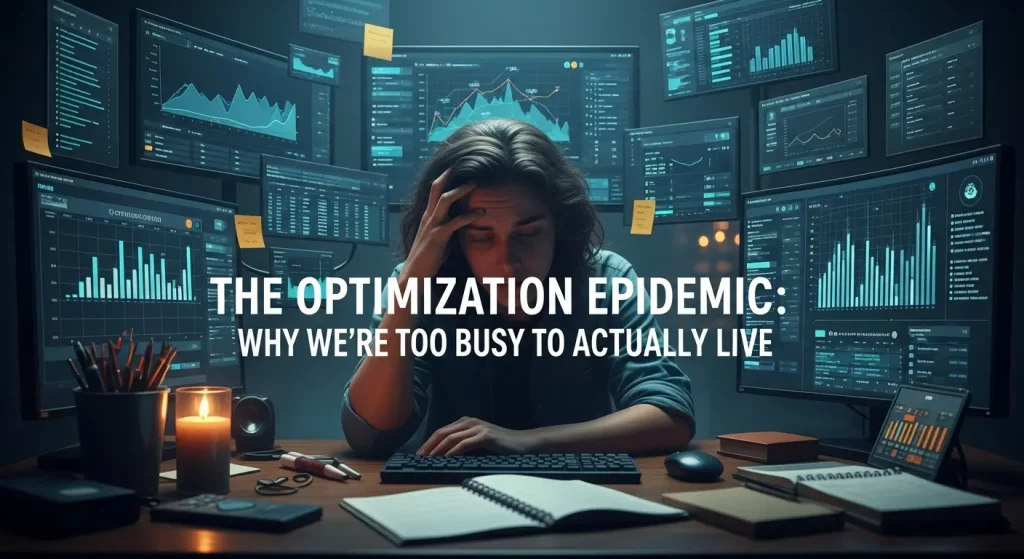
This is the optimization epidemic. And it’s destroying everything we used to enjoy.
The Disease Has a Name: Action Bias
Action Bias is the tendency to believe that doing something is always better than doing nothing. Even when that something is pointless.
Parkinson’s Law says work expands to fill the time available. So we create more tasks. More tracking. More measurement.
Modern productivity culture married these two. The result: we’re drowning in busywork, convinced it’s meaningful.
We can’t just exercise. We need to track calories, heart rate, steps, sleep, recovery metrics. Fitness stopped being enjoyable and became a data project.
We can’t just meditate. We need an app. Streaks. Progress charts. Hours accumulated.
We can’t just walk. We need step counters. We need to hit 10,000. We feel guilty at 8,000.
Everything fun has been colonized by optimization.
The Transition Nobody Noticed
When did hobbies become unpaid jobs?
Ten years ago, I played guitar for fun. Now there’s a metronome app. A practice tracker. YouTube tutorials expecting daily consistency. Discord communities comparing progress.
I used to paint on weekends just to paint. Now it feels like I should be improving. Learning techniques. Building a portfolio. Maybe eventually monetizing it.
The guilt of doing nothing became unbearable. So we optimized nothing away.
We optimized leisure into labor.
Why We Can’t Stop Optimizing
Action Bias makes sitting still feel wrong. Immoral even.
If you’re not moving, you’re falling behind. If you’re not tracking, you’re wasting potential. If you’re not improving, you’re stagnating.
Self-worth became a metric. Measured in:
- Books read
- Hours worked
- Workouts completed
- Projects shipped
- Skills learned
- Income earned
Anything unmeasurable feels worthless.
So we measure everything. And in measuring, we kill the thing we measure.
Reading isn’t about the story anymore. It’s about the count. Exercise isn’t about how you feel. It’s about the data. Rest isn’t restoration. It’s procrastination.
We’ve turned life into a spreadsheet. And spreadsheets are never satisfied.
The Psychological Trap
Here’s what keeps us trapped: true rest is uncomfortable.
Sitting without your phone feels like failure. Doing nothing feels like laziness. Unstructured time feels like wasted time.
Psychologically, productivity feels safe. You can measure it. You can show progress. You can prove your worth.
Rest? Rest is terrifying. Because rest doesn’t produce anything. And we’ve been taught that if you don’t produce, you don’t matter.
So we optimize our hobbies into side hustles. We monetize our interests. We turn passion projects into “opportunities.”
And we wonder why nothing brings us joy anymore.
The Cost of the Epidemic
The optimization epidemic costs us:
- Spontaneity (can’t be unscheduled)
- Joy (can’t be measured)
- Presence (always tracking for later)
- Trust (need metrics to prove worth)
- Rest (guilty luxury)
We’ve gained productivity. We’ve lost living.
How to Stop
First, admit that doing nothing is not laziness. It’s necessary.
Second, reclaim one activity from optimization. Just one. Stop tracking it. Stop improving it. Do it purely for the experience.
Third, embrace the guilt. It will pass. The discomfort of not producing is temporary. The relief of actually resting is permanent.
Finally, remember: the most important things in life aren’t measurable. Relationships. Presence. Joy. Spontaneity. These don’t appear on spreadsheets.
Your worth isn’t your productivity. Your value isn’t your output.
You deserve to exist without producing. To rest without guilt. To enjoy things without optimizing them.
Reflect & Reclaim
What did you used to love that you now feel obligated to track or improve?
When was the last time you did something purely for joy with no measurable outcome?
What would your life look like if you stopped optimizing and started living?
Reclaim your time. Reclaim your hobbies. Reclaim your rest.
The optimization epidemic thrives on your guilt. The antidote is doing nothing about it.