I watched my friend play a personalized AI horror game last week.
The experience pulled his Instagram photos, his voice patterns, his mannerisms. Then it created a corrupted version of him—his face subtly wrong, his movements just off. The thing on screen was him, but not him.
He lasted 47 seconds before quitting. Not because it was visually scary. Because it was psychologically devastating.
This is personalized VR/AI horror. And it’s viral in 2026 for a reason that has nothing to do with jump scares.
What Personalized AI Horror Actually Is
Personalized VR/AI horror games use your data to construct terror.
They scrape social media photos. Analyze voice recordings. Track movement patterns. Then AI generates a twisted version of you—subtly corrupted, eerily familiar, fundamentally wrong.
It’s not a monster. It’s you. Broken.
This technology exploits something ancient in your brain: the fear of the familiar made strange. The horror isn’t in what’s different. It’s in what’s almost the same.
The Uncanny Valley (Why Your Face Terrifies You)
There’s a psychological phenomenon called the Uncanny Valley.
When something is obviously artificial, you feel fine. You recognize the distance between real and fake. Your brain categorizes it as “not real” and relaxes.
When something is almost human but not quite, everything breaks. Your brain detects the inconsistency without understanding it. You feel wrongness without being able to name it.
This is where personalized AI horror lives.
Your face is hardwired into your brain’s recognition systems. The Fusiform Face Area—a specific region in your temporal lobe—is tuned to recognize you and people you know. It processes facial details automatically and instantly.
When that system encounters a corrupted version of your own face, something primitive activates. Not intellectual fear. Instinctual dread.
Your brain is screaming: “This is wrong. This shouldn’t exist. This is dangerous.”
The Biological Terror (Evolution’s Vulnerability)
Fear of near-human entities isn’t random. It’s evolutionary.
For millions of years, the most dangerous thing to humans was other humans who looked sick, possessed, or fundamentally wrong. A family member acting strangely. A tribesman with unfamiliar features. An enemy in disguise.
These weren’t intellectual threats. They were existential dangers.
Your survival instincts evolved to detect wrongness at the face level. Slight asymmetry. Unnatural movements. Eyes that don’t quite focus correctly.
Personalized AI horror hijacks this ancient circuit.
When you see your own face but wrong, your evolutionary fear response activates. Not because you consciously think “this is threatening.” Because your amygdala—the fear center—detects corruption and screams danger.
Your conscious mind knows it’s a game. Your limbic system doesn’t care. It responds to the near-human threat the way it always has: with terror.
Why This Matters (The Effectiveness)
Traditional horror relies on external monsters. Ghosts. Demons. Things outside yourself.
You can intellectually separate from external threats. They’re not you. You’re safe.
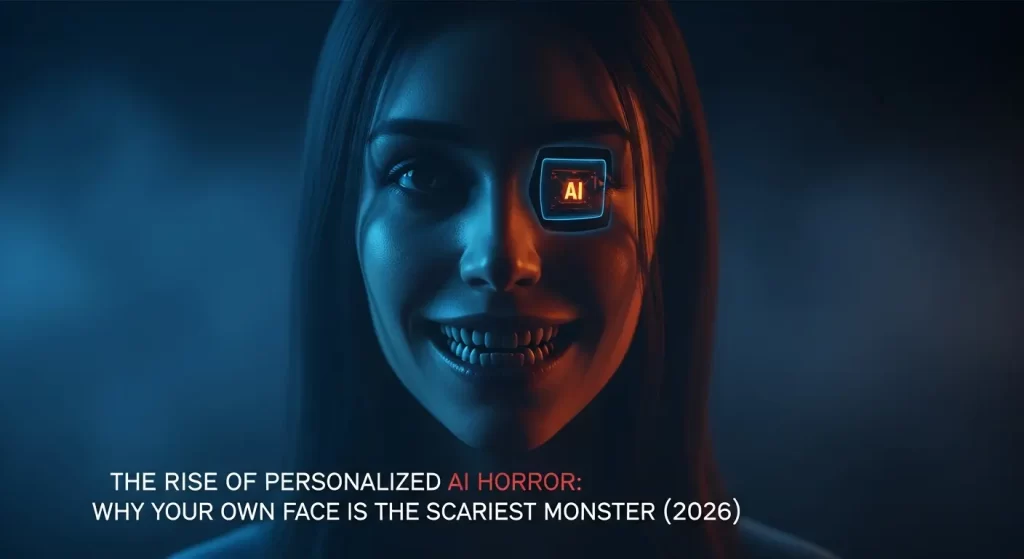
Personalized AI horror destroys that separation. It shows you as the threat. It shows your familiar features corrupted. It shows your loved ones as wrong versions of themselves.
There’s no distance. No escape from the fear because the fear is wearing your face.
This is why players quit within seconds. This is why it’s psychologically devastating. This is why it’s viral.
The Ethical Question (What We’re Creating)
Here’s what keeps me awake: we’re creating technology that weaponizes intimacy.
We’re taking your face—the thing closest to your identity—and weaponizing it. Using your own data to create psychological terror.
This isn’t just entertainment. This is psychological manipulation at a biological level.
The question isn’t whether personalized AI horror will work. It already does. The question is: should we continue developing technology that turns our own identity into a source of fear?
Where Do You Draw the Line?
Have you experienced personalized AI horror? Did you feel genuine fear, or psychological unease?
The scariest part isn’t the technology. It’s realizing that the deepest fear isn’t external. It’s internal.
It’s the fear of yourself made strange.