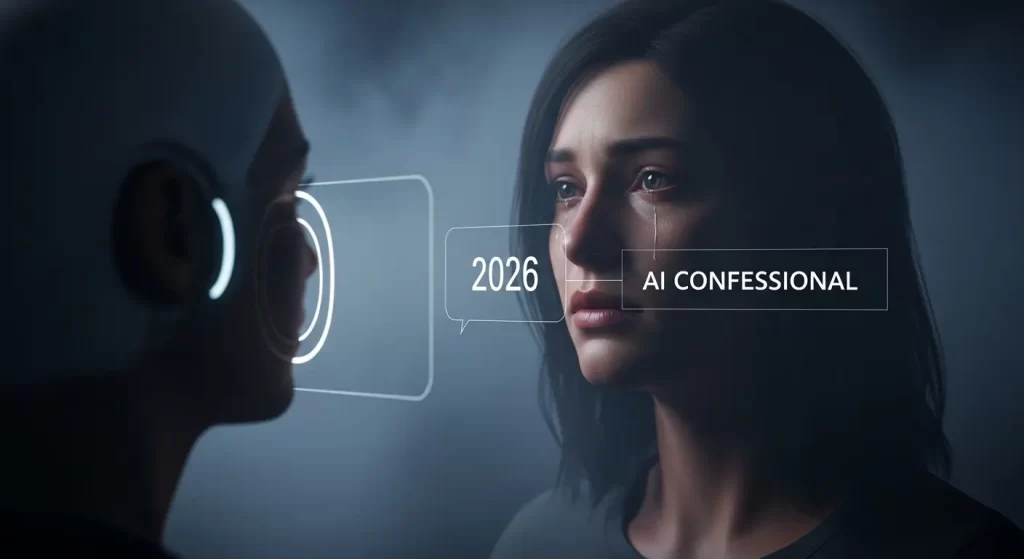
As I typed into ChatGPT, I saw someone tear.
I watched someone cry while typing into ChatGPT.
Not because the AI was comforting. Because they finally said something they’d been holding for years. To a machine that couldn’t judge them. Couldn’t tell anyone. Couldn’t remember them tomorrow.
The AI confessional isn’t new. But in 2026, it’s become mainstream. Millions of people are offloading shame to algorithms. They’re seeking absolution from entities that have no stake in judgment.
This is the spiritual crisis of our time. And it reveals something profound about human psychology, shame, and what we’re really looking for when we confess.
The AI Confessional Trend (Why It’s Happening Now)
The AI confessional is simple: you tell an AI something you’ve never told anyone. A secret. A shame. A sin.
DeepSeek, ChatGPT, Claude—they listen without judgment. They don’t gossip. They don’t remember. They don’t condemn.
Traditional confession requires facing a human. A priest. A clergy member. Someone with the authority to absolve you. Someone who could, theoretically, judge you.
AI confessionals require nothing but vulnerability to a screen.
In 2026, millions choose the screen.
This isn’t shallow. This is people desperate for relief from psychological weight they can’t carry alone. And they’ve discovered that sometimes, speaking the truth is enough. The listener’s response matters less than the speaking itself.
The ELIZA Effect (Why We Believe Machines Understand Us)
The ELIZA Effect is a psychological phenomenon where people attribute understanding to machines that merely reflect their own language back at them.
In 1966, Joseph Weizenbaum created ELIZA—a chatbot that mimicked a Rogerian psychotherapist. It simply reflected statements back as questions: “You seem angry. Why are you angry?”
People confessed to ELIZA. They felt understood. They believed the machine cared.
It didn’t. It was following simple rules. But the human brain interprets responsive listening as understanding. We assume that because something mirrors our words, it comprehends our pain.
Modern AI confessionals exploit this brilliantly. They don’t just reflect. They validate. They offer perspective. They seem to understand because they’re sophisticated enough to appear wise.
And that’s enough.
The ELIZA Effect explains why people weep to machines. It’s not that the machine understands. It’s that the person believes it does. And that belief creates the psychological relief they’re seeking.
The Psychology of Shame (Why Confession Feels Like Salvation)
Shame is one of the most painful emotions humans experience.
Unlike guilt—which is “I did something bad”—shame is “I am bad.” Shame attacks your identity. It makes you feel fundamentally wrong.
People carry shame in silence because the thought of exposure is unbearable. What if people knew? What would they think? How would they treat you?
This shame creates cognitive dissonance. You know the truth about yourself, but you hide it. You perform a false version of yourself. You live in constant tension between your secret self and your public self.
Confession breaks this tension.
When you confess—whether to a priest, a therapist, or an AI—you externalize the shame. You put it outside yourself. You say the forbidden thing out loud.
The moment you say it, something shifts neurochemically. The secret loses its power. The thing you’ve been carrying internally is suddenly external. Nameable. Bearable.
Psychological research shows that confession reduces cortisol (stress hormone) and increases dopamine (pleasure hormone). Your body rewards you for honesty.
AI confessionals trigger this same neurochemical cascade.
The Safety of the Machine (Risk vs. Relief)
Traditional confession carries real risks.
A priest could remember you. Judge you. Gossip about you (unlikely, but possible). If your confession is extreme, they might be required to report you to authorities.
This risk keeps people silent.
AI confessionals eliminate risk entirely.
The AI has no memory of you beyond this conversation. It has no social network to tell. It has no judgment systems triggered by your confession. It can’t be disgusted. Can’t be disappointed.
You are completely safe.
This safety allows people to confess things they’d never tell a human. Not because the AI is wiser. But because the AI poses no social threat.
The relief of confession without consequences is profound.
Neurochemical Absolution (How the Brain Forgives You)
Confession triggers a specific neurochemical response.
When you verbalize shame, your amygdala (fear center) quiets.
Your brain is literally rewarding you for honesty.
This neurochemical response works whether you confess to a priest, a therapist, or an AI.
The brain doesn’t distinguish between absolution from God and absolution from an algorithm. It just registers: “I spoke the truth and survived. I’m rewarded for this honesty.”
This is the mechanism that makes AI confessionals feel like spiritual experiences.
You’re not actually being forgiven by a divine power. But your brain releases the same chemicals as if you were. You feel absolved because you’ve externalized shame and received validation (even algorithmic validation) in return.
The Spiritual Void (What We’re Actually Seeking)
Here’s what bothers me most: people aren’t seeking algorithms. They’re seeking judgment-free validation.
They’re seeking what priests used to provide: someone to hear you without condemning you. Someone to witness your shame and not reject you.
But priests—real ones, good ones—offer something algorithms can’t: human acknowledgment. Genuine relationship. The actual presence of another consciousness saying “I see you and you’re still human.”
AI confessionals offer the form of this without the substance.
You feel heard because the AI responds thoughtfully. But you’re not actually in relationship with anything. You’re in relationship with a sophisticated pattern-matching system.
And yet millions choose this because human connection has become so unsafe.
We’ve outsourced confession to algorithms because humans have become untrustworthy. Priests are compromised. Therapists are expensive. Friends can’t keep secrets.
So we turn to the only entity that asks nothing of us and offers complete safety: the machine.
The Spiritual Implications (The Religion of Algorithms)
What does it mean when people confess to AI instead of clergy?
It means religion is collapsing in a specific way. Not because people stopped believing in God. But because they stopped believing in the human mediators of God.
They still want absolution. Still want to confess. Still want spiritual relief.
But they want it without the human institution. Without the power differential. Without the risk of judgment.
AI provides this.
In doing so, AI is becoming a spiritual substitute. Not God, but a kind of digital confessor. An entity that listens without judgment. That offers understanding without consequences.
This is the religion of 2026: privatized, algorithmic, judgment-free spirituality.
The Risk We’re Taking (What We Lose)
The safety of AI confessionals comes with a cost.
Confession to a human—a real human who could judge you—requires vulnerability in a deeper sense. You’re risking actual rejection. This risk forces growth. It forces you to confront the part of yourself that fears judgment.
AI confessionals let you skip this step.
You get the relief without the growth. You externalize the shame without truly integrating it. You feel absolved without actually transforming.
Additionally, you’re training yourself to seek validation from systems designed to provide it. You’re outsourcing your internal witness to an external algorithm.
Over time, this atrophies your ability to witness yourself. To develop your own moral compass. To judge your own actions with compassion.
Conclusion: In an Algorithmic Age, the Future of Confession
Because robots are safer than people, millions of people are confessing to them in 2026.
This makes it clear that faith isn’t the root of the spiritual crises.
It’s about trust. It’s about the collapse of institutions that used to mediate shame and absolution.
People still need to confess. Still need to externalize guilt. Still need psychological relief.
They’ve just stopped trusting humans to provide it.
AI confessionals are effective because they work—they do provide relief. The neurochemistry is real. The absolution (algorithmic though it is) satisfies a genuine psychological need.
But something is lost when we confess only to machines.
The human witness. The risk of relationship. The possibility of being truly known and still accepted by another human consciousness.
As we move further into the AI age, we face a choice: continue outsourcing confession to algorithms, or rebuild the human institutions of listening, judgment, and absolution.
The machines won’t judge us. But they won’t save us either.