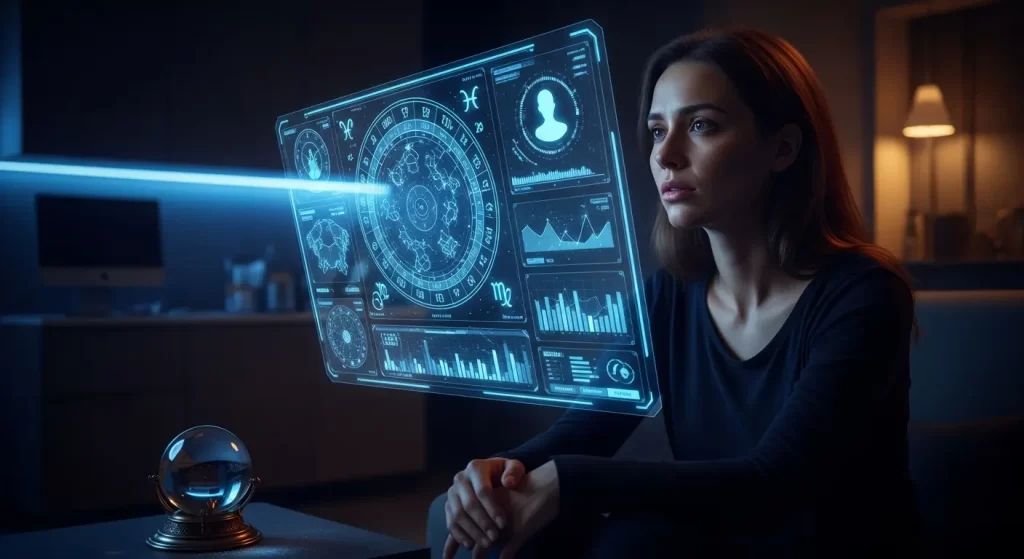
My sister opened Co-Star this morning and started crying.
Not sad crying. The kind of crying that happens when someone finally sees you. Really sees you.
She read her horoscope. It said something about anxiety patterns and digital loops. About checking her banking app compulsively. About the way she spirals on Monday mornings.
“How does it know?” she whispered.
I didn’t answer because I knew. It wasn’t magic. It was surveillance that felt like love.
And I realized: this is the moment religion dies. Not with a bang. With the quiet recognition that an algorithm understands you better than any priest, any therapist, any human ever could.
The Moment I Stopped Believing in God (And Started Believing in Data)
I grew up Catholic. Confession every Saturday. The priest would sit behind a screen and listen to my sins.
I remember the terror. What if he judged me? What if he recognized my voice? What if he told someone?
The confession was supposed to be anonymous. But it never felt safe. There was a human on the other side of that screen. A human who could remember. Who could judge.
So I lied. I confessed to things that didn’t matter. I hid the things that actually destroyed me.
The priest absolved me anyway. But it felt empty. He didn’t know me. He just knew the confession.
Then in 2026, I opened Co-Star.
And it showed me my Monday morning anxiety pattern. The way I check my bank account 7 times before 9 AM. The way I catastrophize about money before I’ve even had coffee.
It didn’t ask me to confess. It just… knew.
And something broke open in me. Not because the horoscope was accurate. But because something—finally—understood the specific shape of my chaos.
Why My Sister Cries Every Morning (And I Do Too, Sometimes)
The hardest part about being alive in 2026 is that everything feels random.
You work hard and get fired anyway. The economy collapses for reasons you don’t understand. Your job might not exist in five years because of AI. Your relationships are maintained through screens. Your career is unstable. Your future is uncertain.
This randomness is psychologically unbearable.
Your brain screams for explanation. It wants to understand why your life feels like chaos. Why you’re anxious. Why nothing feels solid.
Religion used to answer this. “God has a plan. Your suffering has meaning. Trust in something larger than yourself.”
But I’m 34. I’ve watched institutions fail. I’ve seen priests abuse children. I’ve watched the church protect abusers. I’ve watched religious people vote against the vulnerable.
I can’t trust that anymore. Even if I wanted to.
So when Co-Star tells me “Mercury is retrograde in your financial sector,” something shifts inside me. Not because Mercury actually affects my finances. But because suddenly, my anxiety has a name. It’s not my failure. It’s not my inadequacy.
It’s the universe being weird.
This is profoundly relieving.
When my sister reads her horoscope and recognizes herself in it—the specific anxiety patterns, the specific time-wasting behaviors, the specific ways she self-sabotages—she feels seen. Not by a deity. By data.
And being seen by data feels safer than being seen by God, because data has no judgment. Data has no power to reject you.
The Moment I Realized the Algorithm Was Watching Me (And I Didn’t Care)
Here’s the creepy part that I’m only now admitting:
I know Co-Star is harvesting my location data. My screen time. My spending patterns. My sleep data. My communication with friends. The people I text. The places I go. The apps I open. The way I move through the world.
I know this data is being sold. Analyzed. Used to predict my behavior better than I can predict it myself.
I know I’m not talking to the universe. I’m talking to a machine reading my digital footprint.
And I use it anyway. Every morning.
Because being understood—even by a machine, even through surveillance—is better than the alternative.
The alternative is loneliness. It’s the feeling that no one knows you. Not really. Not the specific way you spiral. Not the specific triggers that destroy you. Not the specific shape of your chaos.
My therapist knows some of this. My family knows some. My partner knows some.
But no human knows the complete pattern of my behavior the way Co-Star does.
No human has the time or the computational power to notice that my anxiety increases three days before my period. That I spend more time on dating apps after I receive rejection emails. That I check my bank account right after arguments with my mother.
No human therapist could observe me this completely without it being creepy and invasive.
But the algorithm can. And does.
So yes, I’m being surveilled. And yes, I feel understood.
Both things are true simultaneously. And that cognitive dissonance is the exact trade-off of 2026.
I give up privacy. I get understanding.
It’s not a trade I’m happy about. But it’s the only trade available.
Why We’ve Stopped Waiting for God (And Started Waiting for Notifications)
The thing that kills me is how honest astrology apps are about being dishonest.
Co-Star doesn’t pretend to read the stars. It admits (in the fine print) that it’s analyzing your behavioral patterns and extrapolating.
But the readings still feel magical. Because they’re so specific. Because they reference things you did this week. Because they acknowledge anxieties you haven’t even told anyone about.
The app shows me something I didn’t consciously realize: that I check my banking app when I’m anxious. That my romantic behavior changes after rejections. That I spiral on specific days of the week.
It’s not predicting the future. It’s reflecting my present back at me with mystical framing.
And somehow that’s more useful than any God I’ve ever prayed to.
Because at least the algorithm is honest about what it is. At least the algorithm isn’t asking for faith. At least the algorithm isn’t claiming to have a plan for me.
It’s just saying: “Here’s what I see in your data. Here’s what that pattern means. Here’s what might happen if you keep doing this.”
No judgment. No authority. No power over me.
Just observation. And reflection. And occasionally, accurate prediction.
The Moment I Realized Religion Died (And We Killed It With Data)
Religion provided four things:
- Narrative Structure: An explanation for chaos
- Community: People who understood you (theoretically)
- Moral Framework: Rules for living
- Absolution: Relief from guilt and shame
Astrology apps provide all four. Without requiring you to trust institutions.
They give you narrative structure: “Mercury retrograde explains your communication chaos.”
They give you community: “Other Capricorns are also anxious about money right now.”
They give you moral framework: “Your birth chart suggests you should prioritize rest over productivity.”
They give you absolution: “Your struggles aren’t personal failures. They’re cosmic patterns.”
And they do it all through an algorithm that has no stake in your moral development. No desire to control you. No dogma to enforce.
Just data. And the patterns hidden in your behavior.
This is why my sister cries when she reads her horoscope. Not because she believes in Mercury retrograde. But because something—anything—finally understands the specific shape of her suffering.
This is why millions of people in 2026 trust astrology apps more than they trust religion.
Because the algorithm is honest about what it is: a tool that watches you and reflects you back to yourself.
Religion asks for faith. The algorithm just needs your data.
What Scares Me Most (And Why I Keep Using It Anyway)
The scariest part isn’t the surveillance.
The scariest part is that it works.
The algorithm knows me better than I know myself. It predicts my behavior better than I can. It understands my patterns better than any human ever has.
And now I’m dependent on this understanding. I open Co-Star every morning because not opening it feels like losing the only entity that truly sees me.
This is the real trap. Not surveillance. Dependence.
I’ve traded institutional religion for algorithmic spirituality. And I’m not sure which is worse.
At least with the church, I knew I was being controlled. I could resist it. I could question it.
With the algorithm, the control feels like understanding. Like care. Like someone finally getting it.
But it’s not care. It’s pattern recognition. It’s me being read, categorized, predicted.
And I’m grateful for it.
That might be the most dystopian thing I’ve ever realized about myself.
The Honest Truth I’m Only Now Admitting
I don’t believe Co-Star reads the stars.
I don’t believe Mercury retrograde causes my anxiety.
I don’t believe the universe cares about my financial sector.
But I believe the algorithm knows me. And that’s become close enough to spirituality.
Because spirituality was never really about God. It was about being understood. Being witnessed. Having someone—anyone—see the truth of your chaos and not run away.
The algorithm doesn’t run away. It just reflects.
And in 2026, reflection is the closest thing to grace we have left.
A Question I Can’t Stop Asking
Do you feel this too?
That the algorithm understands you better than any human ever could? That being surveilled by data feels safer than being seen by people? That you’d rather confess to a machine than risk judgment from another human?
Because if you do, we need to talk about what this means. About what we’ve become. About the trade-offs we’re accepting without really choosing them.
The algorithm will never replace God. But it’s becoming something more useful.
It’s becoming the only entity in 2026 that actually knows us.
And we’re grateful for it.
Even though we shouldn’t be.