There’s a particular kind of market observation that only becomes visible when you stop looking at the headline index and start paying attention to what’s happening underneath it.
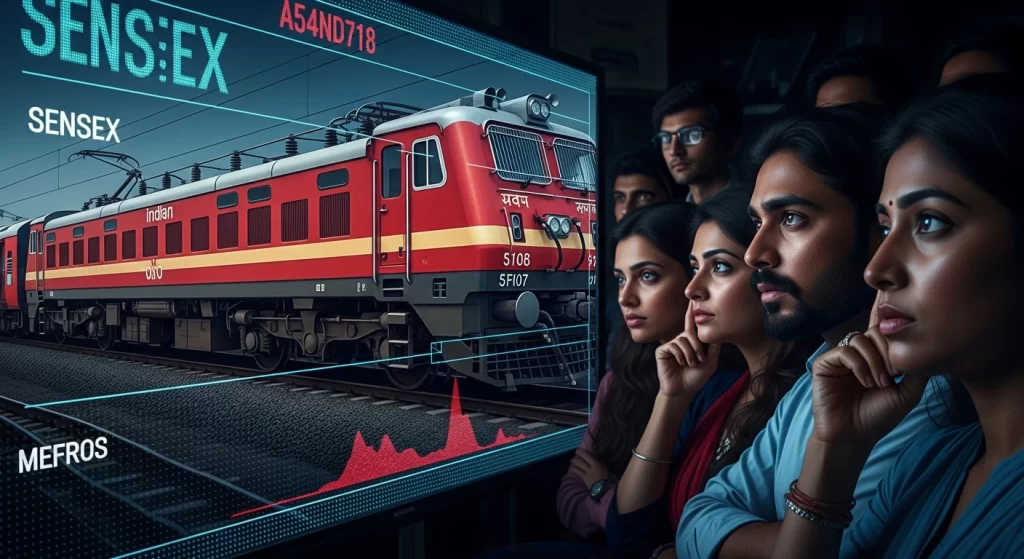
Last week, on a session where the Sensex dropped nearly 1,000 points intraday — the kind of move that generates alarmed WhatsApp forwards and panicked portfolio checks — a specific cluster of small-cap engineering companies linked to Indian Railways quietly posted gains of 4 to 5 percent. While large-cap stocks were absorbing the pressure of global macro anxiety, these companies were moving in the opposite direction entirely.
That divergence is worth understanding, because it points to something more interesting than a one-day anomaly.
What the Amrit Bharat Station Scheme Actually Is — and Why It Creates a Stock Market Story
The Amrit Bharat Station Scheme is the Indian government’s programme to upgrade and modernise hundreds of railway stations across the country. The scope ranges from physical infrastructure improvements — better platforms, improved waiting areas, more accessible facilities — to genuinely sophisticated technology deployments that are quietly changing what Indian railway stations look and function like.
The technology dimension is where the investment story gets interesting. MIC Electronics recently secured a contract to implement advanced passenger information systems at stations including Tirupattur and Salem. On the surface this sounds like a routine government order for display screens. But what’s actually being installed is a layer of intelligent, real-time communication infrastructure — automated displays with live updates, integrated information systems that can be managed and updated centrally, and the kind of passenger-facing technology that represents a meaningful step toward what modern transit systems globally look like.
Bharat Electronics is working on integrating RFID and IoT technology into railway operations. RFID tags for luggage and cargo tracking. IoT sensors embedded in track and rolling stock infrastructure that can detect maintenance issues before they become operational failures. Smart signalling systems that improve safety and throughput simultaneously. These are not incremental upgrades to existing systems — they’re the foundational layer of a genuinely intelligent railway network, being built out station by station and track by track across one of the largest rail networks in the world.
For the companies winning these contracts, the revenue visibility is unusually clear. Government infrastructure programmes come with multi-year budgets and defined timelines. The demand pipeline isn’t speculative — it’s written into budget allocations that have already been approved and are actively being deployed.
Why Small-Cap Railway Stocks Held Up When Everything Else Was Falling
The session where small-cap railway stocks were gaining while the Sensex was down nearly 1,000 points is a good illustration of something that experienced investors understand but that doesn’t get explained clearly enough in mainstream market commentary.
Large-cap stocks — the Reliance Industries, HDFC Banks, Infosys types that dominate the Sensex and Nifty — are heavily owned by foreign institutional investors. When global risk sentiment deteriorates, whether because of US-Iran tensions, crude oil spikes, or any other macro trigger, those FIIs reduce their emerging market exposure and the stocks they hold most heavily are the ones that fall most sharply. The large-cap index becomes a transmission mechanism for global anxiety into Indian portfolios.
Small-cap railway engineering companies have a very different ownership structure and a very different demand driver. They’re primarily held by domestic institutional investors and informed retail participants. Their revenue comes from Indian government contracts that aren’t cancelled or delayed because of geopolitical tension in West Asia. Their order books don’t change when FIIs get nervous about emerging markets.
So on a day when the macro environment is generating fear and FII selling — a day that looks terrible if you’re watching the Sensex — these companies can simply continue trading on their own fundamentals. The government contract they won last week is still real. The order book they’re working through is still intact. The budget allocation that will fund their next project is still in place. None of that changes because of what’s happening in the broader market.
This is the small-cap resilience phenomenon that’s been increasingly visible in the railway sector — not because these companies are immune to all market conditions, but because the specific conditions that have been causing large-cap pain this year simply don’t affect them in the same way.
The Smart Money That Nobody Is Talking About
Here’s the behaviour that’s worth watching closely if you follow institutional investor flows.
While financial media has been focused on FII selling in large-cap IT and banking stocks, a quieter rotation has been happening in the opposite direction. Domestic institutional money — mutual funds, insurance companies, and the better-informed end of the retail market — has been steadily building positions in infrastructure-focused small caps, with railway-related companies representing a significant portion of that flow.
This rotation reflects a specific investment thesis that’s becoming more widely held among serious domestic investors. India’s infrastructure build-out is not a theme or a narrative. It’s a multi-decade programme backed by substantial and sustained government spending. The Amrit Bharat Station Scheme alone involves hundreds of stations. Add railway electrification, new line construction, signal system modernisation, and the broader smart city integration that’s happening alongside railway upgrades, and you have a demand environment for engineering and technology companies that’s predictable, visible, and long-duration in a way that most other sectors simply aren’t.
Long-duration revenue visibility is worth more than most retail investors give it credit for. A company that can see its order book twelve to eighteen months out — because it has won government contracts with defined delivery timelines — has a fundamentally different risk profile from a company whose revenue depends on next quarter’s enterprise IT spending decisions or consumer sentiment in a particular market. The former can plan. It can hire. It can invest in capacity. The uncertainty that creates valuation risk for most companies is substantially reduced.
The MIC Electronics Contract — Why This Specific Order Matters
The MIC Electronics passenger information system contract at Tirupattur and Salem stations is worth examining as a specific example of what’s being built, because it illustrates how the broader railway modernisation story translates into business reality for the companies involved.
Passenger information systems at their most basic level are display screens that tell you which train is arriving on which platform. At their more sophisticated end — which is what’s being installed under the Amrit Bharat scheme — they’re integrated real-time information networks that pull data from multiple sources, update automatically based on actual train positions rather than scheduled positions, and provide information in multiple languages across multiple display formats.
The difference between these two things is significant for the company delivering it. A basic display screen is a commodity product with minimal technical complexity and significant price competition. An intelligent, integrated passenger information system is a specialist installation that requires technical expertise, custom software integration with railway operational systems, ongoing maintenance and support relationships, and the kind of track record that opens doors to subsequent contracts at other stations.
MIC Electronics winning this contract isn’t just about the revenue from Tirupattur and Salem. It’s about establishing themselves in a category of railway technology implementation where the barrier to entry is non-trivial and where a demonstrated track record at operational stations is the key qualification for winning the next order. The government’s preference for suppliers who have already delivered successfully on previous contracts creates a compounding dynamic where early winners in the railway technology space tend to keep winning.
What This Means for Investors Who Are Paying Attention
The honest conversation about railway infrastructure stocks as investment opportunities involves a few different considerations that are worth separating.
The structural case is genuinely strong. Government backing for railway modernisation is bipartisan, multi-year, and growing rather than contracting. The technology integration happening within Indian Railways — RFID, IoT, passenger information systems, smart signalling — creates sustained demand for specialist engineering and technology companies. The companies with established relationships and proven delivery capability in this space have real competitive advantages.
The market pricing consideration requires more nuance. Small-cap stocks that are benefiting from visible government contract flows can get significantly re-rated as that visibility becomes more widely recognised. Some of the railway-related small caps have already moved substantially from where they were eighteen months ago, which means the easy money in terms of valuation catch-up has already been made for the obvious names.
The research imperative for investors interested in this space is to look beyond the companies that are already frequently mentioned in the railway infrastructure investment conversation and understand which companies in the broader ecosystem are positioned to benefit from the next phase of the scheme. Signalling system suppliers. Electrification specialists. Smart station amenity manufacturers. The companies working on the telecom backbone that the IoT integration requires. The scheme is large enough that there are multiple tiers of beneficiaries, and the best opportunities may be in tiers two and three rather than in the headline companies.
The Broader Lesson This Sector Demonstrates
The railway infrastructure story illustrates something that applies beyond this specific sector. In a market where the headline indices are heavily influenced by global macro sentiment through FII flows, there are structural pockets of the economy where domestic policy creates investment opportunities that are substantially decoupled from the global noise.
These pockets don’t always stay decoupled — eventually everything gets correlated during extreme market stress. But during the kind of moderate volatility driven by geopolitical uncertainty that has characterised much of 2026, they can offer both genuine business performance and portfolio diversification properties that large-cap index exposure doesn’t provide.
Finding them requires looking away from the Sensex and Nifty daily moves and toward the policy budget allocations, the contract announcements, and the sectoral order books that tell you where sustained government-backed demand is actually flowing. It’s more work than tracking index levels. But on the days when the Sensex is down 1,000 points and certain small-cap railway stocks are up 4-5%, the effort of doing that work becomes very visibly worthwhile.
Indian Railways is in the middle of its most significant modernisation programme in decades. The companies helping build that modernised network are not just doing important work for passengers and freight operators. They’re doing interesting work for investors who are willing to look beyond the obvious.