Horror Trend Analysis | Film & Culture · June 2026 · 10 min read
Let me ask you something. When was the last time a horror film actually got under your skin? Not a jump scare — those don’t count — but the kind of dread that follows you home, sits at the foot of your bed, and waits. If you’ve watched anything from horror’s current wave, you might already know the answer. And chances are, whatever it was, it looked familiar.
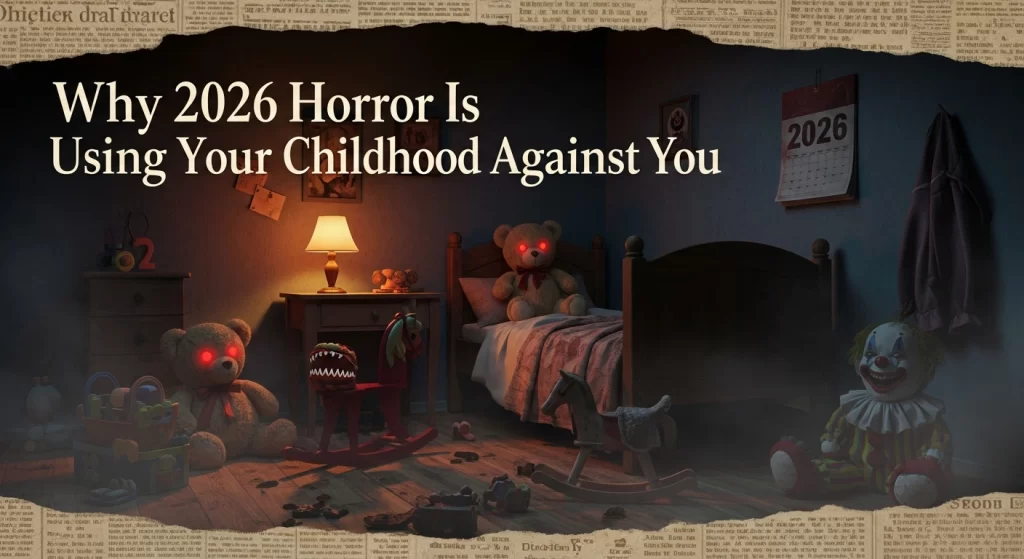
In 2026, the most talked-about horror films aren’t haunted houses or masked strangers. They’re something else entirely — stories that take the characters you grew up with, the ones you loved before you understood what fear even was, and turn them into something that makes your stomach drop in the worst possible way.
The clearest example right now is Pinocchio: Unstrung. Take a second and really sit with that. Pinocchio. The little wooden boy who just wanted to be real. The story your parents read to you. The film you watched on a Saturday morning with cereal in your lap. Now imagine him standing over someone with a sharpened puppet string. That’s not just shock value — that’s something deliberate, and it’s working on a level most people don’t fully understand yet.
So What Exactly Is the “Childhood Corruption” Trend?
It’s pretty much what it sounds like. Filmmakers are reaching into the shared childhood memory of their audience — fairy tales, nursery characters, beloved animated icons — and reimagining them with a sinister, often violent edge. The result is a growing sub-genre of horror built entirely around the psychological discomfort of seeing something safe become something dangerous.
And look, I know what you might be thinking. “Isn’t this just cheap nostalgia-bashing? Shock tactics dressed up as storytelling?” I thought that too, initially. But the more you dig into why these films actually unsettle people — and they genuinely do, in a way that your average slasher simply doesn’t — the more you realize there’s real psychology at work here. This isn’t accidental.
Worth Noting: The Childhood Corruption trend didn’t appear out of nowhere. It’s the logical endpoint of over a decade of nostalgia-driven entertainment — and perhaps the first honest thing that nostalgia economy has produced.
The Brain Thing: Why Familiar + Dangerous = Maximum Dread
Here’s where it gets genuinely interesting. There’s a concept in psychology called a schema — essentially a mental shortcut your brain builds over time to make sense of the world quickly. You don’t stop and analyze every single thing you encounter. Your brain has already filed millions of things under “safe,” “threatening,” “funny,” “boring,” and so on.
Childhood is when some of your deepest schemas get formed. And the characters from those years — the puppets, the fairy-tale figures, the animated friends — get filed away under warmth, comfort, safety. That’s not metaphorical. It’s an actual cognitive association your brain built, probably before you were old enough to articulate it.
Now here’s what happens when a horror film takes one of those characters and makes it threatening. Your brain fires two completely contradictory signals at once. There’s the old, deep one saying “this is safe, this is comforting, you know this character” — and then there’s the new one screaming “this is wrong, this is dangerous, something is very off here.”
That collision — psychologists sometimes call it cognitive schema violation — produces something that isn’t quite fear in the ordinary sense. It’s more like a short-circuit. Your pattern-recognition system, which normally runs smoothly in the background, suddenly hits an error it can’t resolve. And that unresolvable wrongness? That’s what people mean when they say a film “got into their head.”
“The most effective horror doesn’t build a new monster. It finds the thing you already decided was safe — and shows you that it never was.”
Traditional horror monsters don’t do this, by the way. When you see a guy in a hockey mask, your threat schema fires cleanly and everything proceeds in an orderly, if terrifying, fashion. There’s no conflict. You know what it is, your brain knows what to do with it, and the fear — however intense — is cognitively simple.
The corrupted childhood character is cognitively complicated. And complicated fear lingers.
Traditional Monsters vs. Corrupted Icons: The Honest Comparison
Let me break this down practically, because I think it clarifies exactly why the trend is landing the way it is.
| Type | What Your Brain Does | Why It Works | Why It Fades |
|---|---|---|---|
| Traditional Monster | Fires threat schema cleanly. “Danger identified.” | Reliable, visceral fear response | No emotional history — once the threat is gone, so is the feeling |
| Corrupted Childhood Icon | Fires safe schema AND threat schema simultaneously. Cannot resolve the conflict. | Deeper, more personal — the fear is attached to your own memories | It doesn’t, really. The character is changed for you permanently. |
That last point is worth sitting with. When a corrupted childhood film works really well, it doesn’t just scare you — it revises something. The next time you think about that character, the horror version is there too. The filmmakers have essentially edited your memory. Not everyone finds that a comfortable thing to think about.
Honestly? This Says Something About Where We Are Right Now
I don’t think you can fully understand this trend without stepping back and looking at the cultural moment it emerged from. We’ve spent about fifteen years watching the entertainment industry sell us our own childhoods back to us — reboots, remakes, legacy sequels, cinematic universes built on IP that was originally designed for people who are now in their thirties and forties.
And for a while, it worked beautifully. Nostalgia is comforting. Familiar things feel safe. Seeing the characters you grew up with again feels, initially, like running into an old friend.
But there’s a thing that happens when you revisit the past often enough and commercially enough — you start to feel, somewhere underneath the warmth, a faint sense of unease. Like you’re being sold something. Like the memory is being handled by strangers who don’t quite understand what made it matter to you.
The Childhood Corruption trend, I’d argue, is horror doing what horror does best: making that unease visible. The corrupted childhood icon isn’t just scary. It’s a metaphor for something a lot of people feel but haven’t found words for yet — the sense that the things we once loved have been quietly changed, monetized, and handed back to us in a form we don’t fully recognize.
- For older millennials: these films feel like an acknowledgment of something real — the suspicion that nostalgia, consumed at this industrial scale, was always going to curdle eventually.
- For younger viewers: it’s more about deconstruction — engaging critically with inherited cultural material that was never quite theirs to begin with.
- For the film industry: it’s efficient and effective. Pre-loaded emotional resonance, minimal world-building required, inexhaustible source material. Of course they’re going to keep doing this.
None of these are incompatible. They’re all true at once, which is part of what makes the trend genuinely interesting rather than just a gimmick.
Where Does This Go From Here?
If I’m being honest, I think we’re still in the early phase of what this trend can do. Right now, most of the films working in this space are primarily interested in the violation — the shock of seeing the beloved thing corrupted. That’s effective, but it’s also the lowest-hanging fruit.
The more interesting question is whether filmmakers will eventually use this framework to actually say something — to build films that don’t just corrupt a childhood icon but genuinely interrogate what that icon meant, what it promised, and what it failed to deliver. Horror that does that has always been the best version of the genre.
Think about what Get Out did with the horror of polite social performance, or what Hereditary did with inherited family trauma. Neither of those films was scary just because of what happened in them — they were scary because of what they were actually about. That’s the ceiling for Childhood Corruption horror, and I don’t think many films have come close to hitting it yet.
But they’re trying. And audiences are clearly hungry for it. So watch this space, because I genuinely believe the best film to come out of this trend hasn’t been made yet.
The Bottom Line
Here’s what the Childhood Corruption trend ultimately gets right: the scariest thing is never the monster itself. It’s the violation of trust. It’s the moment when something you had categorized, somewhere deep in your nervous system, as safe — reveals that the categorization was wrong.
Filmmakers working in this space have discovered that your childhood memories are a kind of psychological trapdoor. All they have to do is find the right character, the right story, the right angle — and the floor you’ve been standing on your whole life suddenly isn’t there.
And that, more than any jump scare, more than any practical effect, more than any amount of blood and violence — is what good horror is supposed to do. It’s supposed to find the thing you decided was safe, a long time ago, before you knew better. And it’s supposed to make you look at it again.
The question the best of these films leaves you with isn’t “was that scary?” It’s something quieter and harder: what else have I been wrong about?
If this one stuck with you, share it with someone who’s currently sleeping fine. You’ll be doing them a favour, probably.
References & Further Reading
- Piaget, J. (1952). The Origins of Intelligence in Children. International Universities Press — foundational schema theory.
- Freud, S. (1919). “The Uncanny” (Das Unheimliche) — the original theoretical framework for the familiar-made-threatening.
- Carroll, N. (1990). The Philosophy of Horror. Routledge — on cognitive incongruity and horror’s affect.
- LeDoux, J. (1996). The Emotional Brain. Simon & Schuster — neuroscience of threat detection and emotional memory.
- Davis, F. (1979). Yearning for Yesterday: A Sociology of Nostalgia. Free Press.
- Lowenstein, A. (2005). Shocking Representation: Historical Trauma and the Modern Horror Film. Columbia University Press.