
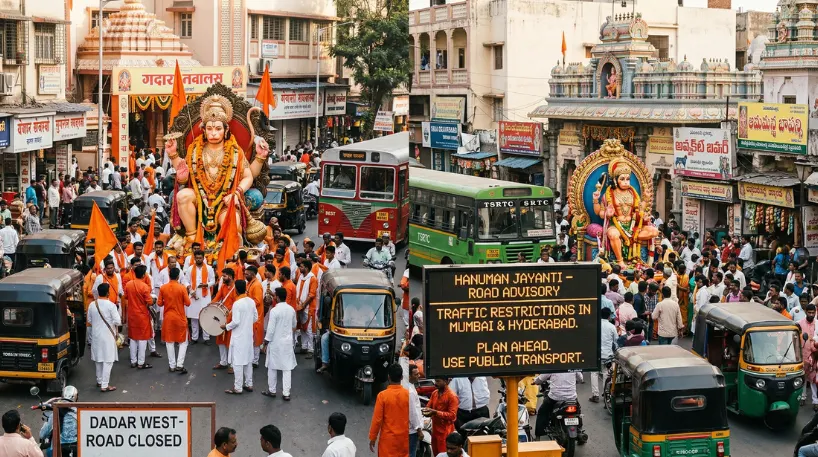
If you live in Mumbai or Hyderabad and had plans to drive somewhere this evening, this is worth five minutes of your time before you leave the house.
Hanuman Jayanti processions are one of the most genuinely moving expressions of collective faith you’ll see in any Indian city — thousands of people, music, colour, and an energy that’s hard to describe if you haven’t witnessed it. But they also transform large stretches of already congested urban road networks into places you really don’t want to be stuck in a car after 5 PM.
Here’s the ground-level picture for both cities today, including the detail that official advisories tend to leave out.
Mumbai: The Areas to Avoid and the Routes That Actually Help
The main processions in Mumbai this year are concentrated in the Western and Central suburbs, with Vakola in Santacruz East and Sakinaka along the JVLR service road being the two zones where you’ll feel the impact most sharply.
The official advisory puts the affected window at 6 PM to midnight, but anyone who has navigated Mumbai during a major procession knows that congestion typically starts building well before the official start time. Roads that feed into procession routes begin backing up as crowds gather, vendors set up, and additional police deployments go into position. If you’re planning to be in either of these areas, the practical advice is to be somewhere else by 5 PM rather than 6 PM.
For east-west movement in the Western suburbs, Khar Subway is worth treating as off-limits for the evening. Milan Subway and the Milan Flyover are your realistic alternatives — they add distance but they move. The math on whether a longer route that actually moves beats a shorter route that doesn’t is very clear on a night like this.
The Golibar Road Situation — This Is the Part Nobody’s Talking About Enough
Here’s the thing that the official traffic advisory mentions briefly but doesn’t fully communicate: Golibar Road is currently under construction.
This matters more than it might initially seem. In a normal year, Golibar Road absorbs some of the overflow traffic from procession-related diversions. This year, it can’t — the construction has narrowed it significantly, created barriers that reduce lane capacity, and generally made it the kind of road that adds fifteen minutes to a journey that should take five even before you factor in festival crowds.
The combination of Hanuman Jayanti procession traffic and an active construction zone on a key arterial road is the kind of thing that turns a manageable evening commute into something you’re still sitting in at 9 PM.
The advice here is blunt: avoid Golibar Road and the surrounding area completely after 5 PM if you have any alternative. If you live in the area and need to get home, do it before 5 or wait until after midnight. That’s not an exaggeration — it genuinely may be the more time-efficient choice.
If you’re travelling from elsewhere and don’t have to go through that part of the city at all, don’t. Reroute proactively rather than reactively.
Security and What It Means for Your Journey
With upwards of 10,000 participants expected in Mumbai’s processions, the security arrangements are substantial. Additional police personnel, traffic officers at key junctions, heightened surveillance particularly in the Western suburbs — all of this is designed to keep things safe and manageable, and it generally works.
What it also does is slow things down at checkpoints and controlled crossings in ways that aren’t always predictable. A junction that normally flows freely might have a police officer managing traffic manually, which creates delays that no navigation app accounts for in real time.
Factor this into your timing. If you’re used to a journey taking twenty minutes and you know it passes through a procession-affected area, mentally double that estimate for today.
Hyderabad: The Pattern Holds Even If the Streets Are Different
Hyderabad’s Hanuman Jayanti celebrations are significant and the traffic impact is real, even though the specific road closures are slightly different in character from Mumbai’s.
The old city and central areas will see temporary diversions and a noticeable increase in police presence for crowd management during evening hours. Traffic movement will be slower than usual across a broader area than just the immediate procession routes — the ripple effects extend into surrounding streets as vehicles try to navigate around closures.
The general principle for Hyderabad today is the same as Mumbai: central routes during evening hours are routes to avoid if you have alternatives. Inner roads and residential streets that don’t connect to main procession areas will move better. Errands that can be done in the morning should be done in the morning. If something can wait until tomorrow, let it wait.
One practical Hyderabad-specific note: the old city in particular gets genuinely difficult to move through during major festival evenings. If your destination is in or near the old city and your journey isn’t essential, consider whether today is the right day for it.
Using Your Navigation Apps — But Smartly
Google Maps and Apple Maps are helpful today but they have a specific limitation worth knowing about. Real-time traffic data is only as good as the current conditions being reported. On a day when large sections of road are suddenly closed or heavily congested due to processions, the apps can sometimes still route you through areas that looked clear twenty minutes ago but have since deteriorated.
Check your route before you leave rather than relying entirely on the app to adjust in real time once you’re already in the car. Look at the full path it’s suggesting, not just the estimated arrival time. If the route passes through Vakola, Sakinaka, or Golibar Road in Mumbai, or central areas in Hyderabad, question whether that route is actually viable tonight regardless of what the estimated time says.
Refreshing the app after 5 PM will give you a more accurate picture of current conditions than checking it at 3 PM.
If You’re Going to the Celebrations
If you’re heading out specifically to be part of the Hanuman Jayanti festivities rather than trying to avoid them, the same awareness applies in reverse. Know where the main procession routes are so you can position yourself well. Expect that parking near procession areas will be essentially unavailable — plan to park further away and walk, or use public transport and metro where it’s accessible.
The crowds are part of the experience, so that’s not a problem to solve. Just make sure your return journey has been thought through before you go, not when you’re standing in a crowd at 10 PM trying to figure out how to get home.
The Simple Version of All of This
Leave earlier than you think you need to. Avoid Vakola, Sakinaka, and Golibar Road in Mumbai after 5 PM. Stay away from central and old city areas in Hyderabad during evening hours. Use Milan Subway and Milan Flyover if you need east-west movement in Mumbai’s western suburbs. Check your navigation app before you leave, not after you’re stuck.
Hanuman Jayanti is worth celebrating and worth experiencing if you get the chance to see the processions. The festival energy in both cities is genuinely something. Just don’t let poor route planning turn an otherwise good day into two hours sitting in traffic wondering why you didn’t read this earlier.
Travel smart today. The festivities will be there regardless — give yourself the best chance of actually enjoying them.