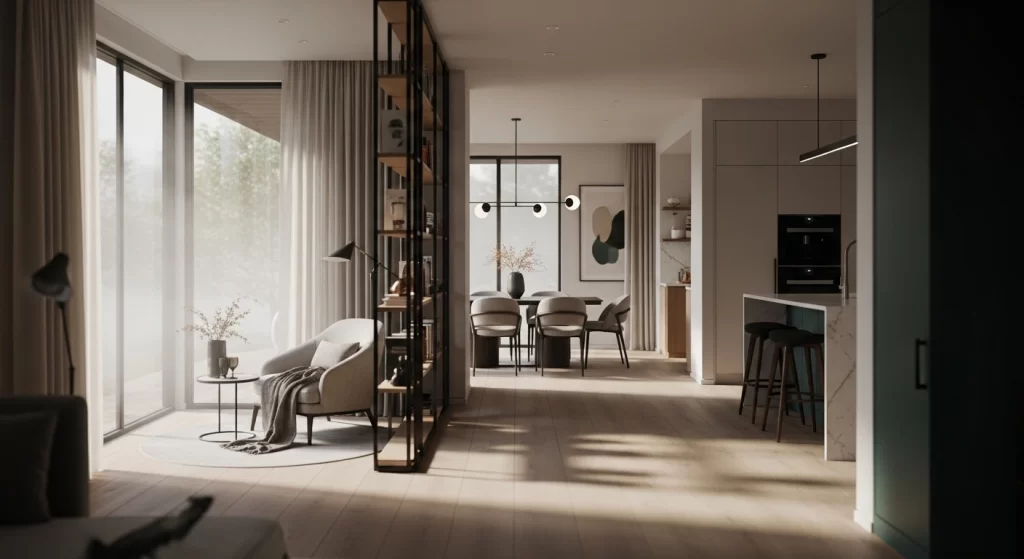
Walk through any housing design expo this May and something becomes immediately clear. The sprawling, all-white, walls-removed living spaces that defined a decade of renovation inspiration are quietly disappearing from the mood boards. What’s replacing them isn’t a return to cramped, compartmentalised floor plans — it’s something more considered, more honest about how people actually live, and considerably more functional.
Designers are calling it intentional separation. And if the conversations happening at 2026’s major housing expos are any indication, it’s about to reshape how Indian homeowners approach renovation in ways that go well beyond aesthetics.
Acoustic Privacy Has Become the Priority Nobody Expected
The pandemic years revealed something that open-concept evangelists had been quietly ignoring: sound travels. When one household member is on a video call, another is cooking, and a third is trying to concentrate on focused work, a single unified space serves none of them particularly well.
The solution gaining traction isn’t rebuilding full walls — it’s acoustic and flex zoning through smarter architectural elements. Glass partitions that separate spaces visually without making them feel disconnected. Pocket doors that open completely when you want flow and close completely when you need privacy. Partial walls at strategic heights that define zones acoustically without blocking light.
For families navigating hybrid work, multigenerational living, and the general complexity of modern household rhythms, this approach addresses real daily frustrations that a beautiful open floor plan consistently fails to solve.
The Colour Shift From Clinical to Warm
The all-white and stark grey palettes that dominated renovation inspiration for years are being replaced by something more liveable. Pantone’s Cloud Dancer — a warm, soft white with subtle creamy undertones — has appeared extensively at 2026 expos as the go-to for people who want lightness without the coldness that clinical white produces.
WGSN’s Transformative Teal is the bolder statement choice gaining ground: a colour that works genuinely well as an accent in spaces designed for specific functions — a study, a reading corner, a defined dining area. These aren’t random colour trend announcements. They reflect a broader shift toward homes that feel inhabited and personal rather than photographed and vacated.
Textured wall finishes, natural material palettes, and heritage-influenced furniture choices are appearing alongside these colour shifts as homeowners prioritise emotional warmth over minimalist precision.
Triple-Glazing Is No Longer Optional in Indian Cities
This is the most practically significant trend for Indian homeowners specifically. Triple-glazed windows — long standard in European construction for insulation purposes — are appearing with increasing frequency in tier-1 and tier-2 Indian cities where summer temperatures and energy costs are both rising significantly.
The performance case is straightforward. Triple glazing dramatically reduces heat transfer, keeping interiors cooler with less air conditioning load. In cities where peak summer temperatures regularly exceed 40°C, the long-term energy cost savings can justify the higher upfront investment within a few years. The acoustic benefits — substantial reduction in external noise penetration — align perfectly with the zoning priorities driving the broader design shift.
Smart Home Technology Without the Gimmicks
The 2026 expo floor was notably less enthusiastic about voice-activated everything than previous years. What homeowners are actually investing in is automation that solves real problems: automated solar shading that adjusts based on sun position and interior temperature, HVAC zoning systems that heat or cool specific rooms rather than entire floors, energy monitoring that provides genuinely useful data rather than impressive dashboards.
The question driving technology decisions has shifted from “what can this do?” to “does this actually improve daily life?” The latter question eliminates a lot of expensive gadgetry and focuses investment where it compounds into genuine quality-of-life improvement.
The Renovation Philosophy for 2026
Intentional separation captures something that the open-concept era never fully resolved: the tension between connection and privacy, between shared space and individual need. The homes being designed and renovated in 2026 are acknowledging that different activities have different spatial requirements — and building those requirements in from the start rather than hoping a single unified space will serve everyone adequately.
The beige era is ending. What’s replacing it is more honest, more functional, and built around how people actually live rather than how spaces look in photographs.
Breakfast in Maharashtra is more than just the first meal of the day. It’s comfort, routine, culture, and in many homes, a small daily celebration.
Walk through any street in Mumbai early in the morning and you’ll smell fresh vada pav being fried. Visit Pune and you’ll find crowded misal places before 9 AM. In smaller towns, people still enjoy homemade thalipeeth with butter or warm poha with chai while reading the newspaper.
What makes Maharashtrian breakfast special is that it feels real. The food is simple and tasty and hearty and connected to everyday life.
Here are 10 breakfast recipes from Maharashtra which people really love and can eat again and again without getting bored.
1. Poha — The Breakfast Almost Every Maharashtrian Grew Up Eating
There’s something comforting about a hot plate of poha in the morning.
It’s light but filling. Simple but full of flavor.
Made from flattened rice cooked with onions, turmeric, curry leaves, mustard seeds, and peanuts, poha is probably the most common breakfast in Maharashtra homes.
Some people like it soft and slightly sweet. Others prefer spicy versions with extra lemon and sev on top.
And honestly, chai with poha on a slow morning just feels right.
In cities such as Nagpur, the popularity of the tarri poha has been enhanced by a spicy gravy poured on the poha, making the dish even more addictive.
2. Misal Pav — Spicy, Messy, and Absolutely Worth It
Misal pav is not just breakfast. For many people in Maharashtra, it’s an emotion.
The spicy curry made from sprouted beans, topped with crunchy farsan, chopped onions, coriander, and lemon, creates a combination that somehow feels chaotic and perfect at the same time.
Every city has its own style:
Kolhapur likes it fiery spicy
Pune keeps it balanced
Nashik has a unique flavor of its own
And everyone believes their city serves the best misal.
One plate is enough to wake you up completely in the morning.
3. Vada Pav — Maharashtra’s True Street Food King
Vada pav doesn’t need fancy introductions anymore.
It’s fast, cheap, spicy, filling, and available almost everywhere.
A hot potato vada inside a soft pav with garlic chutney and fried green chili may sound simple, but the taste hits differently when eaten fresh from a roadside stall.
For students, office workers, travelers, and even busy businesspeople, vada pav is often the quickest and happiest breakfast option.
Especially in Mumbai, life genuinely feels incomplete without it.
4. Sabudana Khichdi — The Dish That Changed Fasting Food Forever
Most people think fasting food is boring until they try good sabudana khichdi.
Soft tapioca pearls mixed with peanuts, potatoes, green chilies, and lemon create a texture that’s surprisingly satisfying.
When made properly, every grain stays separate and soft instead of sticky.
Many people now eat sabudana khichdi even on normal days because it’s light on the stomach while still keeping you full for hours.
Add curd on the side, and it becomes even better.
5. Thalipeeth — Homemade Food at Its Best
Thalipeeth feels like the kind of breakfast made with care.
This is a traditional multigrain flatbread that is commonly made with a blend of different flours combined with spices, herbs and onions.
It is fried slowly in a pan until it is slightly crispy on the outside and soft within.
Thalipeeth is served with white butter, curd or pickle and tastes simple but deeply satisfying.
It’s the kind of food that reminds people of home.
6. Upma — The Underrated Everyday Breakfast
Upma rarely gets the attention it deserves.
In many Maharashtrian homes, it is one of the most useful and comforting breakfasts.
Upma is made from roasted semolina cooked with onions, mustard seeds, curry leaves and vegetables. It is fast, warm and filling.
It’s especially perfect during busy mornings when people want something homemade without spending too much time cooking.
And somehow, hot upma with chai always feels better during rainy weather.
7. Kanda Bhaji — Rainy Morning Happiness
The moment monsoon arrives in Maharashtra, kanda bhaji starts appearing everywhere.
Thin onion slices coated in gram flour and spices are deep-fried until golden and crispy.
Served with hot tea and spicy chutney, this combination feels impossible to resist during rainy mornings.
People often say food tastes better during rain.
Kanda bhaji proves that statement completely true.
8. Ghavan — Konkan’s Soft and Comforting Breakfast
Ghavan may not be as famous as misal pav or vada pav, but people from the Konkan region know how special it is.
This rice-flour pancake is so delicate and light, and comforting.
Some people eat it with coconut chutney, while others enjoy it with jaggery or even fish curry.
It’s one of those dishes that feels peaceful and homemade.
9. Puran Poli — Sweet Breakfasts Still Exist
Not every breakfast needs to be spicy.
Puran poli brings sweetness to the table in the best possible way.
This soft flatbread is stuffed with chana dal, jaggery and cardamom and is made rich and flavorful when hot ghee melts down on top of it.
Many families also have it for breakfast on special mornings, but traditionally it is made during festivals.
One puran poli can fill the entire house with an amazing smell.
10. Shira — Simple Food That Taste Like Home
Shira is the proof that simple food can be special.
Made with semolina, ghee, sugar and cardamom, this sweet dish is a staple in Maharashtrian homes to be served during celebrations, prayers and family breakfasts.
Some people add banana or dry fruits to make it richer.
Warm shira early in the morning has a kind of softness and comfort that’s hard to explain unless you’ve grown up eating it.
Why Maharashtrian Breakfast Feels So Special
What makes Maharashtra’s breakfast culture different is that the food feels deeply connected to everyday life.
These are not dishes created only for restaurants or social media photos.
They are foods people actually grew up eating.
Foods connected to:
Family mornings
School days
Train journeys
Rainy weather
Festivals
Weekend outings
That emotional connection makes the experience even stronger.
Final Thoughts
Maharashtrian breakfast is one of the most flavorful and comforting food cultures in India.
From fiery misal pav to fluffy poha and crunchy vada pav, each dish has a personality of its own.
And really, after you have a proper Maharashtrian breakfast with hot chai on the side, your everyday breakfasts start seeming a little dull.